The Sakaza House: The Story of a Forgotten Treasure Coast House
Built in 1956, this 1,926-square-foot Florida home once stood as part of a quieter, more rural landscape. Today, its darkened windows, weathered exterior, and lingering sense of stillness make it a compelling reminder that some of the most fascinating abandoned homes in Florida are not grand hotels or sprawling institutions, but ordinary places left behind by time. For URBEX photographers and history-minded explorers, its appeal lies in that familiar feeling of a life interrupted.
The exact reason the home was abandoned is not publicly documented, but its history points toward a changing landscape shaped by development pressure and rising land value. Once part of an area associated with agricultural land and open space, the property now reflects a larger story of change across the Treasure Coast. It is a quiet but powerful example of what makes urban exploring in Florida so captivating: the chance to witness the remains of everyday life before they disappear completely. Below, a virtual tour featuring 16 immersive 360-degree panoramic images allows readers to explore this abandoned home room by room and experience its atmosphere from anywhere.
Click here to view it in fullscreen.
Why this house matters
There are abandoned homes in Florida that announce themselves from a mile away. They lean, sag, gape open to the weather, and wear their ruin loudly. Then there are the quieter ones: houses that still look like they remember family dinners, weekend chores, and the heat of normal life, even after the windows go dark. The home at the center of this story belongs to that second category. It is the kind of place that draws the eye of anyone interested in abandoned in Florida, not because it is a castle, a hospital, or a landmark estate, but because it feels personal. It feels like a life interrupted. It feels like the sort of structure you pass once, then think about all the way home.
That is part of what makes it such a strong fit for an article aimed at urban explorers. In the world of URBEX, the most compelling places are not always the biggest or the most famous. Often, they are the homes that seem to hover in an in-between state, still recognizable as domestic spaces but already being absorbed by weather, weeds, and time. This Treasure Coast property is exactly that: a modest postwar Florida home whose records tell one story, whose setting suggests another, and whose recent paper trail hints that its days may already be numbered. Public-record listings consistently describe it as a single-family house built in 1956 with 1,926 square feet of living area, three bedrooms, one bathroom, and about 0.56 acre of land.
For readers who search phrases like abandoned homes in Florida, urban exploring in Florida, or URBEX Florida, this house also captures something broader about the state itself. Florida abandonment rarely looks like rust-belt abandonment. It does not always come wrapped in brick factories and soot. Instead, it often appears along highways, grove roads, former ranch tracts, and suburban edges where old agricultural land meets new commercial pressure. That tension matters here. Commercial marketing tied to the same address described the surrounding land in 2016 as a 16.48-acre “Turnpike Mixed Use” property, then a citrus grove with utilities available and strong development potential because of its access to State Road 70, I-95, and the Florida Turnpike.
That detail changes the mood of the house. Suddenly the structure does not read as a simple forgotten residence. It reads as a survivor from an earlier landscape. It looks less like an isolated mystery and more like a remnant of a corridor that has been steadily revalued by traffic, infrastructure, and growth. Reports from the Economic Development Council of St. Lucie County describe continued industrial and commercial activity around the Okeechobee Road and I-95 area, while transportation documents show ongoing work and planning around the SR-70 corridor and Florida’s Turnpike.
Because the exact property location is being kept private here, it becomes easier to focus on what the place actually represents. This is not just one more old house with boarded windows. It is a very Florida kind of ruin: mid-century, roadside, tied to agricultural land, and now caught in the dragnet of modern land use. For anyone fascinated by abandoned in Florida, that combination is pure magnetism. It holds the human scale of a family home and the larger story of a region changing around it.
The hard facts behind the silence
The clearest starting point is the public record, because rumor tends to multiply around properties like this. According to multiple real-estate and public-record aggregators, the house was constructed in 1956. The same sources consistently place the finished living area at 1,926 square feet, with three bedrooms and one bathroom on a 24,394-square-foot lot, which works out to roughly 0.56 acre. Those figures appear across Realtor.com, Redfin, Compass, Zillow, and Homes.com, making them the most stable details available for this property.
That consistency matters because other details in the record are much messier. One aggregator lists the home as a 3-bed, 1-bath house; another shows two baths in a public-record summary; another presents later sale figures that are so high they almost certainly reflect a larger land package or grouped transaction rather than the house alone. The safest approach is to trust the details that repeat across sources and treat the outliers with caution. On the repeatable facts, this is a mid-century single-family residence, one story, modest by Florida standards, and no grand mansion. It was built in an era when much of inland St. Lucie County still felt rural and agricultural, long before warehouse space, highway services, and mixed-use development became the dominant language of value in the corridor.
The property history also reaches back farther than many casual observers would expect. Realtor.com’s public-record summary shows sale events in 1978, 1989, 2005, 2023, and 2026. The older sales were at amounts that align more naturally with a house of this type: $75,000 in 1978, $57,000 in 1989, and $250,000 in late 2005. Then the record becomes strange. That same source reports a sale of $2,241,300 in December 2023 and another of $4,800,000 in April 2026. Since those price points are dramatically out of scale with a 1,926-square-foot house on a little more than half an acre, they likely indicate a broader deal structure, parcel grouping, or land-driven transaction rather than a buyer paying several million dollars for the house as a residence.
Homes.com reinforces the idea that the ownership pattern changed in a meaningful way. Its public-record summary shows the property held by a private individual until late 2005, then by a company from 2005 until late 2023, and then changing company ownership again in 2023 and 2026. The same source also shows a newer mortgage amount far above what a modest residential purchase would usually suggest for a house in this condition and size. Again, that is not proof of a single neat story, but it is strong evidence that the property entered the orbit of commercial or land-focused ownership long after its days as a normal home.
Tax history adds another layer. Realtor.com’s public-record display shows 2025 taxes at $3,313 and a total 2025 assessment of $147,300, broken into $58,000 for land and $89,300 for additions. Years earlier, the same display shows the assessed total much higher in 2007 and 2008, then declining through the next decade before rising again into the 2020s. That pattern does not by itself explain abandonment, but it does show a property that stayed in the system, stayed taxable, and remained materially recognized even while it drifted out of ordinary residential life.
So the hard facts are these: a 1956 house, 1,926 square feet, mid-century, ordinary in scale, ordinary in layout, but no longer living an ordinary life. That is often where the fascination begins for abandoned homes in Florida. The facts are solid enough to build a frame. The mystery arrives in the spaces between them.
Reading the paper trail like an explorer
If you want to understand a forgotten house, the paper trail often tells you as much as the peeling paint. In this case, the records show a long life that was not entirely dormant. The property’s permit history, as surfaced through Realtor.com’s public-record feed, includes an electrical permit in 1991 and a pool enclosure permit in 1999. Those details sound small, but they matter. They point to a house that was still active, improved, and cared for well after its 1956 construction date. This was not a home frozen in time from the 1960s. It was used, updated, and maintained into the late twentieth century.
Then comes the jolt. The same permit history shows an applied residential demolition permit dated March 16, 2026. It also lists an environmental permit for vegetation removal dated April 20, 2026, plus demolition-related electrical and plumbing sub-permits finalized on June 1, 2026. That sequence is one of the strongest clues available anywhere in the public record. Whatever this house was once meant to hold, the county-level permitting stream visible through aggregated public data suggests the structure entered a formal path toward removal in 2026.
This is an important distinction for anyone who loves urban exploring in Florida. A house can feel abandoned for years and still have no active final chapter. This one appears to have crossed into a different category: not just neglected, but processed. Once demolition, vegetation removal, and utility-related sub-permits appear together, you are no longer looking at poetic decay alone. You are looking at a site transitioning from memory to asset management. That is a different emotional temperature. It means the house may already be in its last brief season as a visible ruin.
The commercial brokerage material tied to the same address deepens that impression. In 2016, the address was marketed as 16.48 acres of mixed-use land with citrus production and direct development appeal because of its frontage and proximity to major transportation routes. That listing did not read like the marketing of a nostalgic old home. It read like land inventory. The language focused on frontage, utilities, zoning, and development flexibility for retail, industrial, multifunction, and residential uses.
For explorers, this is where the paperwork becomes almost cinematic. On one page, there is the image of a 1956 house with family-scale dimensions and a permit for a pool enclosure in 1999. On another, there is the language of frontage, utility access, turnpike proximity, and mixed-use potential. Put those pages together and a story begins to sharpen. The house was not merely forgotten by the market. It was eventually overtaken by a bigger economic story than itself. In other words, the silence around the structure likely does not come from one dramatic tragedy. It comes from slow displacement by value.
That is one reason places like this resonate so deeply with the URBEX crowd. A school or asylum often comes with a known institutional collapse. A humble Florida home like this carries a quieter ache. Nobody erects a museum plaque for the death of the ordinary roadside residence. But in public records, you can still see the stages: lived in, improved, sold, absorbed, revalued, cleared. The explorer’s eye notices broken blinds and weather stains. The paper trail notices demolition. Together, they tell the whole story.
Why it was likely abandoned
The honest answer is that no publicly indexed source I found gives a single official reason in plain language. There is no verified newspaper story saying the family moved because of a fire, a death, a foreclosure, or a hurricane. There is no county narrative page explaining, in one clean sentence, why the house ended up empty. That uncertainty matters, and it is worth stating clearly. If you publish this for readers interested in abandoned homes in Florida, the strongest version of the story is the truthful one: the exact cause of abandonment has not been conclusively documented in accessible public sources.
But public records do support a careful inference. The evidence points most strongly toward redevelopment pressure and changing land economics, not a single sudden catastrophe. First, the house passed from private use into company ownership after 2005, then changed company ownership again in 2023 and 2026 according to public-record aggregators. Second, commercial marketing connected to the same address treated the site as development land rather than a residential dwelling as early as 2016. Third, demolition and vegetation-removal permits appear in 2026. Those three threads together create a persuasive pattern: the property seems to have shifted from home to land play.
The broader corridor supports that reading. Economic-development materials from St. Lucie County describe major industrial and logistics growth around the I-95 and Okeechobee Road area, including new Class A industrial facilities and commercial expansion. The county’s jobs-corridor work also notes that much of the present development activity in this part of the region clusters around Okeechobee Road and connected commercial nodes. Transportation planning documents further show sustained investment in the SR-70 corridor and planning tied to Turnpike widening toward Fort Pierce. When you place a mid-century house inside that kind of growth geography, abandonment begins to look less like accident and more like attrition.
In plain terms, the land around the house became more valuable for what could come next than for what was already standing there. That is a familiar storyline across Florida. A house can remain structurally recognizable and still lose the contest against roadway access, development zoning, utility availability, and the gravitational pull of interchanges. In this case, the commercial listing language is especially telling because it emphasizes flexible mixed-use potential, existing utilities, and closeness to both I-95 and the Turnpike. Those are not the selling points of a preserved family homestead. They are the metrics of redevelopment.
It is also possible that prolonged vacancy accelerated the final decision. Once a place sits empty, the cycle gets harsher fast. Weather enters. Landscaping slips. Insurance and security become headaches. Maintenance no longer creates ordinary comfort; it becomes a cost attached to a building the owner may no longer want. If the surrounding land is already being evaluated through a commercial lens, the house stops looking like an asset and starts looking like an obstacle. The 2026 demolition permit fits that logic almost too neatly.
The phrase “likely abandoned because of redevelopment pressure” is therefore the most defensible conclusion. It stays within the record. It does not invent a dramatic backstory. It respects the fact that the paper trail is stronger than any local legend. And for readers interested in abandoned in Florida, it offers something more useful than gossip: a realistic look at how many Florida ruins actually happen. Not through one cinematic event, but through slow economic replacement.
What it tells us about abandoned homes in Florida
One reason this property deserves attention is that it expands the usual image people have when they think about abandoned homes in Florida. The state’s most famous ruins tend to be photogenic extremes: grand resorts, cracked motels, ghost subdivisions, collapsed schools, forgotten attractions. But a modest 1956 house on the Treasure Coast tells a more common and more revealing story. It shows how ordinary residences become relics when the world around them changes faster than they do.
That matters because Florida’s vacancy story is complicated. Statewide housing-vacancy statistics do not map cleanly onto abandonment; many vacant units are seasonal, recreational, or otherwise in use part of the year. National and state data sources make that distinction explicit. The U.S. Census Bureau notes that many vacant units are not abandoned at all, and FRED’s Florida home-vacancy series tracks a statewide home vacancy rate rather than a count of derelict structures. In other words, not every empty house is a ruin, and not every ruin is captured neatly by vacancy statistics.
That is exactly why a site-specific story like this one matters to urban explorers. It lets you move past abstraction. Here, you are not looking at a spreadsheet. You are looking at a documented 1956 house whose public record shows ordinary upkeep in earlier decades, a long period under company ownership, land-marketing language tied to mixed-use development, and active demolition-related permitting in 2026. That chain of evidence gives the phrase abandoned homes in Florida real texture.
There is also a cultural angle. Florida is famous for reinvention, and reinvention leaves debris. Groves become distribution centers. Two-lane approaches become widened corridors. Outlying homesteads become frontage. A house like this becomes historically significant not because it is architecturally rare or officially landmarked, but because it captures a transition that thousands of Floridians recognize instinctively: the handoff from rural or semi-rural life to road-driven development. The home’s significance is vernacular. It is rooted in being typical. It stands for the everyday past that growth tends to erase first. That reading is supported by the address-linked commercial listing describing citrus land and by economic-development and transportation records showing the surrounding corridor’s growth trajectory.
This is why abandoned in Florida often feels different from abandonment elsewhere. The ruins here sit in humidity, yes, but they also sit inside a development machine that rarely pauses for long. Even when a structure looks forgotten, the land beneath it may already be deeply remembered by brokers, planners, engineers, and investors. A boarded house can still be central to somebody’s spreadsheet. That contrast gives Florida URBEX its peculiar tension. You are often looking at places that are both emotionally gone and economically active at the same time.
For a reader interested in urban exploring in Florida, that duality is part of the thrill and part of the sadness. Houses like this one are not merely atmospheric. They are evidence. They show how quickly the ordinary can slip out of use and into ghost territory, and how swiftly that ghost territory can be reclaimed by bulldozers, permit offices, and new site plans. In that sense, this forgotten house is not just a local curiosity. It is a case study in how Florida remakes itself.
URBEX, ethics, and urban exploring in Florida
Any good blog for urban explorers should say this plainly: admiration is not permission. URBEX works best when it is guided by respect, restraint, and legality. That is especially true in Florida, where trespass law is not something to treat casually. Florida Statute 810.08 covers trespass in a structure or conveyance, and Florida Statute 810.09 covers trespass on property other than a structure or conveyance. The state also specifies that, on enclosed land of not more than five acres with a dwelling house, posting is not necessary to trigger certain trespass protections.
For a site like this, that means distance and discretion matter. The real value of the story is not in telling readers how to get inside. It is in helping them understand why the place affects them in the first place. The best urban exploring in Florida begins with observation, photography from lawful vantage points, contextual research, and a steady refusal to confuse access with entitlement. Houses that appear dead may still be owned, monitored, permitted, or scheduled for active work. In this case, the 2026 demolition-related permits are a reminder that quiet does not mean abandoned to the law.
There is also an emotional ethic to good URBEX. A house like this is not just wallpaper for moody photos. It was somebody’s daily geography. The 1991 electrical permit and the 1999 pool enclosure permit are tiny but intimate clues of maintenance and use. They suggest effort, improvement, plans, money spent, ordinary living. When explorers lose sight of that human layer, a place becomes content instead of history. This house deserves better than that.
That human context is one reason the strongest abandoned-homes writing usually lingers on scale and texture. A 1,926-square-foot house is big enough for routine, arguments, cleanup, birthdays, and stretches of boredom. Three bedrooms and one bath speak to a practical domestic life rather than luxury. Even the fact that the lot is just over half an acre keeps the story grounded. This was not an untouchable estate sealed away from the world. It was a reachable, livable, everyday place. That is precisely what makes its emptiness hit harder.
For readers searching URBEX stories or urban exploring in Florida, this is worth remembering: not every abandoned site offers the same reward. Some places thrill because they are sprawling. Others grip you because they are ordinary enough to imagine yourself into them. This house belongs to the second category. It speaks in a lower voice. It does not need a dramatic mythology. Its power comes from what the records expose and what the landscape implies: a normal house, outlived by the future around it.
And there is a final, sobering point. Once demolition permits appear, the window for memory narrows. A house can survive years of rumor and neglect, then vanish in a week of equipment noise. That is why careful storytelling matters. It preserves meaning without compromising respect. It lets readers feel the draw of abandoned homes in Florida while still understanding the line between witness and intrusion.
The last look before it disappears
Some abandoned places feel ancient even when they are not. This one was built in 1956, and that date matters because it places the home in a Florida that was still inventing the corridor where it stands. Public records suggest a long, ordinary life: sales across decades, maintenance permits, changing ownership, tax assessments, and then, at the end, a sequence of demolition-related filings that reads less like mystery and more like a final administrative countdown.
If you are writing for people who love abandoned in Florida, that is the real hook here. This is not just a spooky house. It is a mid-century domestic relic caught between memory and redevelopment. It carries the DNA of old grove country and the pressure of modern Florida land economics at the same time. A 2016 mixed-use land listing tied to the same address, continuing growth around the Okeechobee Road corridor, and a 2026 demolition path all point in the same direction: the house was very likely left behind because the land became more important than the life it once held.
That makes it one of the more telling case studies in abandoned homes in Florida. Not the grandest. Not the most famous. But perhaps more representative than either. For URBEX readers, that is often where the deepest fascination lives: in the places that look small on paper and enormous in atmosphere. A house like this reminds us that Florida’s past does not only disappear in storms. Sometimes it disappears in permits, listings, frontage maps, and new uses no one was thinking about when the walls first went up in 1956.
And that is why this forgotten home lingers. Even before the structure is gone, the story is already clear enough to feel. The road kept getting busier. The land kept getting more valuable. The house stayed still. Then the future arrived.
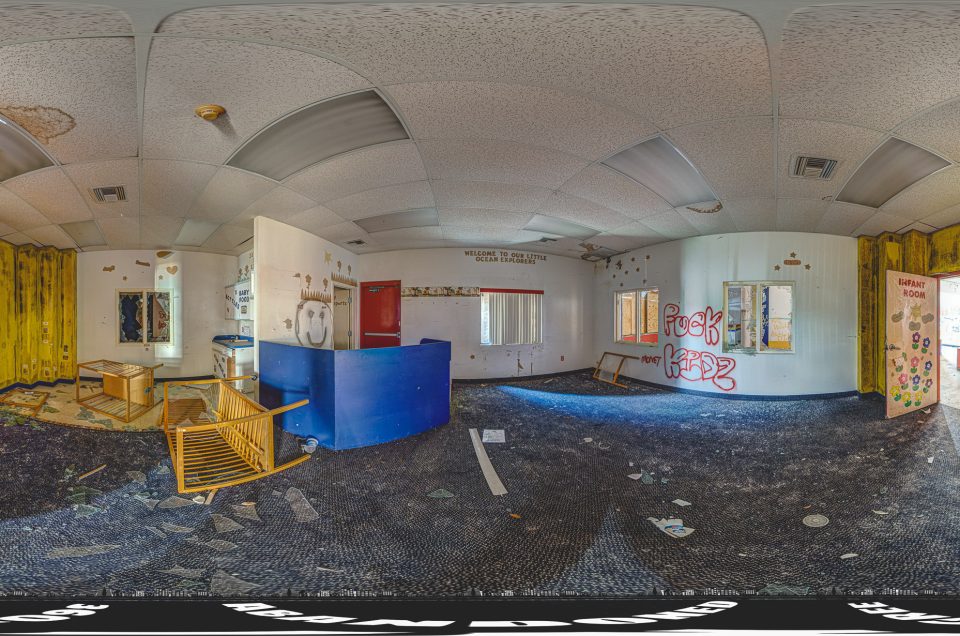
If you liked this blog post, you might be interested in learning about the St. Lucie Driving Range, the Denbigh Asylum, or the abandoned Wish Upon A Star Daycare in Florida.

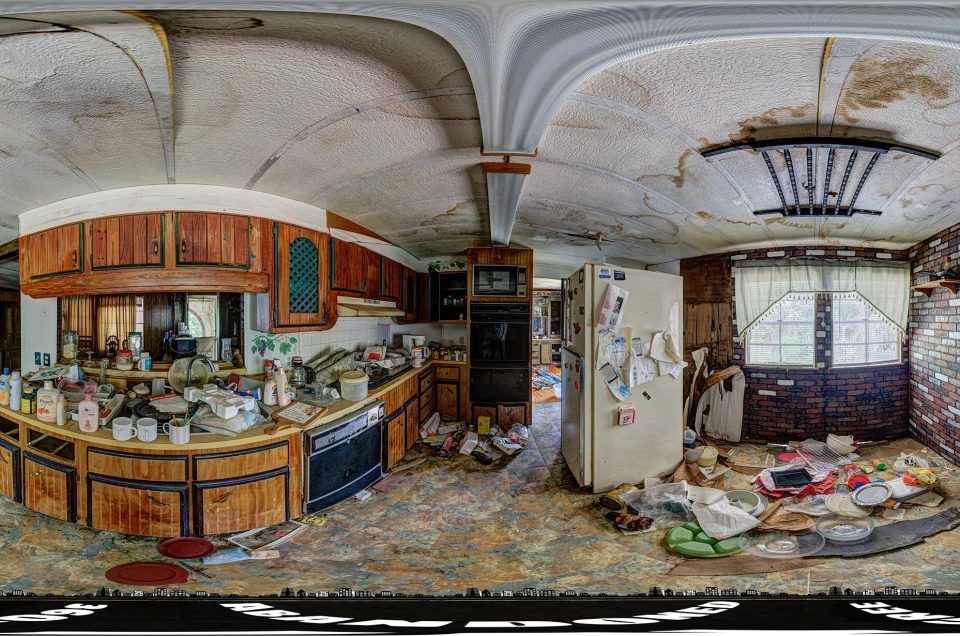
A photo inside an abandoned home in South Florida. Photo by the Abandoned in 360 URBEX Team.
Welcome to a world of exploration and intrigue at Abandoned in 360, where adventure awaits with our exclusive membership options. Dive into the mysteries of forgotten places with our Gold Membership, offering access to GPS coordinates to thousands of abandoned locations worldwide. For those seeking a deeper immersion, our Platinum Membership goes beyond the map, providing members with exclusive photos and captivating 3D virtual walkthroughs of these remarkable sites. Discover hidden histories and untold stories as we continually expand our map with new locations each month. Embark on your journey today and uncover the secrets of the past like never before. Join us and start exploring with Abandoned in 360.
Equipment used to capture the 360-degree panoramic images:
- Canon DSLR camera
- Canon 8-15mm fisheye
- Manfrotto tripod
- Custom rotating tripod head
Do you have 360-degree panoramic images captured in an abandoned location? Send your images to Abandonedin360@gmail.com. If you choose to go out and do some urban exploring in your town, here are some safety tips before you head out on your Urbex adventure. If you want to start shooting 360-degree panoramic images, you might want to look onto one-click 360-degree action cameras.
Click on a state below and explore the top abandoned places for urban exploring in that state.
You might also like





2 Comments
[…] you liked this blog post, you might be interested in The Sakaza House, the Hotel Marina Lučica, or the The Futuro House UFO […]
[…] post, you might be interested in learning about the abandoned Yaniv Train Station in Ukraine, the The Sakaza House in Florida, or the Green Mountain Racetrack in […]