Bali Festival Park: The ruin that still haunts Denpasar
Explore Bali Festival Park, an abandoned theme park in Bali, Indonesia, through a 360-degree virtual tour on Google Maps Street View. Once designed as a lively attraction filled with entertainment, animal displays, and large-scale themed structures, the park now stands quiet, weathered, and slowly overtaken by nature.
For urban explorers, Bali Festival Park offers a rare look at a forgotten tourist destination where faded architecture, empty pathways, and tropical decay create an eerie sense of place. Use the panoramic images below to move through the site virtually and experience one of Bali’s most intriguing abandoned locations from wherever you are.
Image by: Giang Nguyen
Image by: Антон Измайлов
Image by: Arjan Paauw
Image by: Nathan Byrne
Image by: Chris Thompson
Image by: Satya Ariya
Image by: Satya Ariya
Image by: Chris Thompson
Image by: Nathan Byrne
Image by: CoolHandShooze
For urban explorers, photographers, and anyone drawn to the poetry of failed mega-projects, Bali Festival Park is one of those places that feels larger than its footprint. Also known as Taman Festival Bali, the abandoned complex sits on Jalan Padang Galak in East Denpasar, near Padang Galak Beach and north of central Sanur. Over time, it has become one of Bali’s best-known ruins: a former entertainment park overtaken by vines, painted over with murals, and repeatedly described as a magnet for urban explorers and graffiti artists.
That status did not happen by accident. Bali Festival Park was designed as a high-concept entertainment destination that mixed theme-park rides, wildlife exhibits, performance spaces, spectacle technology, restaurants, and heavily staged scenery. A contemporary university research document, based on 1999 interviews with the park’s own marketing staff, described it as a recreation complex that combined advanced technology, traditional Balinese artistic ideas, wildlife, and a broad menu of attractions for all ages. In other words, this was never meant to be a quirky roadside attraction. It was meant to be a statement.
That is what makes the site so compelling for anyone interested in places abandoned in Indonesia. Bali Festival Park is not simply a broken amusement park. It is a physical record of late-1990s optimism, Indonesian financial turmoil, underperforming tourism economics, and the way nature and informal culture can reclaim a failed commercial vision. The walls now carry layers of graffiti, the roofs have collapsed in sections, and local lore gave the grounds a haunted reputation, but underneath all that decay is a very precise story about ambition and collapse.
For readers interested in urban exploring in Indonesia, this matters. URBEX is never just about entering a ruin and snapping dramatic photos. At its best, it is also about understanding what a place once promised, what it delivered, and what its remains still say about the society that built it. Bali Festival Park works so well as a URBEX subject because the gap between dream and outcome is enormous. The park was conceived as a polished, family-friendly entertainment world, yet it is remembered today as a haunted shell, an outdoor gallery of urban decay, and, increasingly, a site whose classic ruined form may be fading as redevelopment moves forward.
If you want the short version before the full dive, here it is. Construction began in mid-1996, and the park was opened to the public in late 1997, with some later reporting specifying October 1997 for its quiet debut. Sources disagree on how long its meaningful operations actually lasted, but the safest synthesis is that Bali Festival Park functioned, in some form, from late 1997 until 1999 or 2000, with several attractions unfinished and the business already in trouble long before the end. A devastating mix of the Asian Financial Crisis, weak visitor numbers, political unease, incomplete development, and the reported lightning strike that damaged its expensive laser system pushed it toward bankruptcy and abandonment.
When Bali Festival Park was built and how it opened
The strongest source for the park’s early timeline is a Petra Christian University hospitality paper that documented Taman Festival Bali in 1999 and cited interviews with its sales marketing staff. That source says the project began construction in mid-1996 with an investment of US$100 million, associated with Bambang Pangestu and cooperation with BNI 1946, while completed and in-progress components were handled by PT Arico. The same document says the park had opened to the public by the end of 1997 and was still being developed further at that stage.
That contemporary evidence is useful because later retellings often compress the story. The Denpasar city government later summarized Taman Festival Bali as having been “built in 1997,” which likely reflects its launch year rather than the beginning of physical construction. VICE, drawing on sources that traced the park’s decline, reported that it quietly opened in October 1997. Put together, those accounts point to a clear sequence: development started in 1996, the public launch came in late 1997, and the park entered the market before it was truly complete.
That incomplete opening matters more than it may seem. Modern theme parks live or die on first impressions. If signature attractions are unfinished, if promised spectacle technology is not fully installed, and if word of mouth starts weak, the model can unravel very quickly. Reporting from VICE and Coconuts indicates that, although Bali Festival Park was lavish by island standards and larger than anything similar in Bali at the time, it opened with elements still under construction—especially the laser infrastructure meant to power its headline nighttime experience.
Despite those weaknesses, the people behind the project marketed it aggressively. The 1999 Petra paper says the park distributed brochures through schools and travel agents, ran regular radio ads, and blanketed roads across Denpasar and Kuta with billboards. It even placed billboard advertising in Jakarta’s Soekarno-Hatta Airport and, according to the same source, in airports in Japan and Singapore. That tells you how heavily the park’s operators were betting on both domestic and foreign visitors. Bali Festival Park was not imagining itself as a local amusement area. It was selling itself as a tourism engine.
The park’s own pricing and daily operating structure also survive in that 1999 documentation. Adults were charged Rp 25,000, children Rp 15,000, and the park used an all-in ticket valid from 11:00 a.m. to 10:00 p.m. Those details are small, but they are gold for anyone reconstructing the reality behind the myth. They show that Bali Festival Park was not just a fantasy brochure project or a site that never admitted guests. It was functioning as a public attraction, selling a full-day entertainment package, even while pieces of the larger dream were still in motion.
This is also why the question of “how long it operated” gets slippery. Some later accounts emphasize the park’s most viable active stretch and describe it as limping along for only about six months before disaster deepened the crisis. Yet official and academic material shows it was still being promoted and used in 1999, including its amphitheater hosting major performances. The most accurate way to frame the operating duration is this: Bali Festival Park had a public life from late 1997 into 1999 or 2000, but its period of real momentum appears to have been very brief. For a park built on spectacle, that distinction is everything.
That short, unstable lifespan also helps explain why the site acquired such a strange afterimage. When a park survives for decades, memories harden around family nostalgia. When a park opens half-finished, struggles almost immediately, and dies before its promised identity ever really settles, it becomes easy for rumor to fill the empty spaces. Bali Festival Park did not have time to become ordinary. It jumped straight from glossy promise to urban legend.
What visitors were supposed to experience inside the park
To understand why Bali Festival Park keeps showing up in discussions of URBEX and abandoned in Indonesia destinations, you have to picture what the place was meant to feel like when functioning. According to the 1999 Petra documentation and later reporting, the concept was sprawling: part amusement park, part animal attraction, part event venue, part technology-driven night show, and part theatrical Balinese fantasy landscape. This was not a simple roller-coaster field. It was a stage set on a huge scale.
One of the most talked-about zones was the reptile park. The Petra source says visitors could see 180 crocodiles divided between two large pools, crossed by a bridge built above the enclosures so people could look down into the pit. Before reaching the crocodiles, guests would also pass displays of rare snakes and iguanas in smaller cages. Years later, the crocodile pit would become a centerpiece of the park’s haunted image, but in its intended form it was simply one more attraction in an ambitious entertainment package.
The bird park was equally ambitious. The same 1999 document says it featured 500 birds from 70 species found across Indonesia, housed in a giant aviary designed to resemble a forest and covered with netting overhead. It reportedly opened from 11:00 a.m. to 7:00 p.m. This detail is worth lingering over because it reveals something many later ghost-story versions of Bali Festival Park miss: the site was built around biodiversity displays as well as thrill attractions. Its creators wanted families, tourists, and day-trippers to stay for hours, moving from animals to rides to night shows.
Then there was the hi-tech entertainment area. The Petra paper lists attractions familiar to anyone who has walked a conventional amusement park midway: a Wave Swinger, Classic Carousel, Whirling Car Convoy, Ferris wheel, teacup-style ride, and a 3D simulator. It also lists a Zero Gravity Roller Coaster, with the note that this ride was only expected to open in September 1999. Coaster databases and later ride-wiki reporting suggest that the roller coaster was delivered and installed to some degree but may have operated only briefly, if at all, because of the park’s financial problems. That uncertainty says a lot about the state of the project: Bali Festival Park had the shell of a major ride, but perhaps not the stable business or technical follow-through needed to make it a dependable centerpiece.
The park’s most sophisticated signature feature was the cultural laser show. Here the concept moved from conventional amusement territory into engineered spectacle. The Petra source describes a nightly laser production staged on an artificial lake measuring 50 by 100 meters, using a waterfall dropping from 10 meters high as a projection screen. The show reportedly ran from 8:00 p.m., repeating every 14 minutes, and was designed by Prof. Dr. I Nyoman Wenten of the California Institute of the Arts. The storyline drew on Balinese folklore and dramatized conflict between good and evil. A faux volcanic backdrop enhanced the effect, with one artificial mountain spewing fire roughly every 15 minutes. This was the heart of the Bali Festival Park dream: not just rides, but a cinematic night spectacle with local cultural framing and imported technical glamor.
The amphitheater pushed the scale even further. The 1999 study says the venue held more than 2,000 seats and claimed views of rice fields, the Ayung River, and the Indian Ocean. It was described as the largest amphitheater on Bali and was used for national and international events, including a concert by Boyzone and Joshua on February 20, 1999, as well as fashion shows and other cultural performances. That detail is hugely important because it proves Bali Festival Park was not only a failed amusement park. It was also, briefly, an events destination with real programming.
Its support infrastructure matched the ambition. The park provided parking for around 500 cars, strategically placed toilets, restaurants slated to serve Chinese, Western, and Balinese food, a Time Zone video-game arcade, an information center at the front gate, and local guides to escort guests through the grounds. Again, this matters for historical accuracy. Bali Festival Park was not a rough concept tossed into the jungle. It was planned as a full-service leisure complex with enough variety to keep visitors on site from late morning into the night.
Later articles compressed these layers into a memorable shorthand: a fake volcano, a crocodile pit, a 3D theater, Bali’s largest swimming pool, laser shows, and an unusual roller coaster. That shorthand is not wrong, but it understates how integrated the project was supposed to be. Bali Festival Park was trying to fuse wildlife tourism, family rides, event programming, food service, nighttime entertainment, and stylized Balinese visual identity into a single destination. For searchers looking for a deep history of Bali Festival Park, that is the key point: the ruin that urban explorers now walk through was once imagined as one of the island’s most comprehensive purpose-built leisure environments.
And this is precisely why the abandoned remains feel so cinematic today. When explorers wander through crumbling halls, pass mural-covered facades, or stand under the skeletal framing of the old theater, they are moving through a ruin whose spaces still announce their original function. The scale was too large, and the design language too theatrical, for the park’s past to disappear cleanly. Even in failure, the architecture keeps talking.
Why Bali Festival Park was abandoned
The simplest explanation for the abandonment of Bali Festival Park is money, but that answer is too shallow to be satisfying. The better explanation is that the park was hit by several failures at once, and each one made the others worse. By the time the public could see the dream, the economics beneath it were already turning dangerous.
The broadest force was the Asian Financial Crisis. The World Bank describes how the late-1990s crisis, combined with drought, forest fires, and political instability, brought an abrupt end to Indonesia’s long run of growth and pushed the economy into free fall. Bali Festival Park opened directly into that environment. What might have looked viable in a boom suddenly had to survive in a collapsing financial landscape, with the rupiah under extreme pressure and confidence draining across the country.
That macroeconomic shock translated into tourism weakness and consumer hesitation. Coconuts and VICE both report that political unrest in Indonesia scared off visitors at the very moment Bali Festival Park needed strong attendance. Coconuts, citing the Wall Street Journal’s reporting from the period, says the park had been projected to attract 1,200 visitors a day but drew only about 200 visitors on weekends. For a capital-intensive destination built around spectacle, that is not a small shortfall. It is a fatal one.
The park’s own timeline made the problem worse. Because Bali Festival Park opened while still being developed, it never got the luxury of a clean, powerful first act. Some of its most marketable elements were unfinished or not reliably operating. Coaster-related sources suggest the roller coaster may never have entered real service. VICE notes that at the opening, some major attractions—especially the lasers—were still under construction. That means Bali Festival Park was trying to sell a premium experience before it had fully become the experience it advertised.
Then came the park’s most famous disaster: the reported lightning strike that damaged the laser equipment on Friday, March 13, 1998. VICE says the park’s US$5 million laser system was hit and that insurance coverage did not fully cover the loss. Later reporting in Coconuts and several travel histories repeats the same core account: the laser infrastructure, which was central to the destination’s identity and nighttime draw, failed catastrophically, and the business could not absorb the blow. Whether you treat that story as the decisive event or the symbolic final crack, it fits the rest of the evidence. Bali Festival Park had already been weakened by the crisis, weak footfall, and incomplete development. A major technical loss at the heart of its showmanship was exactly the kind of event that could tip a fragile venture into collapse.
Local government summaries support the bankruptcy angle even if they present the timeline more tightly. A Denpasar city government article states that the attraction, summarized there as built in 1997, experienced bankruptcy in 1999 because the monetary crisis left its grand plans unfinished and underfunded. Another 2026 Bali Discovery report says the seaside amusement attraction closed in 1999 for multiple reasons, including the national economic crisis. Those accounts line up well with the idea that by 1999 the business was effectively broken, even if its formal afterlife stretched into 2000 in some reporting.
This is where the operating-duration question comes into focus. If you ask how long Bali Festival Park “operated,” later journalism gives two overlapping answers. One answer is practical: the park’s viable life was extremely short, perhaps only months before the lightning damage and collapsing demand crushed it. The other answer is institutional: the park’s business dragged on in some form until 2000, with the company’s collapse and the site’s defunct status becoming more obvious over time. Both are true in their own way. The park died as a compelling concept faster than it died on paper.
There is also a rumor stream that muddies the picture. Atlas Obscura notes that some stories blame fears of unprofitability after the 2002 Bali bombings, but the chronology makes that explanation weak as a primary cause because the park was already struggling badly and is otherwise reported as closed by 1999 or 2000. At most, the 2002 attacks may have dimmed any realistic prospect of revival or new investment in an already failed destination. If you are writing accurate Bali Festival Park history, this distinction matters. The bombings belong in the park’s afterstory, not at the center of its original collapse.
By the early 2000s, then, Bali Festival Park had slipped into the condition that makes ruins so eerie: it was no longer functioning as intended, yet its architecture still loudly advertised its original purpose. Empty ticket booths, unfinished entertainment systems, crumbling show spaces, animal infrastructure, and abandoned fantasy scenery all remained visible. The park had failed too early to be cleaned up neatly and too expensively to be easy to erase.
How the ruin became a URBEX icon
Once a place like Bali Festival Park loses its commercial identity, something else usually moves in. In this case, it was a mix of jungle growth, local superstition, photography culture, graffiti art, and internet-era curiosity. That combination is exactly why Bali Festival Park became so important to urban exploring in Indonesia. It is not just derelict. It is visually legible, emotionally provocative, and layered with myth.
Atlas Obscura describes the site as an “urban explorer’s dream,” while Coconuts says it draws graffiti artists, photographers, and urban explorers because of its eerie charm. Denpasar’s own government coverage, although much more straightforward in tone, notes that the abandoned complex became lively again as a photo destination because of its many visual spots and graffiti. Those three strands—official recognition, travel-culture attention, and explorer fascination—help explain why Bali Festival Park became so widely recognized among people who chase atmospheric ruins.
There is also the psychological factor. URBEX tends to gravitate toward locations where use and disuse remain visible at the same time. Bali Festival Park is full of that tension. The old theater skeletons still look like venues. The fake-volcano concept still reads as deliberate spectacle. The animal zones still feel too engineered to be mistaken for anything natural. Yet every one of those spaces is now softened, distorted, or half-hidden by vegetation and weather. That contrast is catnip for explorers. It is why photographs from the site feel theatrical even before you add any editing.
The park’s reputation for being haunted amplified the draw. Coconuts notes that many Balinese believe abandoned sites can become homes for lost spirits, while VICE recounts a gatekeeper casually speaking about daily ghost encounters and explains that offerings continued to be placed around the grounds. None of that proves paranormal activity, of course, but it does explain the atmosphere people report. Bali Festival Park developed a social identity that went beyond “abandoned theme park.” It became a place where ghost stories, local caution, and visual fascination all fed one another.
This is where the keyword URBEX actually means something useful and not just trendy. At its best, URBEX is the practice of documenting hidden, abandoned, or off-limits built spaces, often to preserve memory as much as to seek adrenaline. A 2024 essay on urban exploration as creative practice defines it as entering vacant or abandoned buildings for exploration or documentation, while Atlas Obscura’s safety guidance stresses that even ruins have owners and should be approached legally and with preparation. Bali Festival Park became famous partly because it could satisfy both sides of that coin: dramatic visuals for adventurous visitors and rich historical texture for those who wanted to document a vanished leisure economy.
The site’s role in the online imagination of urban exploring in Indonesia also comes through in Indonesian-language coverage. A 2020 Kumparan article on urban exploration in Bali named Taman Festival as one of the island’s most-liked exploration sites, praising its traditional Balinese architectural features, graffiti, and the trees gradually reclaiming the remains. It also repeated the soft-opening-in-1997, closure-in-2000 narrative that circulates widely in explorer culture. That matters because it shows Bali Festival Park was not only being discussed by foreign travelers. It was also circulating in Indonesian conversations about memory, place, and exploration.
Of course, romanticizing ruins can blur practical reality. Atlas Obscura’s guidance on abandoned places is a good corrective here: always confirm whether you can legally visit, wear sturdy footwear and protective clothing, bring light and first-aid basics, avoid unstable structures, and never explore alone. That advice is especially relevant for Bali Festival Park, where descriptions repeatedly mention broken glass, insects, partial roof collapse, and decaying surfaces. If you are writing for an urban-explorer audience, the honest tone is not “go anywhere and hope for the best.” It is “respect the place, respect the law, and understand that the thrill is never worth an avoidable injury.”
That tension—between beauty and hazard, fascination and restraint—is part of what made Bali Festival Park stick in people’s minds. It gave explorers the visuals they wanted, but it also forced them to confront how fragile this kind of destination really is. Ruins are never frozen. They are rotting, being reused, being mythologized, being claimed by vegetation, and sometimes disappearing altogether. Bali Festival Park was always more temporary than its internet fame made it seem.
What Bali Festival Park means now
For years, the site’s afterlife looked almost stable in its instability. Travelers reported paying a small entry fee to a local gatekeeper. Government and travel coverage described it as a photo destination, an eerie offbeat attraction, and a decayed canvas for street art. VICE wrote in 2020 that there seemed to be no immediate demolition plan because of the complexity and expense of removing the remains. That made Bali Festival Park feel like one of those permanent ruins that could sit outside conventional tourism forever.
But ruins do not stay suspended indefinitely. One of the most important up-to-date facts for anyone publishing a Bali Festival Park article in 2026 is that the site’s condition appears to be changing fast. Bali Discovery reported in May 2026 that the former amusement complex was undergoing redevelopment, with demolition and bulldozing already underway in order to divide the old grounds into three new zones. According to that report, the plan includes a green area, a central parking area connected to the nearby Sanur Harbor, and a space dedicated to Balinese ceremonial plants, medicinal plants, and rare local flora.
That change matters because it reframes the entire Bali Festival Park story. For years the ruin represented unfinished leisure capitalism. Now it also represents a broader Balinese pattern in which abandoned tourism land can be absorbed back into new civic, environmental, ceremonial, or transport uses. The 2026 redevelopment plan suggests that the park may be moving from private-sector failure to community-facing land reuse. Even if every detail of implementation still evolves, the direction is significant: the classic URBEX version of Bali Festival Park may be giving way to a new chapter.
Yet the site has not been culturally dead, even in abandonment. Denpasar’s tourism office reported that NK13 Custom War 2023, a major custom-culture event featuring bikes, skateboarding, BMX, murals, tattoo art, photography, and music, was held at Taman Festival in Padang Galak and expected more than 40,000 visitors across two days. That is a fascinating twist. A park that failed as a polished family attraction later found life as a rawer, more subcultural event space. The original model collapsed, but the location still retained enough symbolic charge and open land to host an entirely different kind of gathering.
This afterlife is one reason Bali Festival Park has historical significance beyond urban legend. It captures three distinct Balinese eras in one site. First came the late-1990s boom-era dream of a spectacular, technology-heavy tourism machine. Then came the long abandonment phase, when the park became one of the island’s signature ruins, full of graffiti, folklore, and explorer attention. Now, in the mid-2020s, it appears to be entering a new phase of urban renewal and partial civic repurposing. That arc gives Bali Festival Park unusual depth. Most ruins are remembered for what they were. This one is also important for what it became after failure.
There is another reason it remains compelling. Bali is often marketed through polished images: beach clubs, rice terraces, temples, villas, and wellness itineraries. Bali Festival Park breaks that visual script completely. It reveals a strand of island history shaped by speculative entertainment investment, unfinished spectacle technology, financial crisis, and long-tail reinvention. That is why the place resonates so strongly with seasoned explorers. It shows a Bali most casual visitors never expect to find.
For a site aimed at an urban-explorer audience, this is the real hook. Bali Festival Park is not interesting because it is “spooky.” It is interesting because it lets you watch several decades of Indonesian tourism history, local adaptation, and visual culture collide inside one decaying frame. The site is atmospheric, yes, but the atmosphere works because the history underneath it is solid, specific, and full of contradictions.
Why Bali Festival Park still captures urban explorers
If you strip away the internet myths and the ghost bait, Bali Festival Park still lands with unusual force. It was started in 1996, launched to the public in late 1997, and effectively lasted only a few troubled years before sinking into bankruptcy and abandonment. During that brief run, it offered crocodiles, birds, rides, a 3D simulator, restaurants, an arcade, a giant amphitheater, and a technologically ambitious laser show staged through an artificial landscape. Very few abandoned places carry that much surviving intent inside their ruins.
Its abandonment also makes sense in ways that are sadly familiar to economic historians and painfully dramatic for explorers: a huge capital outlay, a soft launch before completion, a region-wide financial crisis, weak attendance, political uncertainty, and a reported lightning strike that crippled one of the park’s central pieces of show technology. When those forces stacked together, Bali Festival Park lost its chance to become what it had promised. It did not simply close. It unraveled.
That unraveling is exactly why the site became such a touchstone for URBEX and for anyone tracking the most memorable places abandoned in Indonesia. In the world of urban exploring in Indonesia, Bali Festival Park has stood out because it offers scale, atmosphere, recognizability, and a clear before-and-after story. Even people who never visited could understand it instantly from a photograph: the murals, the concrete, the broken theater frames, the jungle growth, the impossible-to-miss feeling that a glossy future had been interrupted and left behind.
At the same time, the site is a reminder that explorer fame is temporary. As of 2026, redevelopment appears to be reshaping the grounds for green space, ceremonial planting, and parking related to the nearby harbor. So the version of Bali Festival Park that filled travel blogs, YouTube videos, and explorer wish lists may not survive much longer in that exact form. That makes its history even more important to document carefully and without lazy mythmaking.
For your audience, that may be the most powerful takeaway of all. Bali Festival Park matters not just because it is eerie, but because it condenses a whole cycle of modern tourism into one location: dream, launch, underperformance, collapse, rumor, rediscovery, reuse, and transformation. If a reader comes looking for Bali Festival Park because they want a dramatic abandoned site, they should leave understanding something larger too. They should leave knowing that ruins are not empty. They are crowded with plans that almost worked.
And that is why Bali Festival Park still deserves its reputation. Not as a cheap haunted headline, but as one of the most visually arresting and historically revealing urban-exploration stories on the island of Bali. For the right kind of traveler—the one who values memory as much as adrenaline—it remains unforgettable.
If you liked this blog post, you might be interested in learning about the abandoned Yaniv Train Station in Ukraine, the The Sakaza House in Florida, or the Green Mountain Racetrack in Vermont.
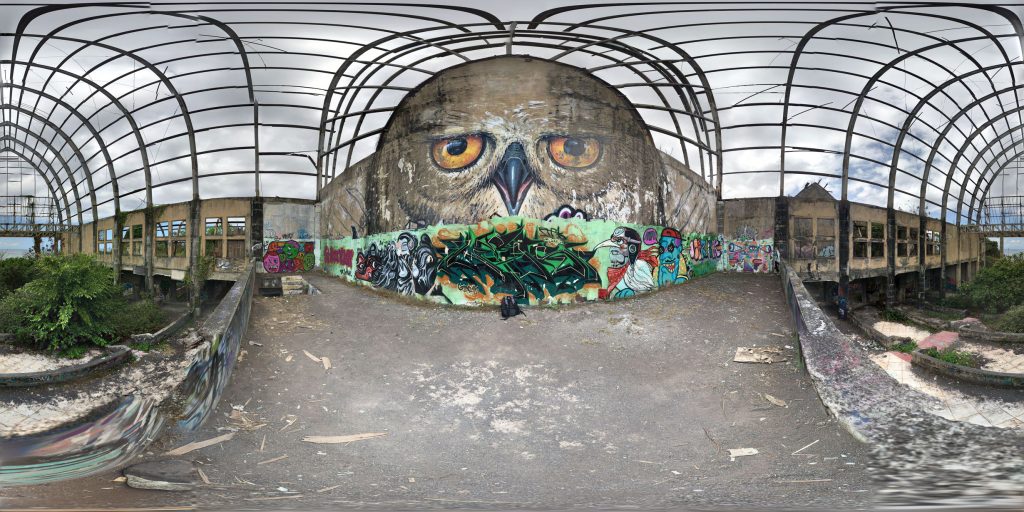
A 360-degree panoramic image captured at the abandoned Bali Festival Park in Denpasar City, Bali, Indonesia. Image by: Giang Nguyen
Welcome to a world of exploration and intrigue at Abandoned in 360, where adventure awaits with our exclusive membership options. Dive into the mysteries of forgotten places with our Gold Membership, offering access to GPS coordinates to thousands of abandoned locations worldwide. For those seeking a deeper immersion, our Platinum Membership goes beyond the map, providing members with exclusive photos and captivating 3D virtual walkthroughs of these remarkable sites. Discover hidden histories and untold stories as we continually expand our map with new locations each month. Embark on your journey today and uncover the secrets of the past like never before. Join us and start exploring with Abandoned in 360.
Do you have 360-degree panoramic images captured in an abandoned location? Send your images to Abandonedin360@gmail.com. If you choose to go out and do some urban exploring in your town, here are some safety tips before you head out on your Urbex adventure. If you want to start shooting 360-degree panoramic images, you might want to look onto one-click 360-degree action cameras.
Click on a state below and explore the top abandoned places for urban exploring in that state.
You might also like






2 Comments
[…] you liked this blog post, you might be interested in learning about the abandoned Bali Festival Park in Indonesia, the Noah “Bud” Ogle Cabin in Tennessee, or the amazing Coalwood High School in […]
[…] location, you might be interested in learning about the Costa del Croco hotel in Bulgaria, the Bali Festival Park in Indonesia, or the Denbigh Asylum in North […]