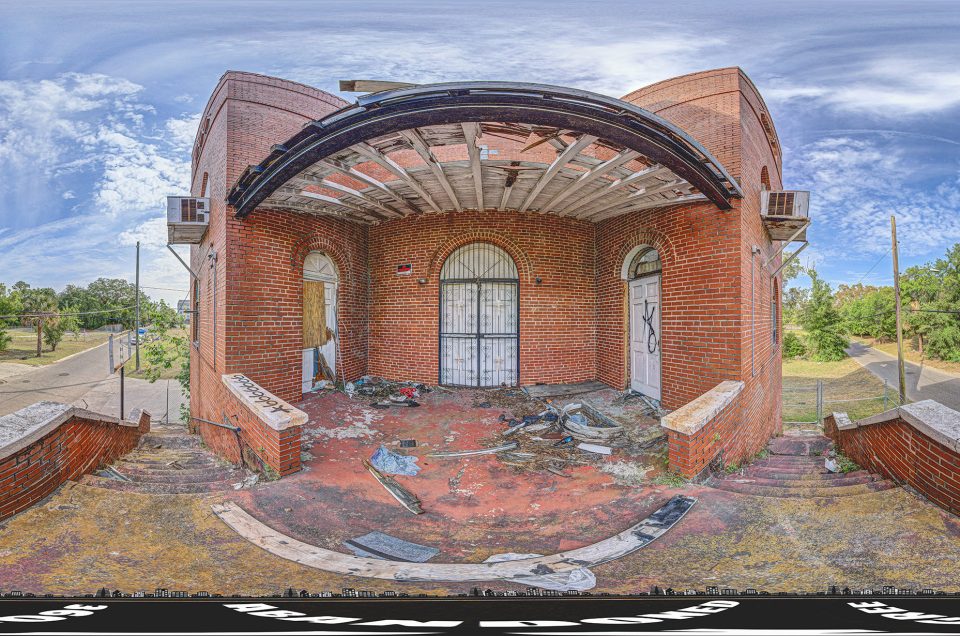
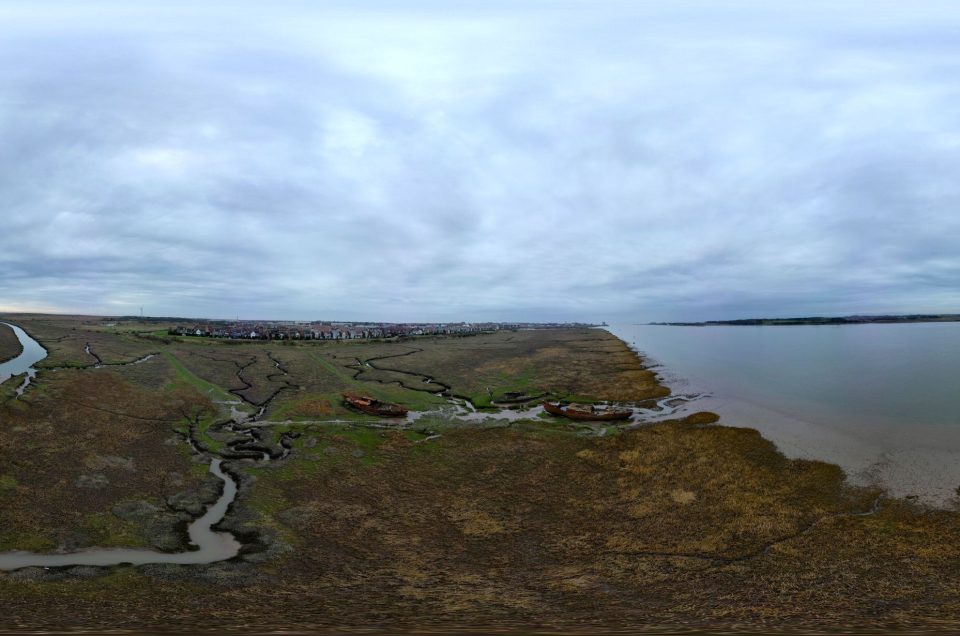
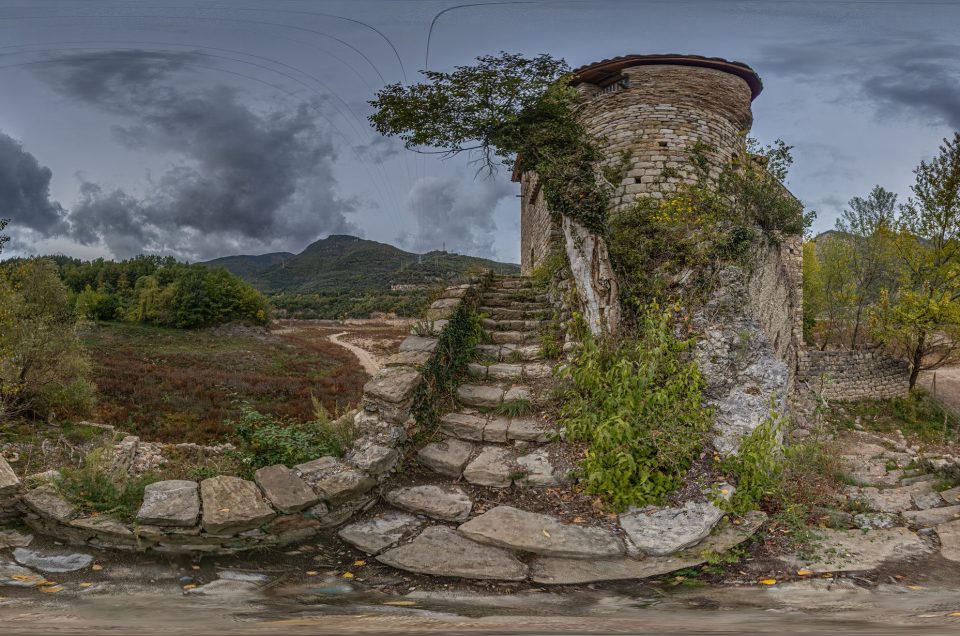
Denbigh Asylum: Inside the Abandoned North Wales Hospital in Denbigh
Explore Denbigh Asylum in Denbigh, North Wales through an immersive 360-degree virtual tour that gives urban explorers a closer look at this historic abandoned landmark. Once one of the most significant psychiatric hospitals in Wales, the site now stands as a haunting reminder of Victorian-era asylum architecture, institutional history, and slow decay.
Use the panoramic images on Google Maps Street View below to look around the grounds and experience the atmosphere of Denbigh Asylum at your own pace. From weathered stonework to forgotten corridors and decaying exterior views, each 360-degree image offers a unique glimpse into one of North Wales’ most fascinating abandoned places.
Image by: Alex Brad
Image by: Alex Brad
Denbigh Asylum: A Landmark of History, Mystery, and Decay
Denbigh Asylum, officially known as the North Wales Hospital, is one of the most fascinating abandoned sites in the United Kingdom. Located in Denbigh, Wales, this vast former psychiatric hospital has become a powerful symbol of Victorian mental-health history, architectural ambition, institutional change, and modern decay. For urban explorers, historians, photographers, and anyone drawn to forgotten places, Denbigh Asylum stands as one of the most important sites abandoned in Denbigh.
Built between 1844 and 1848, Denbigh Asylum opened in 1848 as the North Wales Counties Lunatic Asylum. Its purpose was both practical and cultural. At the time, North Wales did not have a major public institution dedicated to the care of mentally ill patients from the region. Many Welsh-speaking patients were sent far from home, often to English asylums or workhouses where language, family contact, and local identity could be lost. Denbigh Asylum was created to change that.
The hospital was designed by architect Thomas Fulljames and planned for around 200 patients. Over time, it grew into a major mental-health institution serving much of North Wales. By the mid-20th century, the hospital held around 1,500 patients. It included wards, gardens, workshops, a farm, a chapel, staff housing, kitchens, laundries, and other facilities that helped make it feel less like a single hospital and more like a self-contained village.
For nearly 150 years, Denbigh Asylum played a central role in the treatment, care, housing, and control of people with mental illness in North Wales. It witnessed major changes in medical thinking, social attitudes, psychiatric treatment, and government policy. It also became part of the lives of thousands of patients, nurses, doctors, attendants, families, and workers.
The hospital finally closed in 1995 after the Health Authority announced plans for closure in 1987. Its decline reflected a national shift away from large institutional asylums and toward community-based mental-health care. After closure, the buildings were left vulnerable to neglect, vandalism, theft, arson, weather damage, and years of uncertainty over redevelopment.
Today, Denbigh Asylum remains one of the best-known URBEX locations in Wales. Its decaying corridors, broken windows, empty wards, and striking Gothic-style architecture continue to attract attention. But it is also a dangerous and protected site. The buildings are in poor condition, and the local council has discouraged people from entering for safety reasons. For anyone interested in urban exploring in Denbigh, Denbigh Asylum is best understood with respect: as a historic place, a fragile structure, and a reminder of a complex chapter in mental-health care.
The Origins of Denbigh Asylum
The story of Denbigh Asylum begins in the early 1840s, when public concern grew over the treatment of mentally ill people in North Wales. At that time, the system was fragmented and often harsh. Some people with mental illness were cared for by families, but many others were sent to workhouses or placed in asylums outside Wales.
For Welsh-speaking patients, this created a major problem. Being removed from their home region could mean being treated in a place where few people understood their language, culture, or background. In a period when mental illness was already deeply misunderstood, that separation could make the experience even more isolating.
Local leaders, clergy, landowners, business figures, and reform-minded individuals began calling for a dedicated asylum for North Wales. Their vision was to create a hospital that would serve Welsh patients closer to home and offer what was then considered a more humane form of care.
The North Wales Counties Lunatic Asylum was planned before the Lunacy Act of 1845 made county-level asylum provision a wider public obligation. This makes Denbigh Asylum historically significant because its planning began before such institutions became mandatory. It was not simply a response to legislation; it was part of a wider movement to reform mental-health care and create a regional institution for North Wales.
The hospital was built through public subscription and county support. Joseph Ablett, a local landowner, donated land for the project. The asylum was designed by Thomas Fulljames, an architect from Gloucester, who created a large U-shaped complex in a Tudorbethan or Jacobean style. The design was intended to be orderly, impressive, and functional.
Construction took place during the 1840s, and the hospital opened in 1848. At the time, it was designed to house around 200 patients. For a Victorian asylum, the building was ambitious. It was not just a place to confine patients; it was built to operate as a therapeutic environment according to the ideas of the period.
A Victorian Asylum Built with Purpose
Denbigh Asylum was constructed during a time when architecture was seen as part of treatment. Victorian asylum planners believed that light, air, order, work, exercise, religion, and routine could help manage mental illness. The buildings were designed to separate patients by gender, condition, and behavior while also creating structured spaces for daily life.
The original asylum had a U-shaped layout, with separate male and female wings. This separation was standard for the period. The central parts of the building included administrative areas and spaces connected to the daily running of the hospital. Over time, a clock tower and chapel became part of the main range, adding to the site’s imposing appearance.
The building’s stonework, formal approach, and landscaped setting helped give it a powerful presence. It was not hidden away as a simple utility building. Instead, it was built to make a statement. Denbigh Asylum represented civic duty, regional pride, and the belief that North Wales needed its own purpose-built mental-health institution.
For today’s urban explorers, this architecture is one of the biggest reasons Denbigh Asylum remains so compelling. Even in decay, the scale of the place is striking. The weathered stone, tall windows, arched openings, surviving details, empty courtyards, and long ranges of buildings show how much planning went into the original hospital.
But the beauty of the architecture also creates a tension. The same buildings that now attract photographers and URBEX enthusiasts were once places of confinement, treatment, fear, routine, recovery, suffering, and labor. Denbigh Asylum should never be viewed only as an abandoned building. It was a lived-in institution, and its walls carry the weight of real human stories.
Why Denbigh Was Chosen
Denbigh was selected because it was considered a central location for the counties involved in the project. The asylum was intended to serve patients from across North Wales, including Welsh-speaking communities that had long lacked a suitable regional facility.
The location also provided space. Victorian asylums often required large sites because they were designed with gardens, airing courts, farms, workshops, laundry buildings, service yards, staff areas, and later expansions. Denbigh Asylum was no exception. It was planned with grounds that could support both care and work.
The countryside setting was considered part of the therapeutic model. Patients could be removed from urban pressures and placed in an environment where fresh air, outdoor labor, routine, and moral supervision were thought to help restore order to the mind. This idea may sound outdated today, but it was central to 19th-century psychiatric thinking.
The asylum’s founders wanted to distance the institution from older images of brutal confinement. They promoted ideas such as kind management, moral discipline, and care in the patient’s own language. While modern readers should be careful not to romanticize Victorian asylums, this intention was important. Denbigh Asylum was built during a period when some reformers were trying to move away from chains, restraints, and neglect.
Still, the reality of asylum life was complicated. Patients lived under strict rules. They were often separated from families. Their daily lives were controlled by the institution. Many stayed for years. Some never left. The story of Denbigh Asylum is therefore not simply one of progress or cruelty. It is a layered history of care, control, medical change, social stigma, and public responsibility.
Life Inside Denbigh Asylum
In its early years, Denbigh Asylum operated according to the principles of moral treatment. Patients were given routine, structure, work, recreation, religious services, and supervised exercise. The idea was that order and meaningful activity could help calm troubled minds.
Men and women were housed separately. Male patients often worked in the gardens, on the farm, or in trades such as tailoring, shoemaking, and joinery. Female patients were commonly assigned domestic work, including sewing, laundry, and other household tasks. Patient labor helped keep the hospital functioning and was also viewed as part of treatment.
The hospital grounds included gardens and airing courts where patients could spend time outdoors. These areas were enclosed, allowing exercise while still maintaining control. For many patients, daily life followed a strict schedule of meals, work, recreation, religious observation, and rest.
As the hospital grew, it developed more facilities. By the early 20th century, Denbigh Asylum had become a large institutional community with a chapel, farm, workshops, private services, staff accommodation, and service buildings. It functioned almost like a small town.
This self-sufficient model was common in large psychiatric hospitals. It allowed the institution to support a large population while limiting contact with the outside world. Patients, staff, and administrators all operated within a controlled environment. For some, this structure may have offered shelter and routine. For others, it could feel isolating and restrictive.
From an URBEX perspective, these layers are what make Denbigh Asylum so historically rich. The site was not just a ward block. It was an entire institutional ecosystem. Every corridor, workroom, chapel space, courtyard, stairwell, and service area had a role in the hospital’s daily rhythm.
Growth and Expansion
Denbigh Asylum was designed for around 200 patients, but demand grew steadily. Mental-health institutions across Britain expanded during the 19th and early 20th centuries as more people were admitted under changing laws, medical practices, and social expectations.
By 1876, the hospital had reached full capacity, and additional accommodation became necessary. New wings and buildings were added over time. The hospital was extended in the 1860s and again during major phases of work in the late 19th and early 20th centuries.
The 1903 to 1908 building phase was especially significant. During this period, the hospital added or upgraded major facilities, including ward accommodation, service areas, sanitation systems, kitchens, dining areas, and laundry facilities. These expansions show how the asylum changed from a relatively small Victorian institution into a much larger hospital complex.
By 1908, the site had become a self-contained village of patients and staff. It included a chapel, farm, workshops, and its own practical infrastructure. By 1956, the hospital housed around 1,500 patients. This huge increase shows how far the institution had moved from its original scale.
Overcrowding was a common issue in many asylums. Institutions designed with reformist ideals often became strained as patient numbers grew. What began as a carefully planned hospital could become crowded, overstretched, and difficult to manage. Denbigh Asylum followed this broader pattern.
For urban explorers, the scale of the ruins reflects that long history of expansion. The remaining buildings are not from one single moment. They represent decades of changing medical needs, architectural additions, and institutional pressure. Some sections speak to the early Victorian period. Others show later efforts to modernize, expand, and adapt.
Medical Treatment Through the Years
When Denbigh Asylum first opened, psychiatric treatment was limited by the medical knowledge of the time. Early treatment focused heavily on routine, supervision, work, exercise, recreation, spiritual care, sedation, and physical management.
As psychiatry developed, the hospital witnessed major changes in treatment methods. Over its long operating life, Denbigh Asylum saw the use of therapies that are now viewed through very different ethical and medical lenses. These included electroconvulsive therapy, insulin shock therapy, leucotomy procedures, and pharmaceutical treatments introduced as psychiatry moved into the modern era.
It is important to discuss these treatments with care. Some were introduced by doctors who believed they were helping patients based on the knowledge available at the time. Others are now remembered with concern because of their risks, side effects, and the lack of patient choice that often existed in institutional settings.
The history of Denbigh Asylum therefore mirrors the wider history of mental-health care. It moved from Victorian moral treatment into 20th-century medical psychiatry. It saw the rise of large institutions, the pressure of overcrowding, the introduction of experimental treatments, the arrival of the National Health Service era, and the eventual move away from asylum-based care.
The hospital’s records are especially important because they provide insight into patient lives, diagnoses, admissions, treatments, staffing, administration, and the social history of mental illness in North Wales. Many patients came from working communities, including quarrying, farming, and industrial backgrounds. Their case records show how mental illness was often connected to poverty, injury, family stress, grief, work, religion, trauma, and social judgment.
Behind the decaying buildings are thousands of individual stories. Denbigh Asylum was not just an institution; it was a place where people were diagnosed, treated, confined, visited, employed, discharged, remembered, and sometimes forgotten.
Denbigh Asylum and the Welsh Language
One of the most important parts of Denbigh Asylum’s history is its connection to the Welsh language. The hospital was created partly because Welsh-speaking patients needed care closer to home and in a language they could understand.
This mattered deeply. Mental-health care depends on communication. A patient’s symptoms, fears, memories, confusion, beliefs, and distress are often expressed through language. In the 19th century, sending Welsh-speaking patients to English institutions could create severe barriers between patients and staff.
Denbigh Asylum was meant to reduce that barrier. Its founders believed patients should receive care in their own language and within their own regional context. This gave the hospital a cultural significance beyond its medical role.
For North Wales, the asylum became both a healthcare institution and a regional landmark. It represented a local response to a local problem. Its history connects with questions of identity, language, class, public welfare, and the treatment of vulnerable people.
This is one reason Denbigh Asylum remains so important today. It is not simply another abandoned hospital. It is part of Welsh social history. It reflects how communities organized care, how public institutions developed, and how language shaped the patient experience.
The Hospital at Its Peak
By the middle of the 20th century, Denbigh Asylum had grown far beyond its original purpose. The hospital housed around 1,500 patients by 1956 and employed a large staff. The site included many buildings and services needed to support such a large population.
At its peak, the hospital would have been busy every day. Nurses moved through wards. Doctors reviewed patients. Kitchens prepared meals. Laundry facilities processed bedding and clothing. Farm workers and patients tended land. Workshops produced or repaired items. Administrative staff handled records. Families visited when they could. Religious services, recreation, and occupational tasks were part of the rhythm of institutional life.
For some patients, Denbigh Asylum may have provided stability, shelter, and medical support. For others, it may have represented loss of freedom, stigma, and separation. The reality varied from person to person.
The scale of the hospital also created challenges. Large institutions were expensive to maintain and difficult to modernize. Buildings designed in the 1840s were not always suitable for later standards of healthcare. Patient populations became complex, and long-stay institutional care increasingly came under criticism.
By the post-war period, attitudes toward mental health were changing. New medications, new policies, and new ideas about patient rights led many officials and medical professionals to question the future of large psychiatric hospitals.
Denbigh Asylum’s long decline began in that context.
Why Denbigh Asylum Closed
The closure of Denbigh Asylum was part of a much wider transformation in mental-health care across the United Kingdom. During the second half of the 20th century, government policy moved away from large psychiatric institutions and toward community-based care.
This shift is often associated with the broader “Care in the Community” movement. The idea was that many patients should no longer live for years in isolated institutions. Instead, they would receive support in smaller settings, community services, outpatient care, supported housing, or general hospitals.
In theory, this approach aimed to give patients more independence and dignity. In practice, the transition was uneven, and many communities struggled to provide enough support. Still, the direction of policy was clear: large Victorian asylums were no longer seen as the future of mental-health treatment.
The Health Authority announced plans to close Denbigh Asylum in 1987. The hospital was wound down over the following years, and the last patient left in 1995. That means Denbigh Asylum operated for roughly 147 years from its opening in 1848 to its closure in 1995.
The closure marked the end of an era. For Denbigh, it meant the loss of a major local institution and employer. For former patients and staff, it marked the closing of a place that had shaped many lives. For the buildings themselves, it began a new and damaging chapter.
Once the hospital closed, the site became difficult to protect, maintain, and reuse. Large historic hospital complexes are expensive to restore. Without a strong plan, they can deteriorate quickly. Denbigh Asylum became a clear example of that problem.
After Closure: Neglect, Vandalism, and Fire
After Denbigh Asylum closed, the buildings entered a period of serious decline. The site changed ownership, redevelopment ideas came and went, and the historic structures suffered from neglect. Over the years, vandalism, theft, weather damage, and fires caused major harm.
Like many abandoned asylums, Denbigh became attractive to urban explorers, ghost hunters, photographers, and thrill-seekers. Its scale, history, and decaying architecture made it famous. But increased attention also brought problems. Trespassing, vandalism, stripped materials, graffiti, and arson damaged the site further.
The hospital’s condition worsened to the point that Denbighshire County Council became heavily involved. The council later took ownership through a compulsory purchase process after previous owners failed to carry out significant repairs. The site’s condition had become a major concern because the main hospital building is Grade II* listed and considered an exceptionally important example of early Victorian asylum architecture.
For anyone interested in abandoned in Denbigh locations, Denbigh Asylum is a reminder of how fast historic buildings can decline when left unsecured and unused. Once roofs fail, water enters. Once windows break, weather and wildlife move in. Once fires occur, entire sections can be lost. Decay is not just visual; it is structural.
That decay is part of what draws URBEX photographers, but it is also what makes the site dangerous. Floors can collapse. Staircases can fail. Masonry can fall. Asbestos, sharp debris, unstable roofs, hidden drops, and fire damage can all create serious hazards. This is why the site should be approached with caution, respect, and awareness of legal restrictions.
Architecture That Still Commands Attention
Even after years of damage, Denbigh Asylum remains architecturally impressive. The main range was designed in a Tudorbethan or Jacobean style, with strong symmetry, stone construction, tall windows, formal massing, and a commanding presence.
The original U-shaped plan helped organize the institution into separate zones. Male and female patients were kept apart, and the design allowed staff to supervise movement and daily routines. Later additions expanded the hospital into a much larger complex.
One of the most striking elements is the way Denbigh Asylum blends beauty and control. The architecture is grand, but its purpose was institutional. The same formal layout that looks impressive from a distance also helped manage the lives of patients inside.
The hospital’s listing recognizes its importance as an early Victorian asylum building. It is not simply old; it is historically and architecturally significant. It reflects a period when asylums were designed as major public buildings and when architecture was believed to play a role in treatment.
For urban explorers, the visual atmosphere is unforgettable. Empty wards, long corridors, broken windows, exposed beams, peeling paint, weathered stone, and damaged interiors create a haunting scene. But the real power of Denbigh Asylum comes from understanding what those spaces once were.
A ward was not just a photogenic room. It was where people slept, waited, recovered, deteriorated, worked, or lived for years. A chapel was not just an architectural detail. It was part of the moral and spiritual structure of the institution. A workshop was not just an industrial remnant. It was tied to the hospital’s system of labor and routine.
Understanding these layers makes Denbigh Asylum more than an abandoned building. It becomes a historical document written in stone, timber, glass, and silence.
Denbigh Asylum as an URBEX Icon
Denbigh Asylum has become one of the most recognized URBEX sites in Wales. Its size, history, dramatic decay, and reputation have made it a frequent subject for urban exploration photography and video.
For people interested in urban exploring in Denbigh, the site represents the kind of location that defines the genre: large, atmospheric, historic, and visually powerful. It has the scale of a lost institution and the mood of a place suspended between memory and collapse.
The appeal is easy to understand. Denbigh Asylum has everything explorers often look for: grand architecture, medical history, long corridors, institutional remnants, weathered surfaces, overgrowth, and a strong sense of story. It is not a small ruin or a simple derelict building. It is a complete historic landscape.
However, its popularity also raises important ethical questions. Urban exploration should never be about damaging property, stealing artifacts, forcing entry, or treating serious history like a playground. Denbigh Asylum was a psychiatric hospital, and many people connected to it still have family memories, local ties, or personal associations with the site.
Responsible URBEX means documenting without destruction. It means respecting barriers, avoiding vandalism, not revealing sensitive access details, and understanding that abandoned places often have owners, legal protections, and safety risks.
Denbigh Asylum deserves that level of respect. Its history is too important to reduce to rumors, shock value, or ghost stories. The real story is already powerful enough.
Myths, Ghost Stories, and the Reality Behind the Ruins
Like many abandoned asylums, Denbigh Asylum has attracted ghost stories and dark legends. Some people are drawn to the site because of its eerie appearance and psychiatric past. Empty hospitals often become the focus of paranormal claims, especially when their architecture is dramatic and their history is poorly understood.
But the factual history of Denbigh Asylum is more meaningful than any legend. The real story includes Victorian reform, Welsh-language care, overcrowding, patient labor, medical experimentation, institutional life, closure, abandonment, and preservation challenges. These facts are far more important than exaggerated tales.
That does not mean the site lacks atmosphere. Denbigh Asylum is undeniably haunting. Its empty windows, damaged rooms, and silent grounds create a strong emotional effect. But that feeling comes from history, decay, and absence. It comes from knowing that thousands of people once lived and worked there.
For a blog targeting urban explorers, it is important to separate mood from misinformation. Denbigh Asylum can be described as eerie, atmospheric, and mysterious without inventing stories. Its documented history is deep enough to stand on its own.
The most respectful way to approach the site is to focus on what is known: why it was built, who it served, how it grew, what treatments were used, why it closed, and what happened after abandonment. That approach gives readers a richer experience and helps preserve the dignity of the people connected to the hospital.
Historical Significance of Denbigh Asylum
Denbigh Asylum is historically significant for several reasons. First, it was one of the most important purpose-built mental hospitals in Wales. Its planning began before the 1845 Lunacy Act made county asylum provision a wider legal requirement, showing that North Wales leaders were already responding to the need for regional mental-health care.
Second, the hospital was created with Welsh-speaking patients in mind. This makes it culturally significant as well as medically important. It reflects the relationship between language, identity, and healthcare in Wales.
Third, its architecture is exceptional. The main building is Grade II* listed, marking it as a structure of more than special interest. It is recognized as a major example of early Victorian asylum design.
Fourth, its records are valuable for understanding the social history of mental illness. Patient records, staff records, annual reports, committee minutes, plans, and other documents help researchers study not just the hospital, but the wider society it served.
Fifth, Denbigh Asylum reflects the rise and fall of the large psychiatric hospital model. It began in an age of institutional reform, grew during the peak of asylum care, adapted to medical changes, and closed during the shift toward community-based treatment.
Finally, its abandonment tells a modern story about heritage, redevelopment, and preservation. Many historic institutions struggle to find new uses after closure. Denbigh Asylum became a major example of what can happen when a large listed site is left without a secure future.
The Current Future of Denbigh Asylum
After decades of uncertainty, the former North Wales Hospital site has been tied to major regeneration plans. Proposals have included restoration of the Grade II* listed building, new housing, commercial space, green areas, training facilities, and wider redevelopment of the former hospital grounds.
The plans aim to bring the derelict site back into use while preserving key historic structures. This kind of project is complex. Restoring a large, damaged, listed hospital is expensive and difficult. Developers must address heritage protection, structural safety, contamination, public access, planning requirements, community concerns, and the need for a financially viable future.
For people who love abandoned places, redevelopment can feel bittersweet. Once a site is restored, the raw URBEX atmosphere may disappear. But without redevelopment, many historic buildings eventually collapse or become too dangerous to save. Denbigh Asylum has already suffered years of decay. A careful regeneration plan may be the best chance for parts of the site to survive.
The challenge is balance. The future of Denbigh Asylum should respect its architecture, its patients, its staff, its Welsh history, and its role in Denbigh’s identity. It should not erase the past. Ideally, restoration would allow the site to live again while keeping visible reminders of what it once was.
For now, Denbigh Asylum remains a place caught between ruin and renewal. That tension is part of its power. It is no longer a working hospital, but it has not fully disappeared. It stands as a landmark of memory, waiting to see what its next chapter will become.
Exploring Denbigh Asylum Through History
For readers who may never visit Denbigh Asylum in person, the best way to explore it is through its history. The site can be understood as a timeline.
In the 1840s, it was a reform-minded project built to serve North Wales. In the Victorian period, it grew as public asylum care expanded. In the early 20th century, it became a large institutional village. In the mid-20th century, it housed around 1,500 patients. In the late 20th century, it declined under changing mental-health policy. In 1995, it closed. In the years after, it became abandoned, damaged, and famous among urban explorers. Today, it stands at the edge of redevelopment.
This timeline helps explain why Denbigh Asylum feels so layered. It is not frozen in one period. It contains evidence of many periods. The original Victorian vision, later expansions, modern medical changes, abandonment, vandalism, and preservation efforts all overlap.
That is what makes the site so valuable for URBEX storytelling. A good abandoned location is not only visually interesting. It has a story that connects architecture, people, policy, and time. Denbigh Asylum has all of that.
When writing about abandoned in Denbigh locations, Denbigh Asylum should be treated as a cornerstone. It is one of the most important abandoned landmarks in the area and one of the best-known former asylums in the United Kingdom.
Safety and Legal Considerations for Urban Explorers
Denbigh Asylum is a dangerous site. Its buildings have suffered from long-term neglect, fire damage, vandalism, and structural decay. Anyone interested in urban exploring in Denbigh should understand that abandoned buildings can pose serious risks.
Loose floors, unstable ceilings, falling masonry, broken glass, exposed metal, hidden holes, unsafe staircases, asbestos, contaminated materials, and poor visibility can all create hazards. Fire-damaged structures are especially unpredictable. A floor or roof may look solid from a distance but fail under weight.
There are also legal concerns. Abandoned does not mean ownerless. Denbigh Asylum has ownership, planning status, heritage protections, and safety restrictions. Entering without permission can create legal consequences and can also interfere with preservation or redevelopment work.
The best approach is to enjoy Denbigh Asylum through legal and safe methods. Historical research, public records, approved photography, virtual tours, documentaries, archives, and exterior viewing from lawful public areas can still provide a meaningful experience.
Responsible URBEX is not about taking risks for attention. It is about curiosity, documentation, respect, and preservation. The most important rule is simple: take nothing, damage nothing, force nothing, and respect the history of the place.
Denbigh Asylum has already lost too much to vandalism and fire. Its remaining history deserves protection.
Why Denbigh Asylum Still Captures the Imagination
Denbigh Asylum continues to fascinate people because it combines so many powerful themes. It is a beautiful building and a damaged one. It was a place of care and control. It was built with reformist hopes but later became part of a system criticized for institutionalizing vulnerable people. It served a Welsh-speaking population but also separated many patients from ordinary life. It closed in the name of modern care but was then left to decay.
These contradictions make the site unforgettable. It is not a simple story of good or bad. It is a human story shaped by the ideas and limitations of different eras.
For urban explorers, Denbigh Asylum offers the visual drama of abandonment. For historians, it offers insight into public health, Welsh identity, architecture, and mental-health policy. For local people, it is part of Denbigh’s landscape and memory. For preservationists, it is a test of how society handles large historic buildings after their original purpose ends.
The hospital’s long life also makes it emotionally powerful. From 1848 to 1995, it existed through Victorian Britain, two world wars, the creation of the NHS, the rise of modern psychiatry, and the shift toward community care. Few abandoned sites carry such a long and complex timeline.
That is why Denbigh Asylum remains one of the most important URBEX landmarks in Wales.
Denbigh Asylum in the Bigger Story of Abandoned Hospitals
Across the United Kingdom, many former psychiatric hospitals have closed, been demolished, converted, or left to decay. These sites often share similar histories. They were built in the 19th century, expanded in the early 20th century, became overcrowded, adapted to modern medicine, and closed during the late 20th-century move away from institutional care.
Denbigh Asylum fits this pattern, but it also stands apart. Its Welsh-language purpose, early planning, strong architectural identity, and Grade II* listing make it especially important.
Abandoned hospitals often attract attention because they feel unsettling. But they also raise serious questions. How should society remember institutions that cared for vulnerable people but also confined them? How should historic buildings be reused without erasing painful history? How can communities preserve architecture while acknowledging the experiences of former patients?
Denbigh Asylum forces those questions into the open. It is not enough to admire the ruins. The site asks visitors and readers to think about what mental-health care used to look like, how it changed, and what was lost when large hospitals closed.
For an URBEX audience, this makes Denbigh Asylum a strong subject. It has atmosphere, history, mystery, and ethical depth. It is exactly the kind of abandoned place that rewards careful research and respectful storytelling.
Final Thoughts: Denbigh Asylum’s Place in URBEX History
Denbigh Asylum is more than a decaying landmark. It is one of the most historically important abandoned sites in Denbigh and one of the most compelling former psychiatric hospitals in the United Kingdom. Built between 1844 and 1848, opened in 1848, and closed in 1995, it operated for nearly 150 years.
During that time, it served Welsh-speaking mental-health patients, grew from a 200-patient asylum into a major hospital of around 1,500 patients, and witnessed enormous changes in medicine, society, and public policy. Its buildings held wards, workshops, gardens, a chapel, service areas, staff spaces, and the daily routines of a large institutional community.
After closure, Denbigh Asylum became a symbol of abandonment. Years of neglect, vandalism, theft, fire, and weather damage transformed the former hospital into a haunting ruin. Its atmosphere made it famous among URBEX enthusiasts, but its danger and legal status also make it a site that must be treated with caution and respect.
Today, Denbigh Asylum stands at a turning point. Its future may involve restoration, redevelopment, housing, commercial space, and new community use. If handled well, that future could preserve key parts of the site while giving the buildings a new purpose. If handled poorly, important history could be lost.
For now, Denbigh Asylum remains a powerful reminder of how places change. It began as a reform-minded Victorian asylum for North Wales. It became a major psychiatric hospital. It closed during a national shift in mental-health care. It fell into ruin. And now, after decades of uncertainty, it may yet find a new role.
For anyone drawn to abandoned in Denbigh history, urban exploring in Denbigh, or URBEX stories with real depth, Denbigh Asylum is a site that deserves attention. Its broken windows and empty corridors may capture the eye, but its true significance lies in the lives, policies, architecture, and memories that shaped it.
Denbigh Asylum is not just a place to look at. It is a place to understand.
If you liked this blog post, you might be interested in learning about the Maximos Ranch in Cyprus, the Dupree Gardens in Central Florida, or the Welch Spring Hospital Ruins in Missouri.
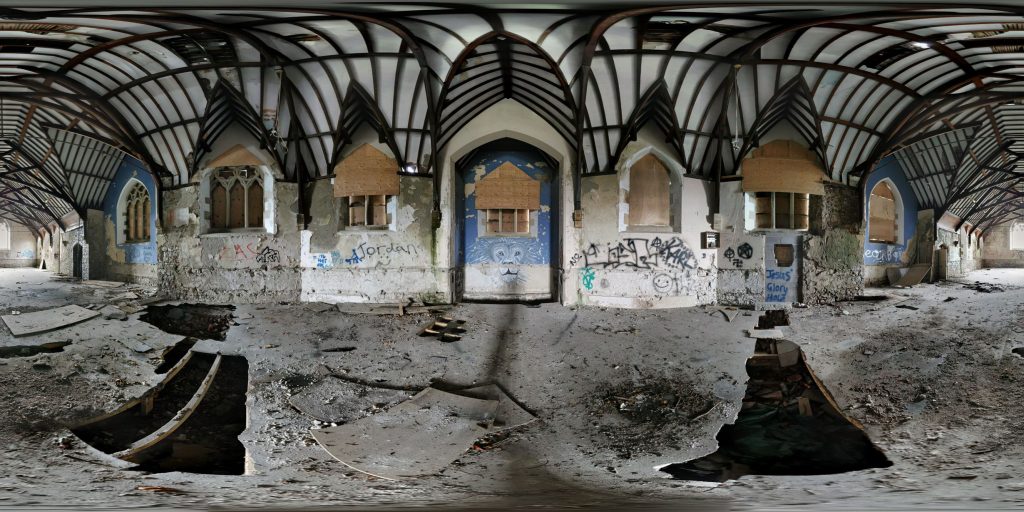
A 360-degree panoramic image inside the church at the abandoned Denbigh Asylum in Denbigh, United Kingdom. Image by: Alex Brad
Welcome to a world of exploration and intrigue at Abandoned in 360, where adventure awaits with our exclusive membership options. Dive into the mysteries of forgotten places with our Gold Membership, offering access to GPS coordinates to thousands of abandoned locations worldwide. For those seeking a deeper immersion, our Platinum Membership goes beyond the map, providing members with exclusive photos and captivating 3D virtual walkthroughs of these remarkable sites. Discover hidden histories and untold stories as we continually expand our map with new locations each month. Embark on your journey today and uncover the secrets of the past like never before. Join us and start exploring with Abandoned in 360.
Do you have 360-degree panoramic images captured in an abandoned location? Send your images to Abandonedin360@gmail.com. If you choose to go out and do some urban exploring in your town, here are some safety tips before you head out on your Urbex adventure. If you want to start shooting 360-degree panoramic images, you might want to look onto one-click 360-degree action cameras.
Click on a state below and explore the top abandoned places for urban exploring in that state.
You might also like