Yaniv Train Station: The Abandoned Railway of Pripyat, Ukraine
Take a 360-degree virtual tour through Yaniv Train Station in Pripyat, Ukraine, using the panoramic images featured in the Google Maps Street View tour below.
Once a key rail stop near the Chernobyl Exclusion Zone, Yaniv Train Station now stands as a haunting reminder of the region’s abandoned past. For urban explorers, this virtual tour offers a rare look at the tracks, platforms, and weathered remains of a place frozen in time.
Image by: Bartosz Cichy
Image by: reiu666
Image by: Tomáš Špaček
Image by: Google Maps
Hidden deep within the Chernobyl Exclusion Zone, the Yaniv Train Station lies frozen in time. It is one of the most haunting places abandoned in Ukraine – a railway hub that once buzzed with activity, serving Pripyat, the city built to support the nearby Chernobyl Nuclear Power Plant. Today, Yaniv Station is a ghostly landmark, drawing in curious urban explorers fascinated by its history and the eerie silence that envelops it. In this comprehensive exploration, we will journey through the station’s past and present: from its construction and operating years to the tragic events that led to its abandonment. Along the way, discover why this location has become a highlight of urban exploring in Ukraine, and how it stands as a poignant time capsule of Soviet ambition and the Chernobyl disaster.
Origins and Construction of Yaniv Train Station
The story of Yaniv Train Station begins long before Pripyat even existed. In the early 1920s, Soviet authorities sought to expand rail connectivity across northern Ukraine. Yaniv railway station was commissioned in 1925, strategically placed along a new railway line between the towns of Chernihiv and Ovruch. Its creation was part of a larger infrastructure project aimed at bolstering transport and industry in the region. By the late 1920s, construction of this Chernihiv–Ovruch railway line was well underway, with Yaniv Station emerging as an important stop in the marshy woodlands near the Pripyat River.
From the outset, Yaniv Station served a tiny rural settlement – the village of Yaniv – which gave the station its name. This isolated village was home to only a few hundred residents and was surrounded by forest and swamp. Despite its remote location, the station quickly proved its worth. It became a focal point for the local economy, handling timber, agricultural goods, and passengers traveling to larger cities. During this period, the station was modest, with a simple platform and a small station building, but it stood as a beacon of progress for the area.
World War II briefly interrupted the station’s early history. In August 1941, as Axis forces advanced into Soviet Ukraine, retreating Soviet troops destroyed a railway bridge near Yaniv Station to slow the enemy’s progress. This act temporarily halted rail service on the line.
However, after the war, the Soviet government rebuilt infrastructure swiftly. Yaniv Train Station was repaired and back in operation by the late 1940s. Over the following decades, it remained a quiet provincial stop – until the 1970s, when global events brought newfound significance to this rural outpost.
Pripyat and the Station’s Heyday
The 1970s marked a turning point for Yaniv Train Station. In 1970, the Soviet Union established the city of Pripyat just a couple of kilometers north of the station. Pripyat was a planned city built to house workers and families for the Chernobyl Nuclear Power Plant, a massive new complex under construction nearby. Suddenly, the once-sleepy Yaniv Station found itself at the heart of a booming project.
Yaniv Train Station became the main railway gateway for Pripyat and the Chernobyl power plant. Throughout the 1970s and early 1980s, this station bustled with activity. It was an essential freight hub, receiving endless shipments of construction materials, machinery, and supplies for building both the city and the nuclear reactors. An extensive road network radiated from the station, allowing trucks to distribute materials directly to construction sites. Massive components for the power plant – from concrete and steel to heavy equipment – arrived by rail at Yaniv before making their way to the reactor construction zones.
In addition to freight, Yaniv Station also handled passenger services. The station was equipped with a platform for commuter and long-distance trains, enabling workers, engineers, and families to travel to and from Pripyat. At its peak, Yaniv Station was part of a popular express route, with a long-distance train running from Moscow to Khmelnytskyi that made a scheduled stop here. Every day, passengers could board trains at Yaniv to reach major cities or to return home after work shifts. The presence of this express line underscored the station’s importance – it was effectively Pripyat’s rail link to the rest of the Soviet Union.
During its heyday, Yaniv Station belonged to the Southwestern Railways network of the USSR. The facilities expanded to meet growing demand. By the early 1980s, the station complex included multiple tracks and sidings: one main line and at least three receiving/departure tracks where trains could load or unload cargo and passengers. A small rail yard branched off, offering space to park or assemble trains. A water tower – still standing today – provided water for steam locomotives in earlier years, hinting at the era when steam engines plied the route. (Diesel locomotives had largely taken over by the 1980s, but the old water tower remained as a relic of mid-century railroading.)
Despite its industrial character, Yaniv Station also served the daily life of Pripyat’s residents. Passenger trains connected the new city with the capital Kyiv and other regions. For example, a person in Pripyat could hop on a train at Yaniv Station and ride to Kyiv, or even catch the direct Moscow–Khmelnytskyi express for a long-distance journey. The station’s small waiting area would see off-duty power plant workers, families visiting relatives, and youths going to university in larger cities. It wasn’t a grand station by any means – more of a functional transit point – but it was an indispensable part of the community. Locals sometimes referred to it simply as Pripyat’s train station, since it was the rail stop that served their city.
By the mid-1980s, Pripyat had grown to a city of nearly 50,000 people. Yaniv Train Station had thus transformed from a quiet village stop into a key artery pumping life into a bustling young city. Little did anyone suspect that this prosperity would come to a sudden and tragic end.
The Chernobyl Disaster and Station Closure
On April 26, 1986, the world of Pripyat and Yaniv Train Station changed forever. In the early hours of that day, Reactor No. 4 of the Chernobyl Nuclear Power Plant exploded during a botched safety test, causing the worst nuclear accident in history.
Life in Pripyat went on normally on April 26, even as invisible radiation spread through the area. It wasn’t until April 27, almost 36 hours after the explosion, that Soviet authorities ordered the evacuation of Pripyat. Buses lined the streets to carry away the entire population in a matter of hours. The village of Yaniv, home to the railway station workers and other locals, was evacuated as well. Approximately 254 people from Yaniv village were forced to leave their homes that day, never to return. Trains were not the primary means of evacuation – most people left by road – but Yaniv Station suddenly fell silent as its purpose vanished overnight.
Following the disaster, a 30-kilometer Exclusion Zone was established around the power plant, encompassing Pripyat, Yaniv, and dozens of other settlements. Yaniv Train Station, lying just south of Pripyat, found itself in the middle of a highly contaminated zone. Radioactive fallout had settled on the station’s tracks, buildings, and surrounding soil. The once-busy hub was now a dangerous hot spot. For safety, the Soviet military and emergency crews took control of the area.
In the immediate aftermath, Yaniv Station was used in the disaster response. The station’s infrastructure became useful for bringing in heavy equipment and personnel to combat the effects of the accident. Trains delivered machinery, construction materials, and thousands of workers known as “liquidators” who were tasked with cleaning up radiation and entombing the destroyed reactor. In 1986, to support these operations, Soviet rail engineers even electrified the railway line leading into Yaniv.
Electric trains began running from the city of Slavutych (a new town quickly built to house Chernobyl plant staff) directly towards the power plant area. The section of track from Yaniv to a new station near the reactors (Semikhody station) was upgraded and electrified so that workers could be shuttled in daily without the need for diesel locomotives or refueling stops. Ironically, Yaniv Station itself – which had never been electrified during normal times – saw electric trains only after the disaster, solely to serve cleanup and construction efforts.
Despite these emergency uses, Yaniv Train Station was no longer open to the public after April 1986. The last regular passenger service had likely passed through just before the accident. Now, with Pripyat a ghost city and the area contaminated, there was no need for civilian trains to stop here.
The Soviet authorities understood that resettlement was impossible for the foreseeable future. As part of the decontamination efforts, crews reportedly washed down the station’s platforms, rail cars, and facilities to reduce radiation levels.
Some rolling stock (locomotives and railcars) that had been caught in the radioactive plume were simply abandoned on site because they were too irradiated to use elsewhere, yet not damaged enough to warrant immediate burial. The entire station took on an otherworldly atmosphere – frozen in the moment of evacuation, with clocks stopped, calendars forever turned to April 1986, and personal items left behind by railway staff in their haste to flee.
By the end of 1986, the worst of the crisis had stabilized. A concrete “sarcophagus” was constructed around the ruined reactor, and evacuation zones were firmly in place. Yaniv Station’s fate as an abandoned site was sealed. The once vital link between Pripyat and the outside world was now a rusting relic inside a forbidden zone.
Decades of Decay: Yaniv Station After 1986
In the years following the disaster, nature and time took their toll on Yaniv Train Station. The Soviet Union collapsed in 1991, but by then, Yaniv and Pripyat had been off-limits for five years. For over three decades now, the station has remained essentially frozen in 1986. However, that doesn’t mean nothing has happened there since.
Shortly after the accident, the village of Yaniv was so contaminated that authorities bulldozed and buried many of its houses. The station building itself remained standing, but it was periodically inspected and decontaminated.
Throughout the late 1980s, the site was used as a logistical base for the ongoing cleanup of the Chernobyl plant. Trains continued to run on a portion of the railway, but they bypassed Yaniv for the most part. Instead, a new route was established to get workers to the power plant: from the newly built city of Slavutych, trains traveled to the Semikhody station right next to the reactors. This meant that the stretch of track beyond Semikhody, leading to Yaniv, saw very limited use. Yaniv Station became a dead-end spur on a ghost railroad.
During the 1990s, with Ukraine now independent and the Chernobyl plant finally shut down for good by 2000, Yaniv Station slipped into deeper disuse. Many of the tracks were left to rust, and some were even dismantled for reuse or scrap. The station’s passenger platform, once trodden by thousands of feet, started to crack and crumble, with weeds and shrubs sprouting through the concrete. The small station building, which likely held a ticket office and waiting room, was abandoned and eventually sealed up to prevent unauthorized entry and vandalism (and perhaps to keep curious explorers from exposure to any residual hazards inside).
One striking feature of Yaniv Station in the post-disaster era is its rail yard full of abandoned trains and equipment. Dozens of railcars and engines that were contaminated by radiation remain parked on the sidings to this day. Their once-bright paint is faded and peeling; windows are shattered; metal surfaces are corroded by decades of exposure. This graveyard of trains includes old diesel locomotives, freight wagons, passenger coaches, and maintenance vehicles – all left to rot because they carry low levels of radioactive contamination. They were not radioactive enough to require burial in a special waste trench, but too contaminated to be put back into service. So they sit in perpetuity at Yaniv, slowly decaying.
Among them is even a rare IMR armored engineering vehicle (built on a Soviet T-72 tank chassis) that was used to bulldoze highly radioactive debris, such as the nearby “Red Forest.” This hulking machine is said to be one of the most radioactive objects still above ground in the entire zone. It’s a chilling reminder of the intense contamination that once blanketed the area.
Over the years, scavengers also made their mark. The chaos of the Soviet collapse and the economic hardships of the 1990s led to some looting in the Exclusion Zone. Metal thieves – sometimes called “stalkers” in local slang – sneaked in to steal valuable materials from abandoned sites, even at the risk of radiation exposure. Yaniv Station, with its collection of railcars and steel rails, was a target. There are signs of dismantled sections of track and stripped parts from railcars, likely the work of scrap thieves.
However, the Ukrainian authorities eventually increased security to curb these activities, recognizing the environmental danger of spreading contaminated scrap metal. By the 2000s, the Exclusion Zone was more tightly guarded and organized, and large-scale scavenging was curtailed.
Despite being abandoned, Yaniv Station wasn’t completely forgotten by officials. It came under the administration of a state enterprise called Chernobylservis, which manages various infrastructure within the Exclusion Zone. In the 2000s, as international projects got underway to further secure the ruined reactor (like the construction of the New Safe Confinement shelter), Yaniv’s rail link gained renewed importance. One of the station’s tracks was actually restored and reinforced so that heavy construction materials could be brought in by train for the building of the new giant steel arch over Reactor 4 (often referred to as “Shelter-2”). For a brief time, the quiet rails of Yaniv echoed again with the rumble of trains delivering steel beams and cranes for this project in the late 2000s and early 2010s.
Even after those projects, the Ukrainian government kept the option of rail transport to Chernobyl open. In 2017, a decision was made to extend and reconnect the railway line through the zone. By rebuilding a section of track between the outlying stations of Vilcha and Semikhody, officials aimed to improve the transport of materials and radioactive waste. The plan involved laying new rails and refurbishing parts of the old line. Yaniv Station saw a flurry of activity during this upgrade: workers cleared overgrowth, repaired one of the main tracks passing through, and made the line passable.
On July 9, 2021, two construction teams working from opposite ends met near Yaniv and symbolically placed a “golden spike,” marking the completion of a 43-kilometer rail connection that once again links the Chernobyl Exclusion Zone to Ukraine’s national railway network. Thanks to this project, trains can now carry equipment and waste in and out of the zone more efficiently.
However, this development doesn’t mean Yaniv Station has returned to its former glory. The station remains a shadow of what it once was. Only a single track is operational for occasional train runs related to zone maintenance. The rest of the yard is still an expanse of derelict tracks and vehicles. In essence, Yaniv today is a living contradiction – mostly abandoned and overgrown, yet still sporadically used in service of the ongoing mission to contain Chernobyl’s legacy.
A Haunting Time Capsule: Yaniv Station Today
Visiting Yaniv Train Station today is like stepping into a time warp back to the mid-1980s. The scene is profoundly quiet and eerie.
The station sits in open terrain just south of Pripyat, with the looming chimneys of the Chernobyl plant visible to the east. All around, nature is slowly reclaiming the area. Grasses and small trees flank the railroad tracks. In summer, wildflowers and shrubs almost obscure parts of the rail yard, and in winter, snow covers the rusting train cars in a stark, silent white blanket.
Approaching the station, one first notices the old station building, a small Soviet-era structure that once housed ticket counters and offices. It stands boarded up and sealed, its windows dark and broken.
Faded Cyrillic letters that once displayed the station name “Янів” (Yaniv) might still be discernible on the facade, though peeling paint and moss have made them faint.
The platform where passengers once eagerly waited is cracked and partially collapsed in sections. Metal railings are bent and rusted. A lone signpost or timetable board might linger nearby, now empty or illegible after decades of neglect.
Stepping beyond the platform, the train yard opens up. Here lie the ghost trains – an array of abandoned locomotives and railcars. They rest exactly where they were left decades ago. Some stand on the rails as if ready to depart, while others are derailed or tipped over, frozen in dramatic poses.
The colors of the train cars – once Soviet green, red, or brown – have largely faded to mottled tones of rust and grime. Some cars have trees sprouting around or even through them. Open boxcars reveal nothing but debris and the occasional wild shrub; passenger carriages still have rows of vinyl seats inside, now coated with dust and shattered glass, evoking images of the last travelers who never returned.
One particularly striking sight is the old diesel locomotives. These engines, built in the 1960s and 1970s, were workhorses of Soviet rail. Now they stand cold and lifeless.
Occasionally, explorers report peeking into a locomotive cab to find control panels and levers still intact, maybe a forgotten manual or personal item left on the seat – all undisturbed since 1986. The locomotives bear identification numbers and Soviet insignia, hinting at their origin. They also tell a story: one engine, for example, a TEM2 series locomotive, still sports its number and is known to have been used in the post-accident cleanup operations, thus remaining here indefinitely due to contamination.
Scattered beyond the trains, one can find other relics. The water tower that once refilled steam engines stands quietly off to the side – a cylindrical structure rising above the shrubbery. It’s now just an empty shell, but it marks the age of the station, having witnessed both steam and diesel eras.
In the distance, to the south of the yard, you might spot heaps of metal and even the carcasses of heavy machinery. These are remnants of military vehicles and earthmoving equipment that were used in decontamination work, left here once their job was done. Camouflaged bulldozers, cranes, and trench-digging machines, now rusted and partially cannibalized for parts, add to the surreal landscape. Among them is the aforementioned IMR armored vehicle on tank treads – a ghost of the Soviet Army’s effort to tame Chernobyl’s radiation, still sitting where it completed its grim task.
While the station is largely devoid of life, it isn’t entirely empty of human presence. From time to time, maintenance crews or researchers enter the area. Chernobylservis personnel occasionally visit to check on the site, especially given the renewed rail link. There are also reports that some of the abandoned rail cars were repurposed in recent years as makeshift shelters or workshops for workers (often called “metalworkers” or “truck drivers”) who deal with scrap and repairs in the zone. Imagine a couple of the less-contaminated train carriages converted into temporary sleeping quarters or storage for tools – even in abandonment, these relics can serve a practical use.
For the most part, however, Yaniv Train Station is left to the elements. The only regular visitors now are wildlife: birds nest in the hollow cars, rodents scurry across the tracks, and wild animals from the surrounding forests (including deer, foxes, and the occasional wolf) have been spotted wandering through this accidental sanctuary. Without constant human disturbance, nature has flourished around the ghostly infrastructure.
Radiation levels in the area today are generally low enough to permit short visits with proper precautions, but “hot spots” remain, especially near certain equipment. Any explorer with a Geiger counter can detect the faint tick of residual radiation on the trains – a reminder that these hulks are not just rusting, but also radiologically contaminated. Visitors are typically warned not to touch or take anything, not only because of radiation, but also due to Ukraine’s strict laws protecting the zone.
Urban Exploring in Ukraine’s Exclusion Zone
With its haunting atmosphere and historical significance, Yaniv Train Station has become a coveted destination for urban explorers in Ukraine and adventure travelers from around the world. The entire Chernobyl Exclusion Zone, including Pripyat and its surroundings, is now a well-known area for URBEX – urban exploration of abandoned places.
For those keen on urban exploring in Ukraine, especially in Soviet-era ruins, Yaniv Station encapsulates the themes that draw people to these locations. Exploring here offers a potent mix of adrenaline, history, and reflection on human endeavors gone awry. Walking through the station’s grounds, an explorer can physically sense the abrupt halt of time in 1986. Unlike many abandoned buildings that deteriorate slowly after being vacated, this place was left in an instant, as if everyone just vanished mid-routine. That feeling is part of what makes Chernobyl’s ruins so compelling.
However, visiting Yaniv Train Station isn’t as simple as driving up to it. Because it lies inside the protected Exclusion Zone, access is controlled by the Ukrainian government.
Legal visits require joining an authorized tour or obtaining special permits. Most urban explorers visit Yaniv as part of a guided Chernobyl tour that also includes Pripyat and other sites. These tours typically drive near the station or even allow a supervised walk through the rail yard. Guides ensure that visitors stick to safe paths and don’t stray into areas with higher radiation or physical dangers.
Despite the restrictions, many explorers find the experience at Yaniv to be uniquely rewarding. Photographers, in particular, are drawn to the station’s post-apocalyptic beauty. The sight of decaying train cars against a backdrop of wild nature and the distant silhouette of Chernobyl’s reactors is truly unforgettable. Images of the abandoned locomotives and overgrown tracks have circulated widely online, fueling the imaginations of travel bloggers and documentary filmmakers alike.
It’s important for any would-be adventurer to approach this site with respect. Not only is it illegal to sneak into the Exclusion Zone without permission (and potentially dangerous due to radiation and unstable structures), but one should also remember that this is effectively an open-air museum of a historic disaster. Every piece of crumbling equipment at Yaniv tells part of the story of Chernobyl. Urban explorers who visit often speak of a sense of solemnity – a realization that they are standing in a place where history took a dramatic turn. The goal is to document and experience, not to disturb or remove anything.
Interestingly, the mystique of Yaniv Station has also permeated popular culture. The location – or a version of it – has been featured in video games like the S.T.A.L.K.E.R. series, which portray adventures in a fictionalized Chernobyl Zone. Such media have further popularized Chernobyl as an ultimate destination for post-apocalyptic exploration. When explorers walk among the real trains and tracks, they sometimes recall scenes from these games or movies, bridging fiction and reality.
For travelers keen on abandoned in Ukraine experiences, Yaniv Train Station offers a profound narrative. It is not just another derelict building; it is a critical piece of the Chernobyl puzzle. From the optimism of its early days and the vital role it played in building a city, to the nightmarish turn of events that left it derelict – every step along its platform is a step through history.
Legacy of Yaniv Train Station
The tale of Yaniv Train Station is inseparable from the larger saga of Chernobyl and Pripyat. In its lifespan, the station symbolized both the aspirations and the follies of the Soviet era. Its very existence facilitated the rapid construction and growth of Pripyat – a city that stood as a proud example of Soviet modernity. Yaniv’s tracks delivered the materials that built the nuclear power plant, which in turn was meant to showcase the USSR’s scientific prowess and promise of cheap energy.
Yet the station also became a witness to one of history’s great catastrophes. In the blink of an eye, its purpose was inverted: from ferrying eager workers and residents, to receiving evacuation orders and then transporting battalions of cleanup crews. Its decline into abandonment underscores the human cost of the Chernobyl disaster – a reminder that the achievements of technology and industry can be undone in a single moment of tragedy.
Even as it decays, Yaniv Station holds a certain dignity. The fact that some of its rusting trains and tracks have been put back into service (even if only occasionally and for specialized purposes) shows how this site continues to contribute to Chernobyl’s evolving story. The “golden spike” laid in 2021 not far from the station was symbolic: it connected the present to the past, joining modern Ukraine’s efforts at radioactive waste management with the old Soviet rails. It was as if Yaniv’s dormant veins briefly pulsed with life once more – not for the glory of expansion, but for containment and remediation.
Looking forward, the station is likely to remain a time capsule. There are no plans to fully reactivate it for public use – Pripyat will remain uninhabited, and trains will not routinely load passengers here again. Instead, Yaniv’s value lies in what it teaches and represents. It stands as a physical piece of history, a place where one can tangibly feel the passage of time and the abrupt halt caused by April 1986. As decades pass, the structures may further crumble, and the forest may overtake more of the yard, but the story will persist in the collective memory.
For the urban explorer and history enthusiast alike, Yaniv Train Station offers a rare connection to the past. It’s a place where you can stand and imagine the screech of brakes and the bustle of commuters – then blink and see only rust and hear only the wind in the trees. It prompts difficult but important reflections: about how quickly normalcy can vanish, and how what is built by human hands can be left to ruin through human error.
Conclusion
Yaniv Train Station in Pripyat, Ukraine is far more than just an abandoned railway stop. It is a silent monument to a city’s rise and fall, a chapter in the story of the Chernobyl disaster, and a poignant site for URBEX adventurers seeking to touch history. From its construction in 1925 to its unexpected closure in 1986, from the height of its service during Pripyat’s golden years to the eerie stillness that followed, Yaniv has witnessed extremes of human experience. Its empty platforms and idle trains convey a powerful message about resilience and ruin.
Visiting or learning about Yaniv Station reminds us that every abandoned place has a story. In the case of Yaniv, it’s a story intertwined with one of humanity’s greatest nuclear tragedies. Yet, amid the decay, there’s also a story of nature’s resurgence and remembrance of the past. As you stand on the cracked platform of this abandoned in Ukraine landmark, you feel both the weight of history and the quiet hope that comes with seeing life (in the form of green plants and animal tracks) returning to a scarred land.
For those passionate about history, urban exploring in Ukraine, or simply understanding the world’s hidden places, Yaniv Train Station remains an essential destination. It is a place where time stopped – and by stepping into it, one takes a journey not just through a physical location, but through time itself. The experience is a truly unforgettable adventure into the heart of a ghostly railway time capsule.
If you liked this blog post, you might be interested in The Sakaza House, the Hotel Marina Lučica, or the The Futuro House UFO Village.
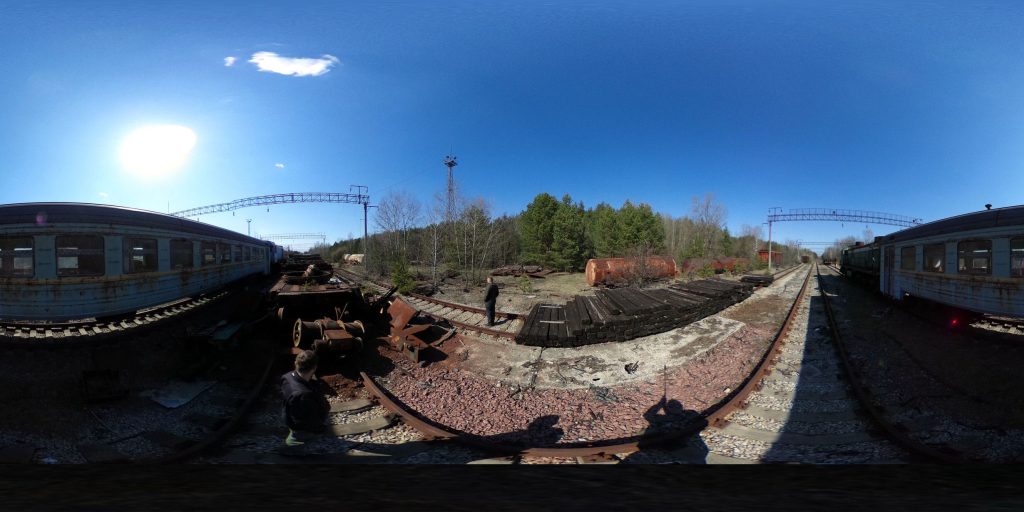
A 360-degree panoramic image captured at the abandoned Yaniv Train Station in Pripyat, Ukraine. Image by: Tomáš Špaček
Welcome to a world of exploration and intrigue at Abandoned in 360, where adventure awaits with our exclusive membership options. Dive into the mysteries of forgotten places with our Gold Membership, offering access to GPS coordinates to thousands of abandoned locations worldwide. For those seeking a deeper immersion, our Platinum Membership goes beyond the map, providing members with exclusive photos and captivating 3D virtual walkthroughs of these remarkable sites. Discover hidden histories and untold stories as we continually expand our map with new locations each month. Embark on your journey today and uncover the secrets of the past like never before. Join us and start exploring with Abandoned in 360.
Do you have 360-degree panoramic images captured in an abandoned location? Send your images to Abandonedin360@gmail.com. If you choose to go out and do some urban exploring in your town, here are some safety tips before you head out on your Urbex adventure. If you want to start shooting 360-degree panoramic images, you might want to look onto one-click 360-degree action cameras.
Click on a state below and explore the top abandoned places for urban exploring in that state.
You might also like