Costa del Croco: The Black Sea ghost resort that never became a resort
Costa del Croco offers urban explorers a rare look inside an abandoned site in Bulgaria, where time, weather, and silence have reshaped the atmosphere. Through the 360-degree panoramic images on Google Maps Street View below, viewers can examine the location from multiple angles and take in the details that make forgotten places so compelling.
This virtual tour gives visitors a closer view of Costa del Croco without disturbing the site itself. From worn surfaces to quiet open spaces, each panoramic scene helps reveal the character of a place left behind, making it a fascinating stop for anyone interested in abandoned locations and digital exploration.
Image by: Virtualstudio
Image by: Nikola Voislav
Image by: Nikola Voislav
If you spend any time looking into places abandoned in Bulgaria, one name keeps surfacing with unusual force: Costa del Croco. Perched beside Popski Beach on the north side of Tsarevo, this unfinished mega-development has become one of the most recognizable failed seaside projects on the Bulgarian Black Sea coast. It was imagined as luxury, sold as a lifestyle, built at great speed during the property boom, and then left behind as a concrete shell when the dream collapsed. Today it is known in Bulgarian reporting as a “ghost city” and a “concrete city,” and for good reason: there are no hotel guests, no apartment owners, no swimmers stepping out from beach villas, and no nightlife where a casino and amphitheater were once promised.
For urban explorers, photographers, and anyone drawn to the uneasy beauty of stalled ambition, Costa del Croco stands out because it is not a tiny forgotten villa or one derelict hotel block. It was conceived as something closer to a self-contained resort town, with a planned capacity of about 2,500 people, spread across 85 decares with roughly 62,000 square meters of built area according to launch-era reporting. The scale is what makes the place hit so hard. This was not a modest project that ran out of steam. It was a statement piece from Bulgaria’s Black Sea boom years, marketed as exclusive, playful, and hugely profitable.
That tension is exactly what gives Costa del Croco its grip on the imagination of the URBEX crowd. The site sits in one of the most scenic corners of southern Bulgaria, only meters from the sea and near a small beach in the northern part of Tsarevo. The contrast is almost cinematic: blue water, green slopes, and then a sprawling unfinished complex whose raw concrete still dominates the landscape. For people interested in urban exploring in Bulgaria, that contrast matters. Costa del Croco is not important only because it is big and empty. It matters because it captures a whole era of overreach, speculation, and coastal transformation in one location.
There is also a crucial factual point that many casual mentions of the site gloss over: Costa del Croco was built, but it never truly opened. That means its operating life, in the normal hospitality sense, was effectively zero years. Construction began in 2007, it was supposed to be finished by 2009, and multiple later reports state that the project was frozen in 2009 after the rough structural stage was completed. So when people ask how long Costa del Croco operated, the honest answer is simple and stark: it did not operate as a functioning resort at all. Its real lifespan was a construction window of roughly two years followed by a much longer afterlife as one of the most famous unfinished coastal projects abandoned in Bulgaria.
That fact shapes everything else about the site: its history, its eerie appeal, and its role in public debate. Costa del Croco is not a story about a thriving resort that later emptied out. It is a story about a place that was sold hard, partially built fast, and then stranded before the first normal season could begin. That makes it one of the clearest examples of how the Black Sea property boom could create not just growth, but long-lasting ruins.
What Costa del Croco was supposed to be
To understand why Costa del Croco still fascinates people, you have to start with the ambition of the original concept. Early coverage from 2007 described a resort complex so large and so feature-rich that local observers compared it to a brand-new town. Officially, the project was presented as a luxury holiday development in Tsarevo’s northern zone, above Popski Beach. The launch reporting described a five-star hotel, 53 residential buildings containing 927 apartments, 30 family houses in the water, a marina for private yachts, a bank, a summer cinema and amphitheater, a casino, 13 swimming pools, three tennis courts, and underground garages. The development was also meant to come with a major infrastructure contribution to Tsarevo itself, reported at more than €2 million.
The planned lifestyle offer went even further. Dnevnik’s 2007 reporting described a wide entertainment and sports program inside the complex, including mini golf, bowling, snooker and billiard tables, electronic games, an internet café, table tennis, sports halls, and a fitness area. There were supposed to be shops and service zones such as dry cleaning, plus family-oriented features including ten playgrounds, a mini aqua park, attractions for children, and a children’s club with caretakers. This is important because it shows Costa del Croco was pitched not merely as beachfront accommodation but as a controlled, self-sufficient leisure environment designed to keep guests, owners, and renters inside the complex ecosystem.
That self-contained vision also extended into the financial marketing. Early reporting said the apartments could be bought with furnishing packages and property-management support, and that the developer even advertised a guaranteed 5 percent rental return for the first two years of letting. Those details place Costa del Croco squarely inside the speculative logic of the mid-2000s coastal property boom: seaside access, luxury amenities, easy ownership, managed returns, and a sense that Black Sea developments could rise indefinitely in value. In that context, Costa del Croco was not an outlier. It was a concentrated expression of a market mood that had become increasingly detached from how hard such projects would be to complete, finance, and sustain.
The numbers attached to the project show how much confidence was being projected at the time. Launch coverage in 2007 put the planned investment at around €60 million, while later reporting referred to promised investment of more than €110 million. Rather than treating those figures as a contradiction, the safest reading is that different outlets were working from different stages of the plan or different definitions of total project cost. What matters more is that, in every version, the scheme was massive by local standards. It was sold as a prestige development that would change the shoreline near Tsarevo and become a new showpiece on the southern Black Sea coast.
Local accounts from later years help fill out the full design fantasy. bTV reported in 2026 that landowners remembered being told the project would include underground streets with parking, electric mobility above ground, a hospital, casinos, pools, and houses extending into the sea. Tsarevo.info likewise summarized the planned program as a five-star hotel, residential and commercial complex, business center, administrative building, hospital, and more, with total build area exceeding 60,000 square meters. That breadth explains why Costa del Croco has lingered in memory for so long. It was not a hotel that failed. It was a miniature urban vision that never crossed the line from speculation into real life.
And that is one of the reasons the place resonates so strongly with people interested in urban exploring in Bulgaria. In many abandoned sites, the original purpose is modest and easy to grasp: a factory, a school, a villa, a station. Costa del Croco is different. Its unfinished forms point to a much larger promise. Every broken curve of concrete suggests pools that never filled, terraces that never hosted breakfast, and apartments that were sold as future assets but never crossed into ordinary use. For URBEX photographers, that sense of suspended intention is part of the site’s power. The architecture is not just empty. It is visibly waiting for a life that never arrived.
When it was built and whether it ever opened
Here is the clean timeline that matters most if your goal is to write accurately about Costa del Croco. The legal and commercial groundwork was already in motion by 2006, when local landowners signed agreements transferring building rights in exchange for promised compensation in finished apartments. bTV’s 2026 reporting includes testimony from landowners who said the superficiary agreement was signed in 2006. That places the project’s true pre-construction phase before the first concrete was poured.
The actual construction start came in 2007. Investor.bg reported on October 22, 2007, that the first groundbreaking had taken place in Tsarevo’s northern zone for the Costa del Croco resort complex. Dnevnik reported in November 2007 that the project was underway and expected to be completed in 2009. Later local and national reporting repeated the same chronology: construction began in 2007 during the peak of the coastal property boom. So if you want the most defensible answer to the question “When was Costa del Croco constructed?” the answer is that construction began in 2007, following earlier land and development arrangements in 2006.
The next key date is 2009, because that was both the planned completion year and the year multiple reports say the project was effectively frozen. Launch-era reporting said the development should be finished by 2009. Later reporting from Tsarevo.info, bTV, and Investor all stated that the project stopped in or around 2009, after the rough structural phase had been completed. bTV’s 2015 report put it plainly: construction stopped two years after the 2007 start. Investor’s 2016 report said the project was frozen in 2009 after the shell stage was finished. Those are unusually consistent markers for a site that has generated years of rumor.
That brings us to the question people often ask in the wrong way: When did Costa del Croco open? Based on the public reporting available, there is no verified evidence that it ever opened to guests or residents as a functioning resort. The 2026 bTV report says there are no residents, no tourists, and no lit windows, and the long chain of earlier reports from 2015 and 2016 describe the site as unfinished, frozen, under seizure, and heading to public sale. The project reached rough construction in many sections, but not normal operation. So the accurate answer is not “it opened in 2009” or “it briefly operated.” The accurate answer is: it was supposed to be completed around 2009, but it never opened in any normal commercial sense.
That means the operating duration of Costa del Croco was zero years as a resort. If you stretch the term “active life” to include the build phase, then the project was actively under construction for about two years, from 2007 to 2009. But if you mean “How long did it operate as a hotel or holiday village?” the answer remains zero. This distinction matters because it changes the whole reading of the site. Costa del Croco is not the decay of hospitality. It is the fossil of speculation.
That also helps explain the strange feel of the place in photographs and drone footage. Many abandoned hotels show traces of use: furniture, signage, reception desks, bars, kitchens, maintenance rooms, small graffiti histories left over years of occupancy. Costa del Croco feels different because the abandonment happened before ordinary daily life could take hold. The site is not full of memories of tourism. It is full of unfinished intention—open structural frames, incomplete interiors, partial fittings, and the geometry of a resort that stayed on the wrong side of completion. That unfinished quality is a large part of why the site became such a touchstone for people interested in places abandoned in Bulgaria.
Why Costa del Croco was abandoned
No serious account of Costa del Croco should reduce its abandonment to one single cause. The project failed because several damaging forces hit at once, and they reinforced each other. The first major factor was the collapse of the holiday-property market around the end of the boom years. Club Z’s 2016 reporting explicitly tied the project’s troubles to the crisis in the vacation-property market after the withdrawal of British buyers, and BTV’s 2015 reporting quoted Tsarevo’s mayor saying that in most such cases the money simply runs out and construction companies cannot continue if no one is paying them. In other words, the economic climate changed sharply just as Costa del Croco needed continuous capital to move from grand shell to viable resort.
The second factor was leverage and debt. By 2016, the site had gone to public sale through a private enforcement agent, with Unicredit Bulbank listed as a creditor and multiple liens recorded, including from public bodies and other claimants. Investor and SeeNews reported that the 2016 sale included over 300 apartments or, more specifically, 294 apartments and 24 storage rooms together with the land. Public sale on that kind of scale does not happen because a project is momentarily paused. It happens because the financial structure has broken down badly enough that creditors are moving against the asset.
The third factor involved the investors themselves. Public reporting over the years consistently identified the main Russian-linked figures associated with the project as Andrey Panpurin and Konstantin Tsiganov. Multiple outlets reported that both men were expelled from Bulgaria in 2010 by order of the State Agency for National Security, framed as a threat to national security. Investor, Mediapool, bTV, and Dnevnik-linked reporting all place that event near the center of the project’s trajectory. Even without leaning into the more sensational language used by some outlets, this was clearly not the sort of ownership crisis a major coastal development could easily survive. A project already exposed to market stress and debt was now also entangled in severe legal and security controversy around its principals.
The fourth factor was insolvency and legal paralysis. bTV reported that one of the related companies was declared insolvent in early 2015, that seizure was imposed on Costa del Croco, and that the company remains in liquidation. In the same 2026 report, local officials described a scenario in which no clear, responsive owner remained in practical terms, leaving the municipality trapped: unable to demolish the site, unable to compel proper securing of the entire property, and exposed to the risk of accidents. That kind of limbo is deadly for large developments. Once a project falls into liquidation, litigation, fragmented claims, and inactive ownership, even basic decisions become difficult, much less completion or removal.
So why was Costa del Croco abandoned? The best concise answer is this: it was hit by the post-boom market crash, burdened by financing and debt problems, destabilized by the expulsion and legal troubles of its leading investors, and then trapped in insolvency and enforcement proceedings that left it unfinished and effectively ownerless in practical terms. Each of those problems appears in the reporting, and together they explain why the place stalled permanently instead of resuming after a short pause.
There is another layer here that matters if you want to write about the site with real weight rather than just mystery. Costa del Croco was not abandoned only in a legal sense. It was abandoned socially. Landowners had transferred rights in exchange for promised apartments. bTV reported one family alone expected 40 apartments as compensation for their land. Those apartments never arrived, and the owners were left staring at concrete ruins on terrain they could no longer freely use. That is one reason the site became more than a local eyesore. It became a symbol of broken trust in the coastal boom.
Even after the freeze, the site did not become stable. Reports from 2023 documented theft from the unfinished complex, including the attempted removal of PVC windows. That matters for two reasons. First, it shows how long-term abandonment turns large projects into scavenging zones. Second, it shows that Costa del Croco is not a sealed relic frozen outside time. It is an active liability, subject to deterioration, stripping, safety concerns, and occasional police attention. Abandonment here is not romantic stasis. It is a slow erosion of structure, value, and accountability.
Why Costa del Croco matters in the history of coastal Bulgaria
Costa del Croco matters because it condenses a whole historical period into one visual shock. In the 2000s, Bulgaria’s Black Sea coast saw intense development pressure, especially around holiday apartments and private resort complexes aimed at foreign buyers and investment-driven second-home demand. Costa del Croco rose in 2007 at the height of that confidence, with extraordinary promises, money talk, and luxury branding. Its failure therefore marks more than one project gone wrong. It marks the point where the speculative fever of the coast turned visible in concrete.
That is why later media kept returning to it as a symbol. Investor described millions of leva buried in the abandoned complex. bTV and other Bulgarian outlets referred to it as a ghost city or concrete city. Mediapool used Costa del Croco as an example inside a broader discussion of “ghost complexes” and the legal difficulty of dealing with abandoned private developments. When one place becomes shorthand for an entire problem—unfinished megaprojects, blocked ownership, damaged landscapes, stranded local interests—you know it has crossed from local curiosity into national significance.
For Tsarevo itself, the symbolism is especially sharp. Popski Beach is small and scenic, sitting in the northern part of town, roughly a kilometer from the center and about a kilometer and a half south of Arapya. The area once included holiday camps from the socialist period, and the shoreline today still carries layers of old and new coastal tourism history. Costa del Croco interrupts that setting with a huge unfinished presence. It is not tucked away in an industrial fringe. It is right beside a place people actually visit for sea, rock, and summer light. That proximity makes the ruin feel less like distant failure and more like a permanent argument with the landscape.
There is also a wider cultural afterlife. Costa del Croco has appeared in international abandoned-place television coverage, including an episode of Mysteries of the Abandoned titled “Russian Mafia Resort,” which identifies the Bulgaria segment as Costa del Croco in Tsarevo. Whether people first hear of the place through Bulgarian reporting, drone photographers, social media, or television documentaries, the pattern is the same: the site keeps re-entering public consciousness because it looks too big, too exposed, and too improbable to forget.
This is where Costa del Croco becomes especially relevant for a website aimed at urban explorers. Some locations are visually impressive but historically thin. Others are historically rich but visually flat. Costa del Croco gives you both. It has the scale and shapes photographers love, but it also has a deep backstory rooted in land deals, boom-era optimism, financial collapse, national-security drama, public sale notices, insolvency, and local frustration. That combination is why it sits near the top of so many conversations about places abandoned in Bulgaria. It is not just photogenic failure. It is layered failure.
You can also read Costa del Croco as a warning about the cost of unfinished private ambition on public landscapes. Once such projects stall, municipalities often have little room to act, especially when ownership is fragmented, companies are in liquidation, or court and enforcement procedures drag on for years. bTV’s 2026 report captured that bind directly: the town could not simply tear the place down, officials lacked clear ways to force full remediation, and there were worries about what would happen if someone were injured on site. That is why Costa del Croco belongs not only in travel and URBEX discussions, but also in conversations about regulation, planning, and the long tail of speculative building.
Costa del Croco through the lens of URBEX and urban exploring in Bulgaria
For people drawn to URBEX, Costa del Croco checks nearly every visual box. The unfinished blocks create unusual curves rather than plain rectangular slabs. The complex spreads across the coastal slope in a way that looks almost organic from above, which is one reason drone footage and aerial photography of the site circulate so widely. Over time, vegetation has crept back around the structures, softening the concrete without hiding it. That collision between planned luxury and natural reclamation is exactly the kind of contrast urban explorers tend to remember long after the visit is over.
What makes Costa del Croco especially compelling for urban exploring in Bulgaria is its refusal to fit the expected categories. It is not a Soviet relic in the usual sense, even though it sits in a post-socialist landscape. It is not an industrial ruin. It is not a decayed grand hotel that had a golden age. Instead, it belongs to a newer class of abandoned spaces: developments born from private capital, speculative resale logic, and the fantasy that a coastline can be remade fast enough to outrun risk. That gives the site a very modern sadness. It is a monument to recent ambition, not distant history.
There is also something useful in the way Costa del Croco teaches scale. On paper, the amenity list already sounded excessive. On site, the scale of the unfinished mass makes the original promise feel even larger. You realize this was never supposed to be a quiet seaside retreat. It was supposed to be a magnet, a branded destination, a self-contained luxury zone. Seeing that scale half-built and then abandoned helps explain why the place has become one of the defining images of property excess on the Bulgarian coast. For photographers and writers alike, the site offers a rare chance to show how grand development language can harden into ruin.
That said, the most responsible way to talk about Costa del Croco to an explorer audience is not to glamorize trespass. Public reporting has shown that site conditions are unstable and have varied over time. bTV reported in 2015 that warning signs and fencing were present around the complex, while its 2026 reporting said access from one side was effectively open and that barriers were insufficient in places. There have also been police incidents on site, including a 2023 case involving attempted theft of windows from the unfinished buildings. So if Costa del Croco speaks to the adventurous side of URBEX, it should also speak to the disciplined side: verify local conditions, respect property law, avoid unsafe entry, and remember that unfinished structures near the coast can deteriorate in ways that are not obvious from a distance.
In that sense, Costa del Croco can be appreciated even without stepping inside. The historical story is strong enough on its own. The coastal setting is visible from public approaches around Tsarevo. The nearby beach and surrounding landscape already frame the contradiction at the heart of the site. And for writers, researchers, and photographers working on the broader subject of places abandoned in Bulgaria, Costa del Croco offers a case study in how a ruin can become a living public issue long after construction stops. It is a location that invites curiosity, but it also asks for thought.
This is also why the complex has such strong storytelling value online. Keywords like Costa del Croco, abandoned in Bulgaria, urban exploring in Bulgaria, and URBEX fit naturally around the site because Costa del Croco is not famous only among locals. It sits at the point where travel curiosity, architectural failure, social history, and exploration culture meet. Whether someone arrives through a search for Bulgaria’s strangest abandoned places or through interest in Black Sea history, the site answers a bigger question than “What is this?” It answers “How does a dream this large end up empty?”
The truth about Costa del Croco and why it still lingers
So let’s bring the facts together clearly. Costa del Croco was constructed starting in 2007, after pre-construction land arrangements in 2006. It was planned to be finished by 2009. Public reporting from several later years states that the project was frozen in 2009, after reaching rough structural completion in many sections. Despite its scale and the luxury language around it, there is no verified public record that it ever opened as a functioning resort, which means its operating duration was zero years in practical hospitality terms. The activities associated with Costa del Croco were therefore mostly planned activities, not real operating ones: pools, tennis, mini golf, bowling, children’s areas, a casino, a marina, waterfront homes, shops, a summer cinema, an amphitheater, and more.
It was abandoned because a wave of problems hit together: the post-boom crash in the vacation-property market, financing trouble and debt, creditor action, the expulsion of the principal Russian-linked investors on national-security grounds, insolvency in related companies, and a long legal afterlife of seizures, auctions, and liquidation. That stack of failures turned what was supposed to be a luxury symbol into one of Bulgaria’s best-known ghost complexes.
Its historical significance reaches beyond architecture. Costa del Croco is a marker of the Black Sea real-estate boom and bust, a case study in how local landowners can be injured by unfinished promises, and a public example of how hard it can be for towns to deal with stalled private megaprojects. It has become a shorthand for speculative excess on the coast, a recurring media subject, and a magnet for photographers and explorers precisely because the site is both visually dramatic and historically loaded.
That is why Costa del Croco deserves more than the usual one-line label of “abandoned resort.” It is one of the strongest stories abandoned in Bulgaria can offer: part real-estate fever dream, part legal puzzle, part coastal scar, and part URBEX landmark. For those interested in urban exploring in Bulgaria, it stands as a reminder that the country’s most powerful ruins are not always the oldest ones. Sometimes the ruins that stay with you are the recent, overconfident, half-finished places that still look as if they are waiting for a future that was carefully sold and never delivered.
And that, ultimately, is the lasting force of Costa del Croco. It did not become the pearl of the southern Black Sea. It became something stranger and, in its own way, more unforgettable: a modern ghost city by the sea, built during the loudest years of optimism, left behind before its first true season, and still standing as one of the most haunting failed developments on Bulgaria’s coast.
If you liked this blog post, you might be interested in learning about the abandoned Bali Festival Park in Indonesia, the Noah “Bud” Ogle Cabin in Tennessee, or the amazing Coalwood High School in West Virginia.
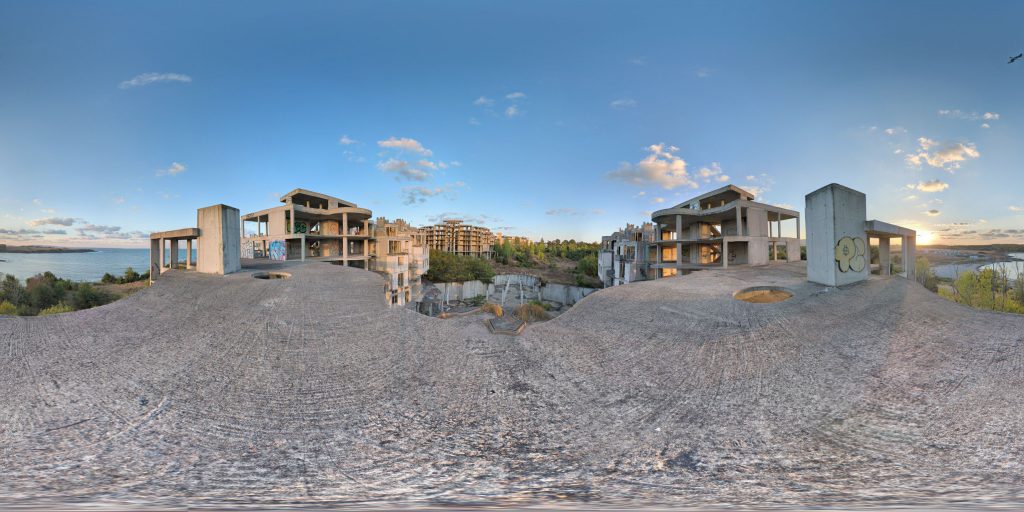
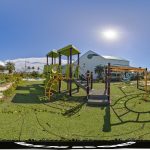
A 360-degree panoramic image captured at the abandoned Costa del Croco in Tsarevo, Bulgaria. Image by: Nikola Voislav
Welcome to a world of exploration and intrigue at Abandoned in 360, where adventure awaits with our exclusive membership options. Dive into the mysteries of forgotten places with our Gold Membership, offering access to GPS coordinates to thousands of abandoned locations worldwide. For those seeking a deeper immersion, our Platinum Membership goes beyond the map, providing members with exclusive photos and captivating 3D virtual walkthroughs of these remarkable sites. Discover hidden histories and untold stories as we continually expand our map with new locations each month. Embark on your journey today and uncover the secrets of the past like never before. Join us and start exploring with Abandoned in 360.
Do you have 360-degree panoramic images captured in an abandoned location? Send your images to Abandonedin360@gmail.com. If you choose to go out and do some urban exploring in your town, here are some safety tips before you head out on your Urbex adventure. If you want to start shooting 360-degree panoramic images, you might want to look onto one-click 360-degree action cameras.
Click on a state below and explore the top abandoned places for urban exploring in that state.
You might also like





Comment
[…] you liked this abandoned location, you might be interested in learning about the Costa del Croco hotel in Bulgaria, the Bali Festival Park in Indonesia, or the Denbigh Asylum in North […]