Alvarez House: Inside a Forgotten Home Abandoned in Florida
Step inside the abandoned Alvarez House in Florida through a fully immersive 360-degree virtual tour. Once a private residence, the property now offers a fascinating look at the effects of time, neglect, and abandonment, giving urban explorers the opportunity to experience the location from nearly every angle.
Explore the Alvarez House using the panoramic images in the virtual tour below and move through the property as if you were standing inside it yourself. The 360-degree views reveal the remaining architectural details, empty rooms, and deteriorating spaces that make abandoned places like this so compelling to document and explore.
Click here to view it in fullscreen.
The Alvarez House is the kind of abandoned place that proves a building does not need to be enormous, famous, or historically celebrated to capture the imagination. Built in 1977, this forgotten Florida residence contains three bedrooms, two bathrooms, and approximately 1,440 square feet of living space on half an acre of land. Once designed for ordinary residential life, the house now exists in a very different condition, shaped by vacancy, age, and the gradual effects of time. For anyone fascinated by urban exploring in Florida, abandoned houses can be some of the most interesting places to document because they are so familiar. Unlike hospitals, factories, prisons, or sprawling resorts, a house is something almost everyone immediately understands. We recognize the purpose of the rooms, the scale of the architecture, and the way the spaces were intended to function. When those familiar surroundings are abandoned, however, they take on an entirely different atmosphere.
The Alvarez House offers exactly that experience. It is not extraordinary because of its size or architectural grandeur. It is compelling because it was once completely ordinary. A home that was created for everyday routines has become a place defined by silence, weathering, and the visible passage of time. That transition from normal residential life to abandonment is what makes the property such an interesting subject for photography and documentation.
A Florida Home Dating Back to 1977
The Alvarez House was constructed in 1977, placing its beginnings nearly half a century in the past. While that may seem relatively recent compared with nineteenth-century mansions or century-old industrial ruins, nearly five decades is more than enough time for a residential property to experience dramatic changes. When the home was first built, there would have been nothing mysterious about it. It was simply another residence intended to provide shelter, privacy, comfort, and the everyday spaces people expect from a home.
Over the decades, the world around the house changed considerably. Technology advanced, Florida continued developing, architectural trends shifted, and communities evolved. Eventually, the Alvarez House entered another stage in its history. Instead of functioning as a residence, it became part of Florida’s abandoned landscape. That transition is one of the most interesting elements of URBEX in Florida. Buildings are usually designed with the expectation that they will continue serving the same basic purpose for many years, but time does not always follow those intentions. Once a building becomes abandoned, its original purpose begins to fade while the physical structure remains behind.
Why Abandoned Homes Feel Different
Residential abandonment creates a very different experience from exploring a large commercial or institutional structure. A factory might feel industrial and unfamiliar, while a hospital may contain specialized rooms and long corridors that most people rarely encounter. A house is different because it is immediately recognizable. We know what a bedroom is supposed to feel like, understand the purpose of a bathroom or hallway, and instinctively recognize the rhythm of a residential floor plan.
That familiarity makes abandonment more noticeable. An empty bedroom is still recognizable as a bedroom, but the activity that once gave the room meaning is gone. A hallway still connects different parts of the house, yet nobody is walking through it as part of a daily routine. Windows still allow daylight into the building, but the rooms beyond them are no longer being used as intended. For photographers interested in urban exploring in Florida, this contrast between familiar architecture and absence can be far more compelling than grand scale. The visual appeal is often found in subtle details such as natural light entering an empty room, worn surfaces, aging construction materials, changing textures, and the relationship between the interior and the surrounding environment.
What Happened to the Alvarez House?
The most obvious question surrounding the Alvarez House is also the one that cannot currently be answered with certainty: why was it abandoned? There is no verified information being presented here that establishes a specific reason the home became vacant. Rather than assign a dramatic story to the property without evidence, it is better to leave that part of its history unresolved.
Abandoned buildings frequently accumulate rumors. Someone makes an assumption, another person repeats it, and eventually a story that was never documented begins circulating as fact. This happens particularly often with abandoned houses because empty residential spaces naturally create questions about the people who once occupied them. There are many possible reasons why any house might become vacant, but possibility is not evidence. Financial circumstances, structural problems, legal issues, family changes, natural events, redevelopment, or simple disuse can all lead to abandonment. Without reliable documentation connecting one of those explanations to the Alvarez House, none should be presented as fact. The mystery does not weaken the story. In some ways, it makes the house more interesting.
When the Building Becomes the Historical Record
When written records provide only limited information, the building itself becomes an important historical artifact. Walls show age, construction materials reveal their era, and windows, doors, fixtures, and interior spaces can provide clues about how the house was originally designed and how it has changed over time. Damage can reveal where the structure has been most vulnerable, while better-preserved areas may retain details that could eventually disappear.
This is where abandoned-place photography becomes more than simply taking interesting pictures. Photography creates documentation. An image records the condition of a room at a particular moment, while a series of photographs can preserve the visual character of an entire property. Years later, those images may become even more valuable if the structure changes significantly or disappears. For the Alvarez House, that documentary aspect is an important part of its appeal.
The Quiet Side of URBEX in Florida
When people think about URBEX in Florida, they often imagine large abandoned resorts, forgotten roadside attractions, shuttered hotels, empty schools, deteriorating medical facilities, or old industrial buildings. Those places can be impressive, but they represent only one part of the abandoned landscape. There is also a quieter side of urban exploration made up of ordinary homes and smaller structures that once blended completely into everyday life.
These places rarely have famous names or extensive histories. They may never have appeared in newspapers, attracted tourists, or received any kind of historical designation. While occupied, most people probably would not have given them much thought. Abandonment changes that perception. A house that once looked ordinary can become visually striking because it is no longer functioning the way we expect a house to function. Empty spaces become more noticeable, architectural details stand out, and nature begins interacting with the structure in new ways. The Alvarez House represents this quieter form of exploration.
Florida’s Environment and Abandoned Buildings
Florida can be particularly hard on unused buildings. Heat, humidity, rainfall, vegetation, storms, and moisture all place constant pressure on residential structures. When a home is occupied and maintained, small problems can be identified and repaired. Roofs are inspected, leaks are addressed, vegetation is managed, and exterior surfaces receive attention. When maintenance stops, those same environmental forces continue working.
Moisture can enter through weak points, vegetation can grow increasingly close to a building, and storms can expose vulnerabilities that might otherwise have been repaired quickly. Heat and humidity can affect materials in ways that become increasingly visible over time. This is one reason locations abandoned in Florida often develop such distinctive visual characteristics. The relationship between architecture and nature becomes increasingly important as plants begin occupying spaces once controlled by people, sunlight enters through openings in different ways, and exterior areas become less defined. Human order gradually gives way to natural processes, and that transformation is one of the recurring themes of Florida urban exploration.
An Ordinary Home Becomes Extraordinary
One of the most fascinating things about abandoned photography is the way time can completely change our perception of ordinary architecture. When the Alvarez House was new, nobody would have considered an empty doorway, hallway, or window especially interesting. These were simply functional parts of a residence. Abandonment changes the way those same features are viewed.
A doorway can become a natural frame for a photograph, while a hallway creates depth and perspective. Weathered surfaces reveal layers of age, and light becomes more dramatic because there are fewer furnishings or activities competing for attention. Even small imperfections begin telling a visual story. Urban explorers learn to notice those details because abandoned buildings often reward careful observation. The most interesting photograph is not always the largest room or most dramatic feature. Sometimes it is the way light falls across an aging wall or how vegetation can be seen through an opening. The Alvarez House is the kind of location where those subtle elements matter.
Exploring Abandoned Spaces Through 360-Degree Photography
Traditional photography allows the photographer to choose exactly what the viewer sees. Composition directs attention toward a specific subject, angle, or detail. A 360-degree photograph offers a different experience because it allows the viewer to look around the entire environment instead of seeing only one selected perspective.
For abandoned properties, this approach can provide valuable context. A conventional photograph might beautifully document a single wall or doorway, while a panoramic image preserves the relationship between everything around it. The viewer can turn toward another room, look at the ceiling, examine the floor, or see how different spaces connect. That makes 360-degree photography particularly useful for residential properties, where understanding the scale and arrangement of the interior can be an important part of experiencing the location. For people interested in urban exploring in Florida, virtual exploration also provides a way to experience abandoned places without requiring everyone to physically visit them.
Why the Exact Location Remains Private
The exact location of the Alvarez House is intentionally withheld. No address, coordinates, nearby landmarks, directions, ownership details, or other identifying information are included in this article. The purpose is to document the property, not to create a guide that helps people find it.
This is particularly important with abandoned residential buildings. An abandoned appearance does not mean a property has no owner, and it does not automatically mean the public has permission to enter. Publishing exact locations can also dramatically change an abandoned site. A relatively unknown structure might remain undisturbed for years, but once coordinates begin circulating online, increased attention can lead to vandalism, theft, graffiti, broken windows, forced entry, and other forms of damage. Sometimes the people who claim to love abandoned places unintentionally help destroy them by making sensitive locations too easy to find. For anyone serious about URBEX in Florida, protecting vulnerable locations should be part of preserving them.
Abandoned Does Not Mean Public
Urban exploration carries responsibilities. A deteriorated building may look forgotten, but that does not mean it is available for unrestricted access. Property rights continue to exist even when a structure appears unused. Responsible exploration should focus on documentation rather than destruction.
Doors should not be forced, windows should not be broken, objects should not be removed as souvenirs, and graffiti should not be added simply to prove someone visited. Nothing needs to be rearranged to create a more dramatic photograph. The strongest abandoned photography records what is already there. Once people begin changing a location, the photographs stop documenting the original environment and begin documenting the changes created by visitors.
Leave the Scene as You Found It
One of the best principles for anyone involved in urban exploring in Florida is simple: leave the location as you found it. Abandoned buildings already exist in a state of constant change. Weather, age, moisture, vegetation, and structural deterioration are continually altering them, so there is no need for photographers or explorers to accelerate that process.
Moving objects may seem harmless, but it changes the authenticity of the scene. Removing something permanently erases a detail, while breaking an entrance alters the building itself. Graffiti replaces natural deterioration with deliberate damage. Photography should preserve a moment rather than manufacture one, and the Alvarez House is most valuable as documentation when the imagery reflects the building’s actual condition.
The Beauty and Loss Found in Decay
Abandoned buildings can be visually beautiful, but that beauty comes with an important contradiction. Decay can produce fascinating textures, unusual colors, dramatic lighting, and unexpected interactions between architecture and nature. Photographers are naturally drawn to those elements because they create scenes that would never exist inside a perfectly maintained building.
At the same time, deterioration represents loss. Materials are failing, original features are disappearing, and parts of the building may eventually become unsafe or impossible to preserve. What looks visually interesting today may be evidence of a structure moving closer to permanent destruction. Good abandoned photography can acknowledge both ideas at once. There can be beauty in decay without celebrating damage, and the Alvarez House occupies that complicated space.
Abandoned Places Are Temporary
One of the most important things to understand about abandoned buildings is that they are temporary. A structure may stand for decades, but its abandoned condition is constantly evolving. A room photographed today could look completely different next year. A roof could fail, vegetation could expand, someone could repair the house, or the structure could eventually disappear.
Nothing about an abandoned site is guaranteed to remain unchanged, which is why photographers often feel a sense of urgency when documenting forgotten locations. Every visit captures one point on a longer timeline. The building existed before the photograph and will continue changing afterward, while the image becomes a permanent record of a temporary condition. For places abandoned in Florida, where weather and development can create rapid changes, that documentation can become especially important.
Urban Exploration as Visual Preservation
Urban exploration is often described as adventure, but photography adds another dimension: preservation. Many abandoned buildings will never receive official historical recognition. They may not qualify as landmarks, appear in museums, or be studied by architectural historians. When they disappear, there may be very little documentation left behind.
Photographs can change that by preserving information about the design, condition, materials, and atmosphere of a building even if the physical structure is later lost. 360-degree imagery expands that record by preserving spatial relationships that are difficult to capture through conventional photography alone. The Alvarez House may represent only one forgotten home among countless places abandoned in Florida, but documenting it still creates a record that would otherwise not exist.
Not Every Abandoned Place Needs a Legend
There is a tendency in urban exploration culture to make abandoned places sound more dramatic than they really are. A damaged room becomes the setting for a mysterious event, an object left behind is described as proof that residents departed suddenly, and a rumor becomes a ghost story. After enough repetition, speculation begins appearing alongside legitimate historical information.
The Alvarez House does not need an invented legend. Its real appeal comes from the contrast between what it was designed to be and what it has become. A normal Florida residence constructed decades ago is now sitting unused, offering a glimpse into the slow transformation of residential architecture after everyday life disappears. That reality is interesting enough.
The Importance of Accurate Abandoned History
Accuracy matters when writing about abandoned places because today’s blog posts, photographs, and videos may become tomorrow’s historical references. Once incorrect information appears online, it can be surprisingly difficult to remove. Other websites repeat it, social media accounts copy it, and eventually people assume the claim must be true because they have seen it in multiple places.
Responsible documentation means being comfortable saying that something is unknown. The exact reason for the Alvarez House’s abandonment is not established here. No dramatic event is being assigned to the property without evidence, and no claim is being made that the house has a specific historic designation. What is known can be documented, and what is not known should not be invented. That approach keeps the Alvarez House grounded in fact while still allowing the photographs and architecture to provide a compelling experience.
Why Ordinary Abandoned Places Matter
The Alvarez House may never become famous, but that does not make it unimportant as a photographic subject. History is not made only by monumental buildings. Ordinary houses, shops, schools, restaurants, and workplaces form the majority of the built environment around us. They shape communities for decades and then sometimes disappear without much documentation.
Most were never expected to become historically interesting, which is precisely why recording them can matter. The Alvarez House represents a familiar type of residential architecture that has entered an unfamiliar condition. It demonstrates how an ordinary place can become visually and historically interesting simply through survival and change. For people interested in urban exploring in Florida, these quieter locations help tell a broader story about the state’s changing landscape.
What the Alvarez House Represents
The Alvarez House is more than an abandoned building because it represents transition. It began as new construction, became an established residence, aged over decades, and eventually reached the abandoned condition documented today. That sequence has occurred countless times across Florida and throughout the country, yet each building experiences it differently.
Some properties are renovated and returned to use, while others deteriorate beyond repair. Some are demolished quickly, and others survive for years. Photography allows one stage in that process to be preserved, and that is ultimately what makes the Alvarez House worth documenting.
Frequently Asked Questions About the Alvarez House
What is the Alvarez House?
The Alvarez House is the name used for an abandoned residential property in Florida documented through photography and urban exploration.
When was the Alvarez House built?
The house was constructed in 1977.
How large is the Alvarez House?
The residence contains approximately 1,440 square feet of living space.
How many bedrooms and bathrooms are in the Alvarez House?
The home has three bedrooms and two bathrooms.
How much land is associated with the property?
The property encompasses approximately 0.50 acres.
Why was the Alvarez House abandoned?
A verified reason for the abandonment has not been established in the information being presented here, so no specific explanation is being claimed.
Where is the Alvarez House?
The property is abandoned in Florida, but its exact location is intentionally withheld. No address, coordinates, directions, landmarks, or other identifying details are published.
Can people visit the Alvarez House?
This article is intended for photographic and historical documentation. An abandoned appearance does not mean a property is public or that permission to enter is unnecessary.
Final Thoughts on the Alvarez House
The Alvarez House is a reminder that some of the most interesting abandoned locations are not the largest or most famous. Sometimes they are ordinary places that survived long enough to become something completely different from what their builders intended. What was once simply a Florida home now exists as part of the state’s abandoned landscape, and its empty spaces, aging materials, changing light, and interaction with the surrounding environment provide a glimpse into what happens when everyday residential life disappears and time begins reshaping the structure.
For anyone interested in places abandoned in Florida, the Alvarez House represents the quieter side of exploration. It does not rely on grand architecture or an elaborate legend. Its appeal comes from familiarity, mystery, and the visible passage of time. For those passionate about urban exploring in Florida, locations like this demonstrate why abandoned residential properties deserve to be documented alongside larger hospitals, factories, hotels, and institutions. They preserve another part of the state’s built history: the ordinary structures that once blended into daily life but now stand apart from it.
For followers of URBEX in Florida, the Alvarez House is also a reminder that abandoned photography is about more than discovering ruins. It is about observing change, documenting what remains, protecting vulnerable locations, and preserving a visual record before another forgotten building enters its next chapter. The exact location of the Alvarez House will remain private because the goal is not to send people searching for it, but to preserve its story through photography and allow others to experience a forgotten piece of Florida from a distance.
Sometimes the most compelling abandoned places are not the ones with the biggest stories. They are the ones that leave us wondering.
If you liked this blog post, you might be interested in the Coralia Hotel in Tunisia, the West Palm Jai Alai in South Florida or the Cisco Zoo in Texas.
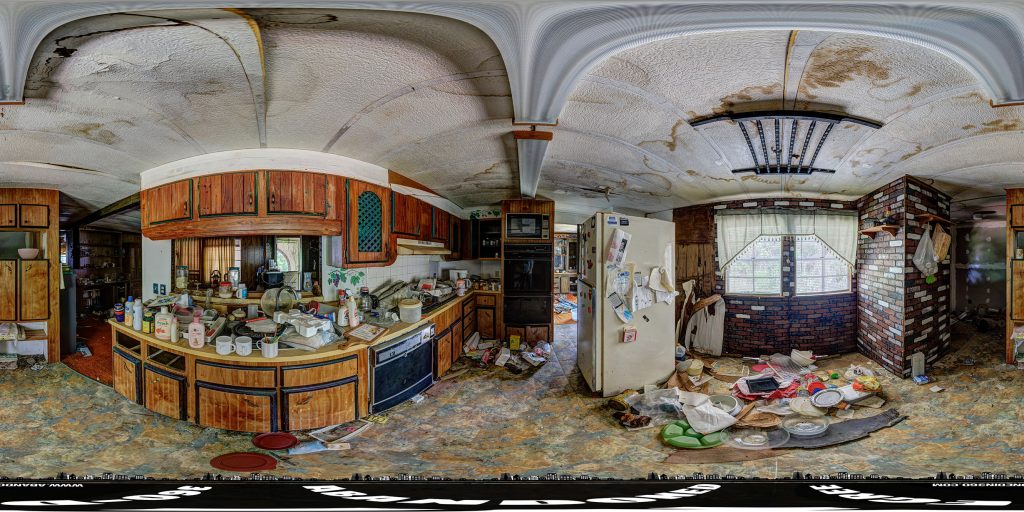
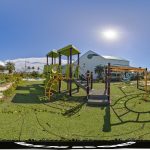
A 360-degree panoramic image captured inside the kitchen area of the “Alvarez House” in Florida. Photo by the Abandoned in 360 URBEX team.
Welcome to a world of exploration and intrigue at Abandoned in 360, where adventure awaits with our exclusive membership options. Dive into the mysteries of forgotten places with our Gold Membership, offering access to GPS coordinates to thousands of abandoned locations worldwide. For those seeking a deeper immersion, our Platinum Membership goes beyond the map, providing members with exclusive photos and captivating 3D virtual walkthroughs of these remarkable sites. Discover hidden histories and untold stories as we continually expand our map with new locations each month. Embark on your journey today and uncover the secrets of the past like never before. Join us and start exploring with Abandoned in 360.
Equipment used to capture the 360-degree panoramic images:
- Canon DSLR camera
- Canon 8-15mm fisheye
- Manfrotto tripod
- Custom rotating tripod head
Do you have 360-degree panoramic images captured in an abandoned location? Send your images to Abandonedin360@gmail.com. If you choose to go out and do some urban exploring in your town, here are some safety tips before you head out on your Urbex adventure. If you want to start shooting 360-degree panoramic images, you might want to look onto one-click 360-degree action cameras.
Click on a state below and explore the top abandoned places for urban exploring in that state.
You might also like





Leave a reply