Coralia Hotel: Inside the Ghost Resort That Time Forgot
The Coralia Hotel in Tunisia stands as a fascinating abandoned destination, offering a glimpse into a once-active resort now left to the passage of time. Through the 360-degree panoramic images below, you can explore the property virtually using Google Maps Street View and examine the architecture, empty spaces, and details that remain throughout the site.
Beyond the abandoned rooms and weathered structures, the Coralia Hotel has a history that adds context to what visitors see today. Explore the immersive 360-degree views while learning more about the hotel’s past, its years of operation, and the circumstances that eventually left this former Tunisian resort abandoned.
Image by: Dima Shirokov
Image by: Dima Shirokov
A shoreline that looks peaceful—until you notice what’s missing
Djerba has a way of disarming you. The air carries salt and sun-warmed sand. The light is bright but soft at the edges. Palm fronds move like slow waves. It feels like a place designed for rest—because for decades, that’s exactly what it was marketed to be.
And then you spot it: a faded mass of white geometry beyond the beach line. Domes. Curves. Long corridors that once funneled tourists toward bars, music, and sea views. The shape is unmistakably hospitality architecture from another era—built to impress, built to host, built to be photographed long before anyone called it “content.”
This is the abandoned Coralia Hotel—a name that, depending on who you ask, is also tied to earlier identities, especially Hotel Tanit, and later “club” branding that carried it into its final operating years. It’s one of those places where the official story is fragmented: pieces live in old travel memories, scattered documents, local recollections, and a handful of published references that confirm dates and details.
For urban explorers, that fragmentation is part of the pull. Not because mystery is better than truth—but because truth, in abandoned places, often arrives in layers. The Coralia Hotel is not just a ruined resort. It’s a lens on how tourism boomed, aged, and sometimes collapsed under economics, reinvention cycles, and neglect.
If your audience is searching for abandoned in Tunisia, urban exploring in Tunisia, or URBEX locations that feel cinematic but historically grounded, Coralia Hotel belongs on the list—handled with respect, caution, and an honest accounting of what we can verify.
Coralia Hotel at a glance (what’s known, what’s disputed, what’s consistent)
Before we go deep, it helps to separate three categories: (1) details that show up consistently across sources, (2) details that appear but conflict, and (3) details that are likely true but hard to prove cleanly without direct archival access.
Consistent threads
-
The property is widely referenced under the name Hotel Tanit in earlier decades and later associated with Coralia branding.
-
It operated as a seaside resort with classic amenities: reception areas, bars, dining spaces, and nightlife-oriented rooms (often described as a disco or entertainment hall).
-
It was closed by the early 2000s in many accounts, and later deterioration accelerated through abandonment and vandalism.
-
It is now widely treated as an “abandoned resort” site on Djerba and appears in modern discussions of Tunisia’s “ghost hotels.”
The key dispute: when it truly opened
You will see two opening narratives:
-
A frequently repeated claim that it opened in 1964 under the Tanit name, sometimes paired with room counts and mentions of prominent visitors.
-
A separate set of accounts describing it as opening in the early 1970s (or “in the 70s”), which may reflect a relaunch, expansion, reclassification, or simply the period when it became broadly known to international package tourism.
Rather than pretending there’s only one answer, this article will handle the discrepancy directly: the site was clearly active by the late 1960s, and the best-supported “early opening” claim points to the mid-1960s, while some visitors and on-site storytellers emphasize the early 1970s as the start of its recognizable resort era.
The hotel’s roots: why Djerba needed resorts like this in the first place
To understand Coralia Hotel, you have to understand why Djerba became a magnet for resort development.
Djerba is Tunisia’s island showcase: beaches, warm water, distinctive architecture, and an identity shaped by layers of Mediterranean history. By the 1960s, Tunisia’s tourism strategy increasingly treated coastal and island destinations as economic engines—places that could convert sun-and-sea appeal into jobs, foreign currency, and international visibility.
A resort like this wasn’t built for subtlety. It was built to communicate arrival. You weren’t just staying overnight—you were stepping into a designed experience: sea-facing views, a “club” rhythm of meals and activities, and a social calendar that moved from beach to dinner to music. When this model worked, it worked loudly. When it aged, it aged just as visibly.
Coralia Hotel’s early significance comes from its positioning as an early-era resort on the island—often described as one of Djerba’s first major hotels, the type that helped define what “a Djerba holiday” looked like for decades.
Construction and opening: what we can state with confidence
The year it was constructed and opened
-
The most frequently repeated early-opening claim states that the property opened in 1964, originally as Hotel Tanit, and later became associated with Coralia branding.
-
Independent cultural and media references place a Hotel Tanit on Djerba as an active, glamorous venue by 1967, which strongly supports the idea that construction and opening occurred no later than the mid-to-late 1960s.
Because resort construction typically precedes opening by months to years, the cleanest factual framing is this:
Coralia Hotel (originally referenced as Hotel Tanit in many accounts) was constructed and operational by the mid-1960s, with some sources citing an opening in 1964, and evidence of the hotel in active use by 1967.
That statement reflects what the public record and published references can support without inventing a “perfect” date.
The operating period: from early prestige to late-stage reinvention
Early era: prestige and nightlife (mid-to-late 1960s)
One of the most vivid period snapshots doesn’t come from a tourism brochure. It comes from a 1967 media account describing Djerba and referencing an evening rendezvous at the “glamorous, white-domed Hotel Tanit,” complete with live music and late-night atmosphere.
That detail matters. It tells you what the hotel was selling: not just beds, but nightlife. Not just a beach, but a scene.
And it also hints at design: “white-domed” is not a throwaway description. It’s a visual identity—one that matches what many explorers still describe today when they see the remaining structures.
Growth and normalization: the package tourism decades (1970s–1990s)
Whether you treat the early 1970s as the beginning of the hotel’s most recognizable “resort phase” or simply its expansion era, the broader pattern is consistent with the region:
-
Resorts become operational systems: arrivals, meal cycles, activity schedules, entertainment nights.
-
The guest experience standardizes: buffet dining, bars, pool time, beach loungers, music, dance floors.
-
The property becomes memory infrastructure: honeymoons, family trips, repeat guests, seasonal staff rhythms.
This is the era when many people’s emotional relationship with the hotel was built. And it’s why abandonment feels personal: former guests don’t just remember a building—they remember a version of themselves inside it.
Late stage: renaming, rebranding, and the last operating identity (1990s–early 2000s)
Several accounts emphasize that the hotel had “many names over the years.” That’s a major clue: when older resorts struggle, one common survival strategy is rebranding—new name, new operator, “club” positioning, a renovation promise that may or may not fully arrive.
In multiple published travel accounts, the property is described as closing in 2003, at times under a Coralia “club” identity.
So the operating period is best expressed like this:
-
Operational by the mid-1960s (with 1964 frequently cited as an opening year)
-
Active through the late 20th century, including periods of renaming and repositioning
-
Closed by 2003 in several on-the-ground and travel references
What guests did here: activities, spaces, and the choreography of a classic beach resort
Abandoned hotels confuse people who never stayed in one during its prime. They see corridors and assume “rooms.” They see a hall and assume “lobby.” They see a crumbling terrace and assume “nice view.”
But a functioning resort is closer to choreography. Every space has a purpose tied to time of day, sound, and social flow.
Reception: the first performance
The reception area wasn’t just check-in. It was the stage where guests became “holiday people.” It’s where language barriers softened into smiles and stamped documents, where staff learned your room number and your rhythm.
In abandonment, reception spaces become eerie because they still look like they’re waiting to be used. They are built for movement. When the movement stops, the emptiness feels wrong.
Bars and cafés: the social engine
Accounts of the site repeatedly mention bar areas. In the resort era, bars were the connectors: daytime shade drinks, sunset rounds, post-dinner conversation, and the casual intimacy of vacation friendships.
In URBEX terms, bars are also where you often find the strongest visual storytelling: curved counters, shelving that once held bottles, signage fragments, sometimes even menu remnants if the building wasn’t completely stripped.
Dining: the logistics of pleasure
Dining areas in a resort are industrial pleasure machines: they have to feed large numbers efficiently while maintaining a sense of relaxation. That means back-of-house spaces—storage rooms, kitchen corridors, service doors—connected to front-facing dining rooms designed to feel airy and easy.
When abandoned, these areas often show the starkest contrast: guest-facing elegance versus utilitarian infrastructure.
Entertainment and the “disco” era
More than one visitor account describes an entertainment space—often referred to as a disco or evening events hall. This aligns with the 1960s–1990s resort formula: nights were programmed. Evenings had a shape. Music wasn’t optional; it was part of what guests paid for.
In places like this, the disco is often the emotional center of the ruins. It’s where you can almost hear the echo of a crowd, even when the building is silent.
Beach and bungalows: the dream product
Many Djerba resorts leaned into low-rise, beach-adjacent accommodation—bungalow-style units or spread-out structures that made the property feel like a village rather than a tower.
Visitor accounts associated with the former Tanit/Coralia site often emphasize the location: close to the sea, with accommodation spread along the shoreline. That spatial relationship—sleep near the water, wake near the water—was the core “sell.”
Why it was abandoned: the most credible explanation is not dramatic—it’s structural
It’s tempting to look for a single scandal. A sudden incident. A headline that “explains everything.”
Most abandoned hotels don’t die like that. They die the way systems die: slowly, through compounding pressures.
1) Aging resort economics
Older coastal hotels have a brutal problem: the features that once felt luxurious become expected, then outdated. Renovation cycles get expensive, especially when room stock is large and infrastructure is old.
If an operator can’t finance a major renovation (or won’t), the property starts slipping:
-
guest reviews decline
-
occupancy falls
-
revenue tightens
-
maintenance becomes reactive instead of preventative
-
the building begins to look tired in a market that sells “fresh”
Renaming can buy time. It rarely fixes structure.
2) Debt pressure and financial constraints in Tunisia’s hotel sector
Modern reporting on Tunisia’s “ghost hotels” repeatedly frames the crisis in financial terms—heavy debt burdens, interest and penalties, and long-running struggles between lenders and operators. This context matters because it explains why properties can remain closed for years: once a hotel is tangled in financial and legal complexity, reopening is not just “cleaning up.” It’s restructuring.
In other words: abandonment isn’t always absence of interest. Sometimes it’s paralysis.
3) Closure, then acceleration of decay
Once a hotel shuts its doors, a second clock starts ticking:
-
theft of wiring, fixtures, furniture
-
vandalism
-
water intrusion
-
corrosion from sea air
-
plant growth reclaiming courtyards and cracks
One published Tunisian report explicitly lists Hotel Tanit (Djerba) among abandoned examples and describes it as abandoned since at least 2013—which is consistent with how many explorers describe the site’s long period of decay.
That timeline also helps reconcile something important: closure is not the same as abandonment. A hotel can close in 2003 and still be partially maintained, guarded, or intermittently used for a time. Abandonment is what happens when the site stops being treated as an asset and starts being treated as a problem.
Historical significance: why Coralia Hotel is bigger than one building
If Coralia Hotel were just “an abandoned place,” it would still be visually compelling. But its deeper significance is that it represents an early chapter in Djerba’s resort identity.
A marker of early resort ambition
The repeated framing of the property as an early-era hotel on the island positions it as part of Djerba’s first wave of modern tourism infrastructure. That makes it historically useful: it tells you what “success” looked like at the time it was built.
A cultural memory site
The comments people leave about old hotels are often more valuable than glossy travel copy. Former guests talk about honeymoons, music nights, specific bungalows, and a feeling that the place had a soul.
Urban explorers should take this seriously. When you walk into a site like this, you are walking through other people’s memories. Treating it as a backdrop without respect misses what makes it powerful.
A case study in the afterlife of tourism
Djerba continues to host active hotels and resort brands. The contrast between working tourism infrastructure and abandoned infrastructure on the same island is not just aesthetic—it’s economic history, visible in real time.
URBEX Field Guide: exploring Coralia Hotel responsibly
Urban exploring in Tunisia can be rewarding, but it is not a free-for-all. Sites can be guarded, privately owned, or structurally unstable. The goal is to document, not to damage—and to leave with the same number of bones you arrived with.
Access and ethics
-
Assume private ownership. Even if a building looks “abandoned,” that does not mean it is legally open to entry.
-
If guards or caretakers are present, respect them. Some traveler accounts describe friendly guards who may allow a supervised walk-through. If you are refused, leave without argument.
-
Do not force entry. No climbing fences, no breaking locks, no “just one door.” The moment you do that, you stop being a documentarian and become a problem.
-
No souvenirs. Removing objects is theft and accelerates loss of cultural material.
Safety realities in a coastal ruin
Sea air is unforgiving. It eats metal, weakens fixtures, and turns stable-looking rails into traps.
Common hazards in abandoned resorts include:
-
broken glass and exposed nails
-
unstable staircases
-
weakened balcony edges
-
collapsed ceiling sections
-
pits where flooring has failed
-
stray animals and insects
-
sharp debris hidden in sand
Wear sturdy footwear. Keep your hands free. Bring a light. Avoid exploring alone. And if something feels wrong—floor flexing, a stairwell echoing strangely—treat that as your cue to back out.
Best practices for URBEX photography here
Coralia Hotel rewards photographers who focus on contrast: luxury design versus decay, clean lines versus organic takeover.
Consider these approaches:
-
Lead with geometry. Domes, arches, long corridors, and repeating doorways create natural framing.
-
Shoot the “service side.” Back corridors, kitchen doors, staff passageways—these spaces reveal how the resort functioned.
-
Look for signage ghosts. Even when the letters are gone, adhesive outlines and mounting points tell stories.
-
Use light as time. Morning light for calm, late afternoon for texture, overcast for mood and detail.
If you’re documenting for an audience that searches URBEX content, pair the visuals with short factual captions rather than dramatic exaggeration. This site doesn’t need hype. The silence does the work.
Coralia Hotel today: what the ruin communicates up close
Standing in front of a resort like this, you notice something strange: it doesn’t feel like one building. It feels like an abandoned system.
You see:
-
pathways designed for crowds that no longer exist
-
social spaces built for laughter now filled with wind
-
traces of design meant to soften heat and create shade
-
the logic of vacation—sun, music, food, sleep—reduced to architecture without purpose
That’s why the Coralia Hotel resonates with urban explorers. It’s not only a “lost place.” It’s a place where a whole economic promise became physical, and then became fragile.
If you’re building a site targeting urban exploring in Tunisia, Coralia Hotel is a strong feature because it lets you do something many URBEX posts fail to do: explain the life of the building, not just its death.
Frequently asked questions
Is Coralia Hotel the same as Hotel Tanit?
Many references tie the abandoned site to Hotel Tanit as an earlier identity, with later Coralia branding appearing in accounts of its final operating years. Naming can vary by era and operator.
When was Coralia Hotel constructed and opened?
Multiple references cite an opening in 1964 under the Tanit name, while other accounts describe the resort opening in the early 1970s (likely reflecting a later phase or relaunch). Independent media references place Hotel Tanit in active use on Djerba by 1967.
When did it close?
Several visitor accounts describe the property as closing in 2003, sometimes under “Coralia Club” branding.
Why was it abandoned?
The most credible explanation is structural: aging resort economics, financial pressure, difficulty funding renovation, and then accelerated decay after closure through vandalism and coastal wear.
Is it safe to explore?
Like most abandoned resorts, it can be dangerous due to structural instability and debris. Treat it as a documentation site, not an adventure playground, and respect all property boundaries and local guidance.
Closing thoughts: what Coralia Hotel teaches, beyond the photos
Every abandoned hotel has two stories.
The first story is the one you can see: peeling paint, broken windows, the skeletal remains of leisure.
The second story is the one you have to reconstruct: the years when the hotel mattered, when its lights were on, when music spilled into night air and the building did what it was built to do.
The abandoned Coralia Hotel in Djerba Midoun—so often remembered through the earlier name Hotel Tanit—is compelling because both stories are strong. It was not a minor property. It was a place people dressed up to go out, a place that represented Djerba’s resort identity, a place that lived a long life before it fell quiet.
For URBEX readers, that’s the point: not to romanticize ruin, but to document it honestly—so the building is more than an aesthetic. So it becomes evidence.
And if your audience came here searching Coralia Hotel, abandoned in Tunisia, or urban exploring in Tunisia, they didn’t just want “cool photos.” They wanted to understand what they were looking at.
Now they can.
Safety and legal note
This article is for historical and educational purposes. Always follow local laws, respect private property, and prioritize safety. Never force entry, and never explore unstable structures.
If you liked this abandoned location, you might be interested in learning about the Costa del Croco hotel in Bulgaria, the Bali Festival Park in Indonesia, or the Denbigh Asylum in North Wales.
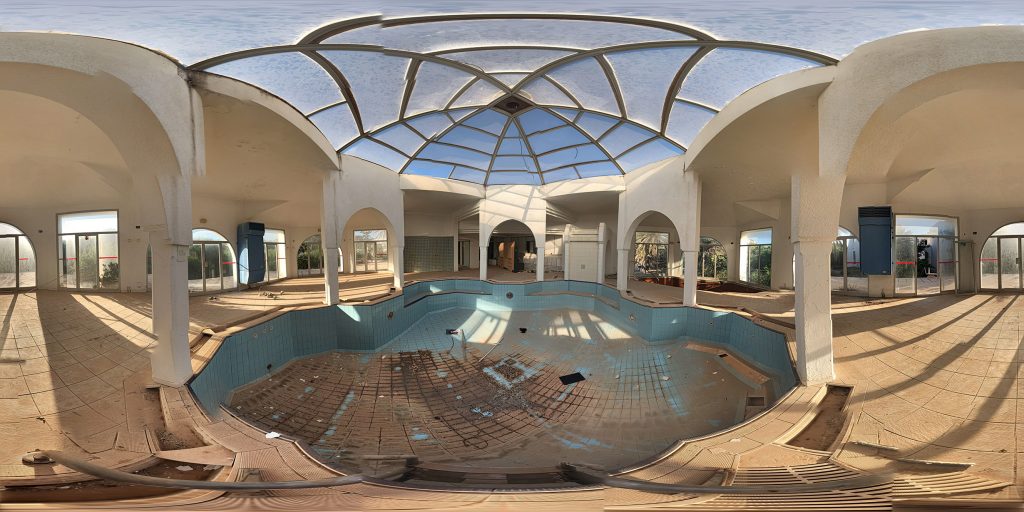
A 360-degree panoramic image captured at the abandoned Coralia Hotel in Tunisia. Image by: Dima Shirokov
Welcome to a world of exploration and intrigue at Abandoned in 360, where adventure awaits with our exclusive membership options. Dive into the mysteries of forgotten places with our Gold Membership, offering access to GPS coordinates to thousands of abandoned locations worldwide. For those seeking a deeper immersion, our Platinum Membership goes beyond the map, providing members with exclusive photos and captivating 3D virtual walkthroughs of these remarkable sites. Discover hidden histories and untold stories as we continually expand our map with new locations each month. Embark on your journey today and uncover the secrets of the past like never before. Join us and start exploring with Abandoned in 360.
Do you have 360-degree panoramic images captured in an abandoned location? Send your images to Abandonedin360@gmail.com. If you choose to go out and do some urban exploring in your town, here are some safety tips before you head out on your Urbex adventure. If you want to start shooting 360-degree panoramic images, you might want to look onto one-click 360-degree action cameras.
Click on a state below and explore the top abandoned places for urban exploring in that state.
You might also like