Fleetwood Shipwrecks: Exploring an Abandoned Boat Graveyard in the UK
Take a look at the abandoned Fleetwood Shipwrecks in Fleetwood, Lancashire, and see how the coastline has turned these forgotten hulls into a haunting landmark. Weather, tides, and time have left the remains stripped down and skeletal, creating the kind of raw, photogenic decay that urban explorers can’t help but study—part history lesson, part coastal mystery.
With the Fleetwood Shipwrecks captured in panoramic detail on Google Maps Street View, you can scan the scene from multiple angles and pick out details you’d miss in a single photo. It’s an easy way to appreciate the scale, textures, and atmosphere of the site—rusted metal, broken lines, and that unmistakable “left behind” feeling—before diving deeper into the story behind what’s still visible today.
Image by: Chris 128
Hidden along the marshy banks of the River Wyre in Fleetwood, Lancashire. lies one of the most intriguing abandoned sites in the United Kingdom – the Fleetwood Shipwrecks. This haunting boat graveyard, with rusting trawlers and sunken hulls, has become a magnet for urban exploring in the United Kingdom. URBEX enthusiasts and photographers are drawn to the eerie beauty of these derelict vessels, which tell a story of a bygone era. In this blog post, we’ll take an adventurous journey through the history of the Fleetwood Shipwrecks – from the year they were built and launched, through their glory days at sea, to the tumultuous events that led to their abandonment. Along the way, we’ll uncover strictly factual and historical information about Fleetwood’s fishing industry, the infamous Cod Wars, and the scandals and decisions that left this “ghost fleet” stranded on the mudflats. Whether you’re a beginner curious about urban exploration or an experienced URBEX veteran, join us as we explore Fleetwood’s abandoned ship graveyard and the rich history behind it.
Fleetwood: A Historic Port Town in Lancashire
Fleetwood’s story begins in the 19th century, when this coastal town in northwest England was founded with grand ambitions. In the 1830s, local landowner Sir Peter Hesketh-Fleetwood enlisted architect Decimus Burton to design a new port and resort town on the tip of the Fylde peninsula. By 1840, Fleetwood boasted two lighthouses guiding ships into port, and a bustling seaside promenade. The town’s strategic location on the Irish Sea and at the mouth of the River Wyre made it ideal for maritime trade. A railway link from Preston to Fleetwood opened in 1840, and soon steamers ferried passengers and cargo between Fleetwood and destinations like Belfast and the Isle of Man.
Fleetwood’s harbor facilities expanded over time. A significant milestone was the construction of Wyre Dock in the 1860s, followed by the opening of a dedicated Fish Dock in 1908. The Fish Dock, accessible through Wyre Dock, provided modern infrastructure for the town’s growing fishing fleet and even featured a covered fish market. By the early 20th century, Fleetwood had firmly established itself as one of Britain’s important fishing ports. In fact, by the 1920s the fishing industry here was at its peak – employing over 9,000 people and becoming the lifeblood of the local economy. Almost half the town’s working population found livelihoods either at sea or in fish processing and related industries during this boom period. Fleetwood earned its place on the map as a proud fishing town, even giving rise to cultural icons like the Fisherman’s Friend lozenges (invented in the 1860s to help soothe sailors’ throats) and the local football club’s nickname “Cod Army”.
However, Fleetwood’s prosperity was not to last forever. By the mid-20th century, shifts in travel and industry began to challenge the town’s fortunes. Cheaper package holidays abroad drew tourists away from English seaside resorts, and neighboring Blackpool’s rise stole some of Fleetwood’s thunder. Yet the most serious blow to Fleetwood would come from the very heart of its identity – the fishing industry itself.
The Rise and Fall of Fleetwood’s Fishing Industry
At its height in the 1950s and 60s, Fleetwood’s fishing fleet was a formidable force. The town’s docks bustled with activity: more than 200 fishing boats were based in Fleetwood in the 1960s, ranging from steam trawlers to modern diesel vessels. Generations of local families went to sea, and it was said that roughly half of Fleetwood’s adult population worked in fishing or related trades during these years. The fleet didn’t just fish the nearby Irish Sea – Fleetwood’s trawlers ventured far into the North Atlantic, chasing rich cod shoals in the cold waters around Iceland and beyond. Indeed, Fleetwood was one of Britain’s major deep-sea fishing ports, sending its hardy “cod men” on long voyages to fill the nation’s fish markets.
The very success of Fleetwood’s fleet, however, set the stage for a dramatic downfall. In the late 1960s and 1970s, a series of international disputes known as the Cod Wars erupted between Iceland and the United Kingdom over fishing rights. Iceland, seeking to protect its fish stocks, unilaterally extended its exclusive fishing zone – first to 50 nautical miles, then ultimately to 200 miles from its coast. The British government responded in kind by extending the UK’s own territorial waters, but it was too late to save the distant-water fishing industry. By 1976, as a result of the Cod Wars, British trawlers had effectively lost access to the Icelandic fishing grounds where the majority of Fleetwood’s prized cod catch came from. This was a devastating blow to Fleetwood’s fishermen and the local economy.
Compounding the crisis was a political decision that many in Fleetwood viewed as a betrayal – a scandal that sealed the fate of their fleet. In the early 1970s, as Britain negotiated to join the European Economic Community (Common Market), Prime Minister Edward Heath’s government agreed to European demands for access to UK waters. Eager to secure Britain’s entry into the EEC, Heath conceded a deal that allowed fleets from other European countries to fish freely in British waters. Almost immediately, this led to an overfishing crisis and the imposition of strict catch quotas under the new Common Fisheries Policy. British fishermen suddenly were allowed to catch only a small fraction of the fish in their own waters – “British waters held 90% of the EU’s fish but British fishermen were only allowed to catch 14% of them,” as one account describes. Anything over those quotas had to be thrown back dead, an outcome that enraged and demoralized local fishing communities.
The combined effect of the Cod Wars and the Common Fisheries Policy was catastrophic for Fleetwood. Virtually overnight, the deep-sea fishing industry collapsed. Fleets that had once ranged across the North Atlantic were now tied up at port with nothing to catch. The numbers tell the story starkly: the demise of Fleetwood’s fishing industry in the 1970s cost the town roughly 8,000 jobs, as employment in fishing and fish-processing plummeted from about 9,000 workers to fewer than 1,000. As one history notes, Fleetwood’s fishing industry was “largely destroyed in the late 1960s and early 1970s by the Cod Wars,” and the last deep-sea trawler left the town in 1982, marking the end of an era. All that remained were a handful of inshore boats and the shore-based processing of fish landed elsewhere. A proud chapter in Fleetwood’s heritage had come to a close – but it would leave behind an astonishing relic in the form of the Fleetwood Shipwrecks.
Birth of the Fleetwood Shipwreck Graveyard
How did a collection of abandoned ships end up stranded on Fleetwood’s marshes? The answer lies in the aftermath of the industry’s collapse and a controversial scrapping scheme that followed. As fishing companies went under and boats became surplus, the British government (with funding from the EEC in Brussels) introduced a decommissioning scheme to encourage fishermen to permanently retire their vessels. Under this program, owners were offered substantial cash payouts to scrap their trawlers – but there was a catch. The rules of the scheme, dictated by the Common Fisheries Policy, required that each fishing vessel be destroyed so completely that it could never be made seaworthy again. This led to an unfortunate spectacle up and down the UK’s coasts: perfectly functional boats were intentionally wrecked by their own captains and crews, simply to prove they were out of commission in exchange for compensation.
Fleetwood was no exception. In the late 1970s, several of the town’s trawlers met their end not by storm or battle, but by deliberate scuttling in the shallows of the Wyre estuary. Accounts differ on the exact number of vessels, but roughly five to six hulls were abandoned on the mudflats just south of Fleetwood’s docklands. They were mostly older Fleetwood trawlers – stout fishing boats from the 1940s–1960s that had once braved the Icelandic waters. Now, with their owners paid off to scrap them, these ships were run aground and left to the mercy of the elements, fulfilling the letter of the law that they be rendered unusable. “The ship owners were apparently paid to abandon and scrap them,” notes one urban exploration report, “the boats have laid here for over 40 years just rotting away.”. Indeed, by the 1980s the Fleetwood ship graveyard was born – an unintended monument to the town’s lost industry, hidden in plain sight on Fleetwood Marsh.
One example among the wrecks is particularly well documented. The M.T. Moreleigh, a diesel trawler built in 1942 for the Royal Navy and later converted for commercial fishing, ended its days in this marshy graveyard. After a long career fishing from ports like Brixham and Lowestoft, the Moreleigh was transferred to Fleetwood towards the end of its working life. In 1978, as the decommissioning scheme took effect, the aging trawler was towed into the marsh and abandoned on the mud. The Moreleigh has remained there ever since, slowly deteriorating. It’s joined by several sister ships whose names and details are now hard to trace – their wooden timbers and steel plates have long since lost any identifying plaques. Local lore often recalls that these hulls were the “Fleetwood trawlers left over from the Cod Wars of the 1970s”, left here after their final owners were paid to scrap them.
Not all the vessels in Fleetwood’s shipwreck graveyard were victims of the Cod War scrapping scheme. Some may have simply been retired and dumped due to age or damage. There are wooden boat hulks in a second cluster further out on the marsh, possibly old inshore fishing or shrimping boats, that also lie half-submerged in the silt. Additionally, a small collection of wrecks near an old dock wall hints that a few boats might have been deliberately scuttled to reinforce the riverbank or simply abandoned in situ over the years. But by and large, the most prominent wrecks – the ones that draw explorers and photographers – are the mid-20th-century trawlers sacrificed during the industry’s collapse. Together, they form the ghostly fleet now known as the Fleetwood Shipwrecks or the Fleetwood Boat Graveyard.
A Tour of the Abandoned Fleetwood Shipwrecks
Walking onto Fleetwood Marsh today, you’re greeted by an almost otherworldly scene. Scattered across the tidal flats are the skeletal remains of multiple ships, their prows and ribs sticking up at odd angles from the mud. Most of these wrecks are fishing trawlers that once crewed Fleetwood’s deep-sea voyages. Their stout hulls, built for North Atlantic gales, now lie cracked open, exposing rusted iron frames and decaying timber planks. Peering into one collapsed hull, you might see remnants of the engine mount or rust-flaked winches that hauled in nets decades ago. Another wreck’s bow juts upward, allowing you to stand beneath and imagine it once cleaving through stormy waves. These silent vessels are arranged haphazardly – as if a phantom tide deposited a whole flotilla and then retreated, leaving them forever marooned.
From a distance, especially on a misty morning or at dusk, the Fleetwood Shipwrecks present an eerie beauty. The estuary’s water at high tide gently laps at the broken decks, and at low tide the ships sit on wet sand, surrounded by rippling channels. It’s hard not to feel a sense of adventure and mystery here. There’s no bustling museum or tourist attraction, just the open marshland and the hulks themselves, slowly being reclaimed by nature. In fact, this spot has turned into an unintended wildlife haven. Birds nest and roost on the wrecks; you might spot gulls perched atop a wheelhouse stump or cormorants drying their wings on a rusty mast. Fish shelter in the shallow pools around the hulls, and even seals have been seen not far away, as the graveyard is now part of a tidal ecosystem teeming with life. Over the decades, the once-proud ships have transformed into artificial reefs of a sort, blending into the salt marsh environment.
One of the most famous historic wrecks associated with this area – though not physically among the marsh hulks – is the Sirene, a Norwegian barque that wrecked off Fleetwood’s coast in 1892. The Sirene met its fate in a storm and actually struck Blackpool’s North Pier before breaking apart; its bell still hangs in a nearby church as a memento. We mention Sirene because it underscores how this coastline has long been known as a “graveyard for ships”. The difference with the Fleetwood marsh wrecks is that these ships did not sink in tragic storms – they were intentionally run aground. Nonetheless, standing before them, you feel the same reverence as at any historic shipwreck. Every rust patch and splintered beam is a testament to the harsh journeys they endured and the abrupt end of their service.
Interestingly, the Fleetwood Shipwrecks are visible only at certain times. Because they sit on a tidal estuary, some of the wrecks are partially submerged at high tide and emerge fully only when the tide goes out. If you arrive when the waters are up, you might just see the tips of masts or the outline of a hull beneath the waves. But at low tide, the marshes extend for hundreds of yards, and you can walk right up to the wrecks on muddy ground. The contrast between high and low tide adds to the ghostly atmosphere – at times the ships seem to disappear into the sea, then reappear as the water drains away, as if reluctant to be seen.
In total, there are about five large trawler wrecks clustered relatively close together on Fleetwood Marsh. Their identities have largely been erased by time and tide, but local enthusiasts have tried to match a few to old fleet records. Besides the aforementioned Moreleigh, some believe one hull might be the Good Hope (a wooden trawler originally from Scotland), and another the Glen Carradale – though confirming this is difficult without visible registration plates. A short distance upriver from the main group lies another solitary wreck, partially buried near the channel’s edge. This one is hard to reach due to very soft mud isolating it, but long zoom lenses have captured its decaying form from afar. And further toward the old docks, explorers have noted a few smaller boats – like the remnants of a fiberglass cabin cruiser and a little fishing boat named Jasmine C which, interestingly, was rescued and refloated by a new owner around 2016. The salvation of Jasmine C is a rare happy footnote in an otherwise melancholy scene: it proves that not every boat left here is destined to remain a wreck forever.
Why Fleetwood’s Ships Were Abandoned: The Scandal and Aftermath
It’s important to understand why these ships were simply left to rot, as this is a key part of their historical significance. From a modern perspective, it might seem shocking that valuable vessels were marooned and allowed to decay in a marsh. The reason ties back to the policies and scandals of the 1970s fishing industry collapse. When Fleetwood’s fishing ground access was cut off and quotas made operations unprofitable, many boat owners faced bankruptcy. The government’s decommissioning scheme offered a lifeline of sorts – a payout to stop fishing. However, this came with the stringent requirement to completely incapacitate the boats. Many skippers and owners felt they had no choice but to comply if they wanted to recoup some money and pay off debts.
So rather than pay for expensive professional scrapping in a shipbreakers’ yard, some took a shortcut: they hauled their trawlers into the shallow backwaters, knocked holes in the hulls, removed anything of value (engines, brass fittings, etc.), and left the shells behind. In the eyes of the law, the vessels were “destroyed” – they would never fish again. And in the context of the late 1970s, environmental regulations were lax about abandoning scrap in coastal areas, especially if it was on private land or unregistered territory. Thus, Fleetwood ended up with a boneyard of ships on its tidal fringe, an unintended consequence of policy. As one Facebook quip puts it, “Captains were paid by the government to abandon their boats during the 1970s Cod Wars.” It sounds unbelievable, but it’s true – the authorities essentially incentivized the destruction of Britain’s own fishing fleet, a decision that many in Fleetwood viewed as a national scandal.
Local memory still harbors bitterness about how those years were handled. Generations of proud fishermen felt betrayed – by both the Icelanders (for pushing them out) and by their own government for “selling out” to Europe’s Common Fisheries Policy. The abandonment of the ships was a highly visible symbol of that betrayal. Imagine being a Fleetwood resident in the early 1980s, walking the marsh and seeing the very trawlers that once fed your town now wrecked and wasting away in the mud. It was a sight that drove home the reality that an era had ended. Even today, long after the fact, Fleetwood’s people haven’t forgotten. In town you’ll find the Lost Trawlermen Memorial, which even incorporates the salvaged funnel of a former trawler (the Goth) as part of the tribute to those who sailed and never returned. The existence of the memorial, and the fact that Fleetwood voted overwhelmingly in 2016 to “take back control of our waters” by leaving the EU, shows how deep the scars of the Cod Wars and fishing policy run.
On a broader scale, the Fleetwood Shipwrecks site is historically significant as one of the tangible remnants of the Cod War era. While other ports scrapped their decommissioned ships in yards or sold them overseas, Fleetwood’s wrecks stayed locally as a stark reminder. Maritime historians point out that the Fylde Coast is a graveyard for ships in more ways than one – not just from storms, but from economic shifts. The rotting trawlers are a testament to the decline of a once-great industry. They represent the human cost of geopolitical conflicts over fish. Every broken beam and rusted bolt out there on the marsh speaks to livelihoods lost, communities changed, and a way of life that was abruptly abandoned. For that reason, Fleetwood’s ghost fleet has attracted interest not only from urban explorers but also from historians, documentary filmmakers, and anyone fascinated by how global events can leave very local marks.
Urban Exploring Fleetwood’s Ghost Fleet (Tips and Safety)
For the adventurous soul, visiting the Fleetwood Shipwrecks is a uniquely rewarding experience. It’s not a manicured tourist spot – it’s as authentic an abandoned site as you’ll find in the UK, which is exactly the appeal for URBEX (urban exploration) enthusiasts. That said, exploring this boat graveyard requires some preparation and caution, especially for beginners. Here are some tips and safety pointers to keep in mind before you set off to explore the abandoned Fleetwood trawlers:
-
Time the Tides: Plan your visit for low tide. The shipwrecks sit on a tidal estuary, meaning they are submerged at high tide and visible at low tide. Consult tide tables for Fleetwood so you arrive when the waters have receded enough to walk out safely. Never get caught by the incoming tide – it can rise faster than you expect and cut off your route back to shore.
-
Wear Proper Footwear: The ground around the wrecks is essentially marshland and mud. After rain or high tides, it can be incredibly slippery and soft. Sturdy waterproof boots (wellies) are a must – expect mud above your ankles in places. Also, be prepared for hidden hazards underfoot: there are deep, narrow channels and pools in the mud that aren’t always obvious under the grass. Step cautiously and use a walking stick to probe if unsure.
-
Watch Your Step (and the Quicksand!): Parts of Fleetwood Marsh are known to behave like quicksand – the mud can suck you in if you linger too long in one spot. It’s usually firm enough where grass grows, but nearer the water’s edge the silt is very soft. Don’t attempt to walk in the obvious mudflats or across any channels filled with water. Stick to the relatively solid ground and do not climb inside the wrecks; not only can the structures be unstable, but the mud around them can be deceptively deep.
-
Access Points: The easiest way to reach the wreck site is through Fleetwood Marsh Nature Reserve, a public reserve managed by the council. There’s a free car park off Jameson Road near a modern housing estate. From the reserve, several footpaths lead toward the river. Look for a wooden archway on the path and head toward the marsh; soon the wrecks will come into view in the distance. It’s roughly a 5-10 minute walk from the car park to the ship graveyard. An alternative approach is from the direction of Fleetwood Docks/Affinity retail park (formerly Freeport shopping village) – a footpath along an old dock wall also leads to some of the wrecks from the north side. Whichever route, remember that you are entering a relatively isolated, undeveloped area.
-
Respect the Site and Wildlife: This abandoned boat graveyard is now part of a nature reserve (opened in 2003) and hosts diverse wildlife. You might encounter nesting birds or other animals. Keep noise to a minimum and do not disturb any creatures making their home among the wrecks. Additionally, while it’s tempting to take a “souvenir,” it’s best to leave everything as you found it – removing artifacts from the wrecks is not only frowned upon, it may even be illegal. Take only photographs and leave only footprints (in the mud!).
-
Bring a Friend: For safety, it’s advisable not to explore this area alone, especially if you’re not experienced with coastal marshes. Having a companion means someone can go for help in case of an emergency (like getting stuck in mud or a sudden medical issue). At the very least, let someone know where you are going and carry a charged phone. Keep in mind cell signal may be spotty in low-lying areas.
-
Photography Tips: Photographers love Fleetwood Shipwrecks for good reason. For the best shots, visit around golden hour when the light can cast dramatic shadows through the broken ribs of the ships. A drone can capture the full layout of the graveyard from above, revealing the ships aligned along the channel (just ensure you follow drone regulations and don’t disturb wildlife). If shooting from the ground, a wide-angle lens will let you frame an entire hull against the open sky. You’ll find endless creative angles – from close-up textures of peeling paint and rust, to wide shots of multiple wrecks silhouetted against the water.
Exploring the Fleetwood Shipwrecks is a bit of a step off the beaten path, but that’s exactly what makes it exciting. You’ll likely have the site all to yourself except for maybe a few dog walkers or fellow curiosity-seekers. The atmosphere is serene yet tinged with the somber realization of what happened here. As you navigate through clumps of marsh grass and tidal puddles, each shipwreck looms larger until you’re right beside these maritime zombies. It truly feels like entering a time capsule – one that nature has partially sealed. For urban explorers who typically venture into abandoned buildings, this outdoor ruin is a refreshing change of pace, combining elements of industrial decay with a windswept natural setting.
Legacy of the Fleetwood Shipwrecks
The abandoned Fleetwood ship graveyard is more than just an eye-catching exploration spot – it’s a site of profound historical resonance. These corroding vessels symbolize the end of an industry and a way of life. For Fleetwood, their story is a microcosm of the larger narrative of many towns in the United Kingdom that faced deindustrialization and change in the late 20th century. Once, Fleetwood stood tall as a fishing powerhouse; now, the Fleetwood Shipwrecks stand silently as guardians of those memories.
Over the years, efforts have been made to document and remember what these ships represent. Local museums (like the Fleetwood Museum) and heritage websites have cataloged the name and fate of as many trawlers as possible, ensuring that the fleets and crews are not forgotten. The very existence of the wrecks has attracted interest from outside as well. Filmmakers and journalists have featured Fleetwood’s ghost ships in documentaries about the Cod Wars, and the site has been highlighted in photography exhibits. In one drone video segment, the narrator calls the ship graveyard “a powerful reminder of the human cost” of the Cod War conflicts. Standing amid the wrecks, it’s easy to see why. Each twisted chunk of metal and each decaying keel drives home the reality of economic conflict and the dangers of the sea in equal measure.
There is also a certain beauty in the decay here. Paradoxical as it may sound, many visitors speak of the almost artistic scene the wrecks create – the way nature has blended with man-made structure. Seaweed and barnacles cling to hulls that once braved Arctic waves; wildflowers sometimes sprout in corners of a ship’s crumbling deckhouse; sea birds swoop and call around these new “islands” in the marsh. In embracing these wrecks as part of the landscape, Fleetwood has turned a page. What was once a graveyard born of economic hardship is now also a quirky tourist attraction and a poignant educational site. The Fleetwood Marsh Nature Reserve, which was officially established in 2003 to regenerate this former industrial land, treats the wrecks as features of interest rather than trash to remove. This speaks volumes about how perspectives have shifted. An entire generation has grown up in Fleetwood for whom the ship graveyard was always just there. Kids might even play around them (though not too wisely!) and local photographers practice their craft on them, finding inspiration in the wrecks.
The question sometimes arises: will the Fleetwood Shipwrecks ever be removed? So far, there’s little push to do so. Removing them now, after 40-50 years, would be a massive undertaking, likely causing more environmental disruption than leaving them in place. The wood has largely biodegraded into the marsh and the metal is rusting into inert form. In a way, the ships have become part of the ecosystem. Unless they pose a navigation hazard or a pollution risk (which, after so long, they generally do not), they are probably safe to remain as they are – slowly diminishing with each passing decade. That means future generations of urban explorers may still get to experience this ghost fleet, albeit perhaps in an even more skeletal form.
From a heritage standpoint, Fleetwood’s ghost ships ensure that the conversation about the town’s past stays alive. They prompt people to ask, “Why are these here? What happened?” – leading to discussions about the Cod Wars, about government policy, and about how communities adapt when their economic base collapses. In that sense, the wrecks have transcended their status as mere junk. They are outdoor museum pieces in a museum with no walls. Every visitor who treks out to them and learns the history becomes a keeper of Fleetwood’s story.
Conclusion
The Fleetwood Shipwrecks site is a rare and fascinating blend of adventure and history. For urban explorers, it offers the thrill of discovering something truly offbeat – an abandoned boat graveyard quietly resting in a corner of the United Kingdom. For history buffs and locals, it stands as an evocative memorial to Fleetwood’s fishing heyday and its subsequent trials. Few places capture the imagination quite like these wrecks do: their very presence invites you to step back in time, to envision the proud ships they once were and to reflect on the events that brought them to ruin.
In writing this extensive exploration of Fleetwood’s abandoned ship graveyard, we’ve touched on all the key elements that make it such a compelling destination. We learned when Fleetwood’s port was built and how its fishing industry flourished and faded. We delved into the operating period of the fleet, the dramatic Cod Wars that curtailed it, and the government schemes that led to the ships’ abandonment. We uncovered the human stories, the economic decisions (and indecisions), and even the hints of scandal behind those decisions. And we didn’t shy away from the strictly factual and historical details – from specific dates like 1976 (when Iceland’s waters were lost) to 1982 (when the last trawler sailed away), and from the 1860s dock construction to the 2003 nature reserve opening.
For both beginners and experienced urban explorers, Fleetwood’s shipwreck graveyard is an accessible yet profound location to visit. Beginners will find it an open-air experience that doesn’t require sneaking into buildings or climbing (though it requires caution with tides), and experienced URBEXers will appreciate the uniqueness of an abandoned in the United Kingdom site that isn’t a factory or asylum, but a maritime relic. It connects the dots between urban exploration and historical tourism – you go for the adventure, but you come away with a lesson in local history and perhaps a touch of melancholy respect for those who lived it.
In the end, exploring the Fleetwood Shipwrecks is not just about capturing stunning photos or ticking off a site on your URBEX bucket list. It’s about walking in the footsteps (or wake) of an industry that once fed a town and a nation. It’s about standing on the same decks where fishermen laughed, toiled, and braved the elements, now tilted in eternal rest. And it’s about understanding how even in abandonment, there can be meaning and beauty. Fleetwood’s ghost fleet may be slowly fading, but thanks to urban explorers and history lovers, its story is very much alive – and now you too carry a piece of that story with you. Happy exploring, and may the tides be ever in your favor when you venture out to the abandoned Fleetwood Shipwrecks of Lancashire.
If you liked this blog post, you might be interested in The Olympic Village of Berlin, the Southwest Elementary School in Georgia, or the Liu Family Mansion in Taiwan.
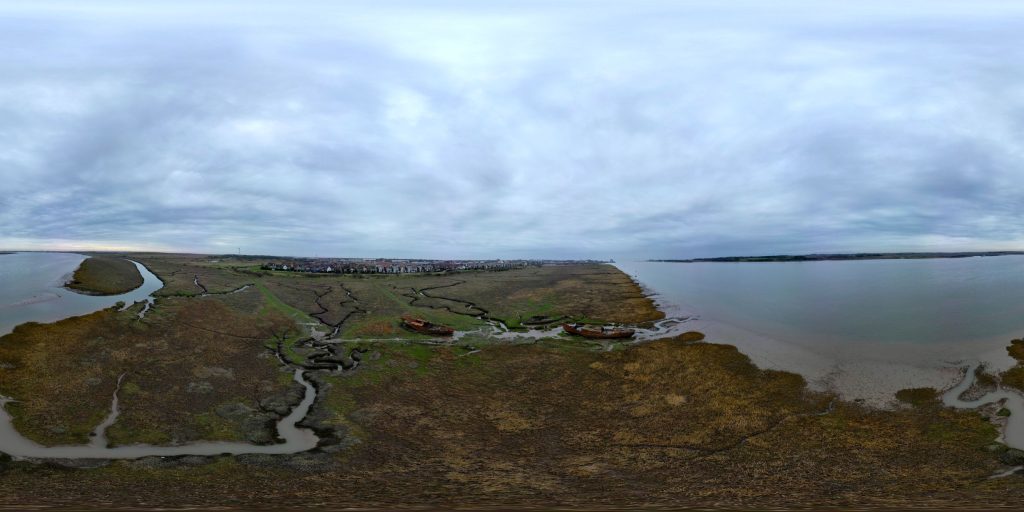
A 360-degree panoramic image captured above the abandoned Fleetwood Shipwrecks along the River Wyre in Fleetwood, Lancashire. Image by: Chris 128
Welcome to a world of exploration and intrigue at Abandoned in 360, where adventure awaits with our exclusive membership options. Dive into the mysteries of forgotten places with our Gold Membership, offering access to GPS coordinates to thousands of abandoned locations worldwide. For those seeking a deeper immersion, our Platinum Membership goes beyond the map, providing members with exclusive photos and captivating 3D virtual walkthroughs of these remarkable sites. Discover hidden histories and untold stories as we continually expand our map with new locations each month. Embark on your journey today and uncover the secrets of the past like never before. Join us and start exploring with Abandoned in 360.
Do you have 360-degree panoramic images captured in an abandoned location? Send your images to Abandonedin360@gmail.com. If you choose to go out and do some urban exploring in your town, here are some safety tips before you head out on your Urbex adventure. If you want to start shooting 360-degree panoramic images, you might want to look onto one-click 360-degree action cameras.
Click on a state below and explore the top abandoned places for urban exploring in that state.