Mount Calvary Baptist Church in Jacksonville Florida: The URBEX Guide to a Gothic Landmark Left Behind
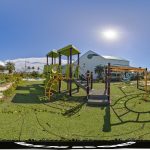
Mount Calvary Baptist Church offers urban explorers a chance to step inside a forgotten piece of Jacksonville, Florida history through an immersive 360-degree experience. The virtual tour below reveals the character of this abandoned space, from its worn details to the quiet atmosphere left behind inside its aging walls.
With the interactive imagery, visitors can take a closer look at Mount Calvary Baptist Church from multiple angles and experience the building at their own pace. This 360-degree virtual tour captures the beauty of decay and gives a rare view into a location that still holds a strong sense of place despite the passage of time.
Click here to view it in fullscreen.
Why this abandoned church has urban explorers talking
There are abandoned places that feel like simple leftovers—structures that lost their purpose and quietly faded. And then there are the ones that still hold the shape of a community, even after the doors have been shut for decades. Mount Calvary Baptist Church in Jacksonville is firmly in that second category: a towering brick sanctuary once rooted in a historically Black neighborhood, now standing as one of the most prominent surviving witnesses to Brooklyn’s disappearing streetscape.
If your interest is urban exploring in Florida, this site draws attention for reasons beyond the obvious “abandoned in Florida” thrill. Its story threads together early Black community-building after the Civil War, the long life of a congregation formed in the 1890s, a mid-century sanctuary designed by a notable Black builder-designer, and the hard realities of displacement and redevelopment pressure that reshaped the neighborhood around it.
A quick note before we go further: this post is written for URBEX history-lovers, photographers, and preservation-minded explorers. It does not encourage trespassing, breaking and entering, or unsafe exploration. The goal is to understand why this place mattered, what happened, and how to appreciate it responsibly—especially when a site is both fragile and historically significant.
The timeline urban explorers should know
Mount Calvary Baptist Church has two “beginnings” that matter: the founding of the congregation and the creation of the sanctuary that most explorers recognize today.
High-signal timeline:
- 1892: The congregation is recorded as constituted/organized in 1892 (formed by members of St. Paul’s Missionary Baptist Church), and the church is documented as established that year in a Works Progress Administration church-record survey preserved by Florida Memory under the Florida Department of State.
- 1896: The same WPA survey notes a rectangular frame “meeting-house type” church building with a bell was erected in 1896, with a dedication on March 15.
- 1892–1910: The recorded first settled pastor is Rev. E.D. Young.
- 1942: Rev. William Hill arrives (described as the church’s ninth pastor in later preservation reporting) and pushes toward a larger sanctuary reflecting the church’s role as a neighborhood anchor.
- 1948–1949: The existing brick sanctuary is commonly described as built in the late 1940s. A Jacksonville architectural history source places construction in 1948, while the Jacksonville History Center and a report tied to its endangered-properties work describes the sanctuary as completed in 1949.
- 1999: The congregation leaves the Brooklyn location; the building becomes vacant and has remained so since.
- March 16, 2020: The property is listed in the National Register of Historic Places (as part of the multiple property submission focused on African American architects and builders in segregated Jacksonville).
What “constructed and opened” means here:
If you mean the original church structure, primary documentation points to 1896 (erected) with a March 15 dedication. If you mean the large brick sanctuary that explorers photograph today, the best-supported window is 1948–1949, with “completed in 1949” appearing in the Jacksonville History Center’s materials.
Brooklyn’s rise, loss, and why this church ended up abandoned
To understand why Mount Calvary Baptist Church feels like such a powerful “still-standing” landmark, you have to see it as a survivor of a neighborhood that was repeatedly cut down in pieces.
Brooklyn (the neighborhood in Jacksonville, not New York) was platted in the late 1860s by Miles Price on former plantation land near McCoys Creek and the St. Johns River. It quickly became a destination for freedmen and freedwomen and their descendants, and the neighborhood grew through the late 19th century, aided by streetcar connectivity and annexation into the city.
That story matters because churches like Mount Calvary weren’t “just” worship spaces. In many Southern cities—especially under segregation—churches served as stabilizers: meeting places, record keepers, mutual aid hubs, youth leadership incubators, and cultural anchors. The Jacksonville History Center specifically describes Mount Calvary as reflecting the role of a church as an anchor for the Brooklyn community.
Brooklyn’s population peak and later disruption show up repeatedly in local historical writing. By mid-century, its population had grown into the thousands, but by the end of the 1950s, major highway construction displaced residents—an early wave in decades of urban renewal and redevelopment pressure that would reduce population and demolish much of the historic building fabric.
In the early 1980s, planning for redevelopment accelerated the neighborhood’s hollowing-out. One account of the area’s planning history cites a city survey and a Downtown Development Authority action plan that envisioned new construction requiring the demolition of 183 houses and displacement of 550 people—with many parcels ultimately cleared without the promised replacement neighborhood materializing as imagined.
That context helps explain why an institution could be “healthy” in spiritual or cultural terms yet still be forced to respond to shrinking residential density, repeated displacement, and shifting land values. When a neighborhood’s households disappear, the local church’s membership base often scatters too. That pressure doesn’t erase faith—but it can push a congregation to relocate for accessibility, growth, or survival.
Mount Calvary’s brick sanctuary is now described by preservation advocates as the largest remaining building from Brooklyn’s historic Black community. The building didn’t just outlast trends; it outlasted waves of demolition. That is exactly why it has become a magnet for URBEX photographers—and why its future raises hard questions about preservation versus loss.
What happened inside: the church’s documented activities and community life
One of the most valuable things for urban explorers (and historians) is when a place isn’t only described through rumor or aesthetic—when it’s measurable through records left behind. For Mount Calvary Baptist Church, a standout primary source is the WPA church-record survey preserved in Florida’s state historical collections.
The WPA survey record identifies the church at Dora and Spruce Streets, notes it was constituted in 1892, and outlines an early worship pattern: services were held in Hartridge Hall (at Park and Stonewall Streets) until the church’s own frame building was erected. The record describes the first church building as a white, rectangular, meeting-house type frame structure with a bell, erected in 1896 and dedicated on March 15.
For a site now associated with abandonment, that detail is grounding: before the brick towers, the congregation worshiped in borrowed space, then built a modest frame church, then eventually replaced it with a larger sanctuary in the postwar era.
The WPA survey also names leadership and record-keeping practices. It identifies Rev. E.D. Young as first settled pastor (1892–1910) and lists Rev. H.T. Wimberly as pastor at the time of that survey record. It also documents robust administrative life: minutes of meetings; election of officers; membership actions; financial receipts and disbursements; membership registers showing baptisms and deaths; and even a maintained deed and church file system.
And here’s where it really helps answer “what were its activities?” in a way explorers can trust: the WPA record explicitly cites specific ministry and community organizations with dedicated record books, including:
- Sunday School record books tracking membership, attendance, offerings, and activities.
- A Baptist Young People’s Union record book tracking membership, attendance, activities, elections, and finances.
- A Woman’s Home Missionary Society record book tracking membership, activities, elections, and finances.
Those aren’t vague guesses; they’re a snapshot of organized community life. Sunday School and youth unions mattered because they trained leadership and cultivated continuity—especially in neighborhoods where institutions were among the few stable places available to Black residents under Jim Crow policies.
Later observer accounts (from local writers who entered the building while documenting it) add sensory detail to the space explorers imagine: pews aligned toward the pulpit, stained glass in arched windows, and a baptistry—a reminder that baptisms were not just a line item in a register; they were a lived ritual inside the room. One narrative about the interior also mentions Sunday School being held in the basement space, reinforcing what the older record books already imply: this sanctuary functioned as an all-ages community pipeline, not a once-a-week hall.
The brick sanctuary: Gothic Revival power, built by Black hands
When most people say “Mount Calvary Baptist Church” today—especially in URBEX circles—they’re picturing the large brick sanctuary at 301 Spruce Street, with its strong vertical lines, twin towers, and pointed-arch rhythm. Preservation materials identify it as a Gothic Revival brick sanctuary completed in 1949, designed by a Black architect-builder and constructed with involvement from craftsmen connected to the congregation.
The designer at the center of this story is James Edward Hutchins (1890–1970). Local architectural history writing describes him as one of the few local African American contractors of his era who also designed the buildings he built, and ties him to multiple churches and residences in historically Black neighborhoods—work produced under the constraints of segregation.
That’s not just a biography footnote. It changes how you read the building’s silhouette. Those towers and arches weren’t merely decorative. For many Black congregations, a substantial sanctuary announced permanence, pride, and collective achievement—built in a city that often denied Black communities equitable investment and visibility. Preservation accounts describe Rev. William Hill as envisioning a “grand building” that would reflect the church’s anchoring role, and they describe it as constructed by craftsmen who were members of the congregation, led by contractor Tom Thompson.
Even if you never step inside, the concept lands: this was not just commissioned; it was made by the community it served.
The year is worth being precise about, because online references aren’t perfectly consistent. Several popular writeups and reposts cite 1955 as the build year, but the Jacksonville History Center’s endangered-properties materials describe the sanctuary as completed in 1949, and a Metro Jacksonville historical article places it as completed in 1948, suggesting a construction window that straddles those years. When you’re writing about abandoned in Florida sites, this kind of “date drift” is common—details get repeated, simplified, and sometimes shifted. The strongest preservation documentation currently points to the late 1940s, with “completed in 1949” appearing as a clear anchor.
Another major historical marker: the property is listed on the National Register of Historic Places (listed March 16, 2020) as part of a multiple property submission focused on African American architects and builders in segregated Jacksonville. That listing matters not only for preservation policy, but because it confirms the site’s recognized architectural and historical value at a national level.
Abandonment in 1999: what we know, what we can infer, and what came next
So why did this place become abandoned?
The core fact is consistent across preservation reporting and local coverage: the congregation moved from Brooklyn to a new location in 1999, and the Spruce Street sanctuary has been vacant since.
More specifically, later reporting describes Rev. John Allen Newman relocating the congregation to a Northside location near the Gateway Town Center area. The end result, for the building, is what URBEX photographers know as reality: a structure that once hosted worship, youth programs, meetings, and milestones now sitting unused for more than a quarter-century.
What can we say about the reasons for abandonment without slipping into rumor?
Confirmed drivers (documented):
- The congregation relocated away from the Brooklyn neighborhood in 1999.
Highly plausible pressures (inference, supported by neighborhood history):
- Brooklyn’s long decline and repeated cycles of displacement/urban renewal reduced the residential base that historically sustained neighborhood institutions.
- Redevelopment and infrastructure projects created physical and social fragmentation, which often pushes congregations to seek a site that better matches where their members live and how they travel. (This is a reasoned inference drawn from the documented history of neighborhood disruption, not a claim about any single decision-maker’s motivation.)
After abandonment, the building did not simply disappear from the city’s imagination. There have been redevelopment concepts over the years. In late 2017, local reporting described plans to adaptively reuse the former church as part of a craft brewery concept, with an intent to preserve the exterior.
But as of the Jacksonville History Center’s endangered-properties lists and similar preservation coverage, the building remains in a fragile in-between state: still standing, still significant, still vacant—yet repeatedly recognized as a priority for adaptive reuse because of what it represents as a surviving landmark of Brooklyn’s historic Black community.
And if you want a single sentence that says why it matters: It’s not only an abandoned church; it’s a rare remaining monument to a neighborhood’s erased footprint.
URBEX ethics and safety for urban exploring in Florida
It’s impossible to write honestly for urban explorers without addressing the line between curiosity and risk. Sites that are abandoned in Florida (especially large structures in humid climates) can degrade fast: roof failures accelerate rot, moisture invites mold, and unsecured interiors create unpredictable hazards. Even when a building looks stable from the street, interior conditions may not be.
Here are URBEX principles that respect both safety and history—without turning exploration into a how-to for trespass:
Start with legality. If you don’t have permission to enter, appreciate the site from public space instead. Historic structures can carry legal protections and serious liability issues, and trespassing can put both you and the site at risk.
Prioritize preservation over “proof.” Don’t move objects, don’t remove artifacts, and don’t “stage” scenes. A building like this is valuable partly because it still holds historical integrity—and because documentation (like the WPA church records) shows the community cared enough to preserve its story on paper. Your photos should honor that same spirit.
Assume environmental hazards. In long-vacant buildings, mold, pests, and structural instability are common concerns, and older materials can carry risks that aren’t obvious. Florida’s humidity can turn small roof damage into widespread interior decay.
Tell the story, not just the ruin. If your website targets urban explorers, this is where you can rise above the generic “abandoned church” label. When you pair atmosphere with documented history—1892 congregation formation, 1896 frame church dedication, youth and missionary organizations, and a late-1940s brick sanctuary designed by a Black builder-designer—you transform a photo set into cultural memory work.
Finally, remember what this structure represents. The Jacksonville History Center frames it as a surviving anchor from Brooklyn’s historic Black community; the National Register listing confirms it as nationally recognized within a broader story of African American architecture and design-build talent under segregation. URBEX is at its best when it doesn’t treat places like disposable backdrops.
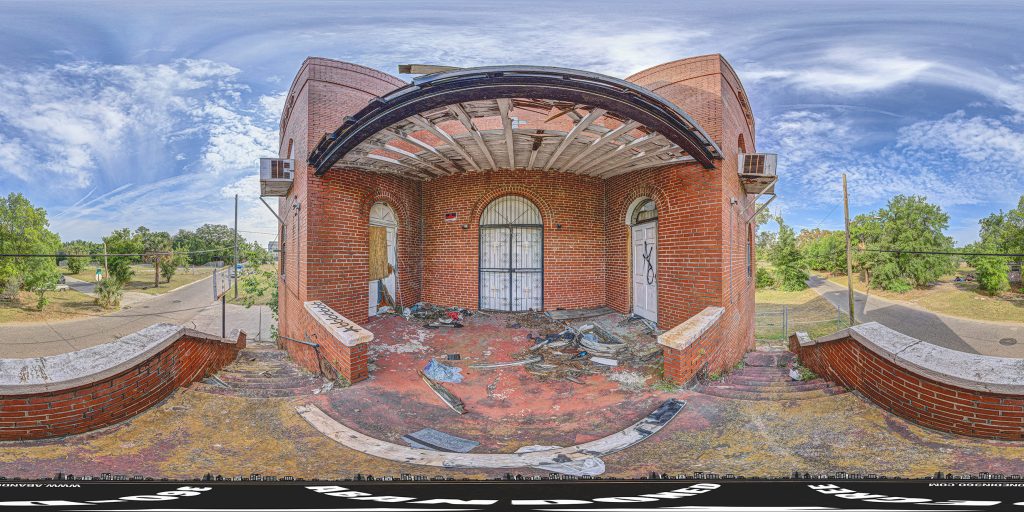
A 360-degree panoramic image captured on the steps of the historic Mount Calvary Baptist Church in Jacksonville, Florida. Photo by the Abandoned in 360 URBEX Team.
Welcome to a world of exploration and intrigue at Abandoned in 360, where adventure awaits with our exclusive membership options. Dive into the mysteries of forgotten places with our Gold Membership, offering access to GPS coordinates to thousands of abandoned locations worldwide. For those seeking a deeper immersion, our Platinum Membership goes beyond the map, providing members with exclusive photos and captivating 3D virtual walkthroughs of these remarkable sites. Discover hidden histories and untold stories as we continually expand our map with new locations each month. Embark on your journey today and uncover the secrets of the past like never before. Join us and start exploring with Abandoned in 360.
Equipment used to capture the 360-degree panoramic images:
- Canon DSLR camera
- Canon 8-15mm fisheye
- Manfrotto tripod
- Custom rotating tripod head
Do you have 360-degree panoramic images captured in an abandoned location? Send your images to Abandonedin360@gmail.com. If you choose to go out and do some urban exploring in your town, here are some safety tips before you head out on your Urbex adventure. If you want to start shooting 360-degree panoramic images, you might want to look onto one-click 360-degree action cameras.
Click on a state below and explore the top abandoned places for urban exploring in that state.
You might also like





Comment
[…] you liked this blog post, you might be interested in the abandoned Spitzer Castle in Serbia, the Mount Calvary Baptist Church in Florida, or the New Manchester Mill in […]