Liu Family Mansion: Haunting History of Taiwan’s Abandoned Minxiong Ghost House
Take a closer look at the abandoned Liu Family Mansion in Taiwan—a place where time, weather, and silence have reshaped what was once a private residence into a striking urban exploration landmark. With its fading details and lingering atmosphere, Liu Family Mansion offers a rare glimpse into the kind of architecture and lived-in history that urbexers are always chasing.
Explore the site through the panoramic images on Google Maps Street View below to see the mansion’s condition from multiple angles and appreciate the textures, layout, and haunting calm that photos often miss. Whether you’re a longtime explorer or just discovering abandoned places in Taiwan, Liu Family Mansion stands out as a must-see stop on the URBEX map.
Image by: 朱紹凱
An Urbex Legend in Taiwan
Nestled in the quiet countryside of Minxiong Township, Taiwan, the Liu Family Mansion (劉家古宅) – better known as the Minxiong Ghost House (民雄鬼屋) – stands as a monument of mystery and a magnet for urban explorers. This abandoned mansion in Taiwan has gained an almost legendary status among locals and international adventurers alike, celebrated for its haunted reputation and evocative decay. With ivy and banyan trees slowly reclaiming its crumbling Baroque Revival walls, the mansion offers an atmospheric journey into Taiwan’s past, complete with spine-tingling ghost stories and rich history. For those passionate about urban exploring in Taiwan, the Liu Family Mansion is often at the top of the must-visit list – a place where historical fact intertwines with folklore in a truly adventurous URBEX experience.
In this blog post, we will delve deep into the story of the Liu Family Mansion: the year it was built and the dreams it embodied, the short years it thrived, the activities and daily life it once contained, and the many reasons it was abandoned. We’ll explore the scandals and legends – from tragic love affairs to wartime intrigue – that have earned it the title of Taiwan’s most haunted house. Join us on a fact-based yet thrilling journey through time as we uncover how this one location became an urban explorer’s treasure, its halls echoing with history and mystery in equal measure.
Constructed in 1929: A Grand Vision Under Japanese Rule
The story of the Liu Family Mansion begins in 1929, during the Japanese colonial era in Taiwan (1895–1945). In that year, a wealthy local merchant named Liu Rong-yu (劉溶裕, also romanized as Liu Jung-yu) completed construction of this expansive family home. The mansion was built as a stately three-story residence (with even a small fourth-story tower) in a Western Baroque Revival style, reflecting the trends favored by prosperous Taiwanese merchants of the time. Its architecture featured graceful arched verandas and ornate facades that were unusual in rural Taiwan, earning it the nickname “Spanish-style” among some observers. The entire structure was constructed with red brick and timber, containing three large rooms on each floor arranged side by side, and crowned by a central tower-like attic room. This grand design was intended to showcase the Liu family’s wealth and modern taste, standing out amid the rice fields and farmsteads of Minxiong.
Liu Rong-yu’s vision for the mansion was as ambitious as the building itself. As one of the first truly wealthy figures to emerge from Taiwan’s southern plains, Liu had seven children (four sons and three daughters) and hoped to create a spacious home where his extended family could prosper together in comfort. Historical notes suggest that he wanted a peaceful retreat in the countryside where he could enjoy pastoral tranquility and eventually entertain grandchildren, away from the bustle of city life. The mansion’s name in Chinese, 劉家古厝 (Liújiā Gǔcuò), literally means “Liu Family Old House,” indicating the pride of ownership and the expectation that it would serve as an ancestral home for generations. In a final decorative touch rich with symbolism, inscriptions were carved above the third-floor balcony, proclaiming auspicious phrases – the top row reading “ethics and holiness will shine” (德聖明以) and the bottom row “brothers in harmony and joy” (兄弟和樂) – reflecting Confucian values of virtue and family concord that Liu undoubtedly cherished.
When the Liu family took up residence in 1929, the mansion must have been an impressive sight: a three-story jewel amid rice paddies, flanked by an avenue of trees. Back then, Minxiong was a fairly remote township. The house’s location was a few kilometers from the town center and even farther from the nearest city, Chiayi, which made the estate feel secluded. Yet, Liu Rong-yu likely believed the tranquility and prestige of a country estate outweighed any inconvenience. For a time, the household bustled with life: the laughter of children echoing through high-ceilinged rooms, servants maintaining the gardens, and Liu himself overseeing business affairs from his countryside abode. Operating as a private family residence, the Liu Mansion would have hosted traditional family activities – ancestral worship in the house shrine, holiday banquets, and perhaps gatherings of local elites given the Liu family’s status. It stood not just as a home, but as a status symbol, a testament to one man’s success and his hopes for a lasting familial legacy.
A Short-Lived Home: From Dream House to Abandoned Relic
Despite its initial promise, the Liu Family Mansion was inhabited for only a brief period. As modern as the house was for its time, its rural setting soon proved impractical for the family’s needs. In the Taiwan of the 1930s – still under Japanese rule – daily life in a far-flung mansion came with significant challenges. Liu’s older sons found employment in the bustling hubs of Chiayi City and the nearby town of Beigang, meaning a long commute on early 20th-century roads. Meanwhile, the younger children needed access to good schools, which were located in the city. In a practical move, Liu’s wife relocated to Chiayi City with the school-age children, seeking better education and convenience. The “center of gravity” of the family shifted away from the Minxiong estate not long after it was built.
For a short while, Liu Rong-yu tried to persevere in the grand home with only a skeleton staff of servants for company. According to one account, after the mansion was finished, Liu himself lived there for around three years, perhaps hoping the rest of the family would return on weekends or holidays. One can imagine him walking through the lofty halls in the evenings, a lone patriarch surrounded by empty rooms that were meant to be filled with family. By the early 1930s, however, reality could not be ignored. The grand house was simply too far from the economic and social life of the city. Reluctantly, Liu locked up his dream home and joined his family in Chiayi, leaving the mansion in Minxiong effectively abandoned after only a few short years of use.
The brief operating duration of the Liu Family Mansion – roughly 1929 to the early 1930s – makes its story all the more poignant. What was intended as a thriving family compound became a ghost of itself in just a generation. Liu Rong-yu reportedly lived to the age of 71, but after departing Minxiong he never again saw his vision fulfilled of a bustling household in that mansion. Caretakers or employees from the family did return periodically to maintain the property for a time, sweeping out dust and ensuring that trespassers didn’t settle in. Yet, despite these efforts, it seems no one ever lived there again as a home after Liu’s departure. By the late 1930s or early 1940s, the grand house stood mostly silent, save for the sounds of nature creeping back into its domain.
Why Would Such a Mansion Be Left Behind?
The reasons for its abandonment were practical at first – chiefly the inconvenient rural location and the family’s decision to relocate for work and schooling. In many ways, the Liu family’s choice was a common story in Taiwan: as modern transportation, industry, and education centered in cities, wealthy families often left their countryside estates for urban life. The Minxiong mansion was not the only rural manor to be forsaken for the lure of city convenience. However, the Liu Mansion’s fate diverged from the ordinary in one crucial aspect: once empty, it acquired a reputation that would prevent it from ever being reoccupied. Over the years, a cascade of eerie tales and tragic legends emerged to explain why the house might be cursed or uninhabitable, giving a supernatural tint to what began as a practical relocation. These legends turned the vacant home into something of a pariah property – and eventually, ironically, into a famous attraction precisely because it was abandoned.
Local lore suggests that even before the family fully moved out, there were signs of misfortune in the mansion. Some whispered that the Liu family had experienced unexplained disturbances in those early years, from disembodied footsteps at night to sudden illnesses, which made them eager to leave. While these stories are hard to verify, they hint that superstition and fear of bad feng shui may have contributed, in the popular imagination, to the family’s departure. In fact, one colorful story claims that during the mansion’s construction, Liu Rong-yu had a falling out with some of the craftsmen – the joiner, stonemason, and bricklayer responsible for the beautiful house. According to this tale, Liu either scolded them harshly or even cheated them out of their full wages. In revenge, the insulted builders supposedly embedded hidden curses and spells within the mansion’s walls and foundation. The legend goes that after the family moved in, these buried curses manifested as mysterious sounds and unsettling phenomena (like inexplicable noises and ghostly footsteps in empty corridors) that plagued the household, causing such stress that it drove them away. It’s a classic folk explanation: a beautiful home gone bad due to a curse placed by wronged workers – a story that ties together the mansion’s abandonment with a satisfying (if spooky) moral about treating people fairly.
Yet, when asked directly, the Liu family’s descendants have consistently downplayed any supernatural cause. The family has explained on multiple occasions that they relocated for mundane business and personal reasons, not because of vengeful ghosts. In their view, Minxiong simply wasn’t the right place to raise a family or run a business long-term, especially after World War II when Taiwan’s economic focus shifted even more to cities. This rational explanation doesn’t stop the rumors, of course. It’s just more exciting for tour guides and storytellers to hint that the Liu clan fled a haunted house in terror, rather than admitting they moved because of commuter traffic and school districts. In truth, it’s likely that both narratives contain grains of truth – the family did move for practical reasons, but the subsequent decades of neglect allowed ghost stories and scandals to take root, forever branding the mansion as a place you wouldn’t want to live in even if you could.
Wartime Woes and Post-War Decay
After the Liu family’s exit, the mansion entered a long period of decline, punctuated by the chaos of war. By the late 1930s and early 1940s, the shadow of World War II had reached even this quiet corner of Taiwan. Under Japanese rule, Taiwan was pulled into the Pacific War, and allied forces targeted Japanese military assets across the island. American bombing raids during WWII damaged part of the building – a bomb blast reportedly struck near the mansion, shattering sections of its upper floors or roof. While the exact extent of damage is unclear, this attack left scars that made the house even less habitable. One source notes that by the time Japan’s rule ended in 1945, parts of the interior woodwork had been removed or destroyed, and the once proud residence already looked wounded by war and weather.
During this era, the empty mansion didn’t entirely escape notice. There are accounts that Japanese Imperial Army soldiers were billeted in the mansion at some point in the 1940s, taking advantage of its solid structure for shelter. This transient military occupation gave rise to one of the most grisly legends associated with the site. Locals tell of a night when a small squad of Japanese soldiers staying in the house met a horrifying fate. According to the tale, one soldier on sentry duty awoke in the dead of night and saw a shadowy figure approaching in the darkness of the mansion’s halls. Panicking and assuming it was an enemy (or perhaps a ghostly entity), he opened fire. The sudden gunshots in the maze-like dark house caused chaos among the other soldiers, who jolted awake to confusion and muzzle flashes. In the frenzy, the soldiers supposedly began shooting in all directions, even at each other. When the smoke cleared, the legend says, the entire squad lay dead or dying – victims of a collective panic. Some versions add that only one mortally wounded soldier survived just long enough to recount how they all came to such a tragic end, claiming that they had seen some apparition that caused the deadly confusion.
Whether this dramatic incident truly occurred is unconfirmed (no official record of a mass shooting at the house exists), but interestingly, visitors today can point to small pockmarks and holes in the mansion’s walls that resemble bullet holes. These lend a veneer of plausibility to the tale, as if the very bricks still whisper about that bloody night. The “Japanese soldiers massacre” story reinforced the growing notion that the mansion was an unlucky place fraught with malevolent forces. After World War II ended, Taiwan changed hands to the Republic of China (ROC), and once again the ghost house saw soldiers on its premises – this time from the Chinese Nationalist Army (KMT soldiers who came over with Chiang Kai-shek around 1949). Unfortunately, their experience was no happier.
When a contingent of KMT soldiers was stationed at the Liu mansion in 1949, they found a shell of a building: parts of the roof gone, no electricity, and jungle-like foliage encroaching on all sides. The soldiers, many of whom were far from home and undoubtedly superstitious, soon started reporting unsettling experiences. In the pitch-black country nights, a few men swore they saw a floating ghostly figure outside the windows – a woman in white, according to some, gliding through the darkness. Terrified, the soldiers begged their superiors for lighting to ward off whatever lurked in the dark. Yet even after rigging up some makeshift lights, the men remained on edge. Over the following weeks, a string of untimely deaths struck the troop stationed there. Some soldiers fell ill with high fevers and died inexplicably, while others – if rumors are to be believed – took their own lives in despair. The haunted house’s curse seemed to spare no one: whether it was truly vengeful spirits or the crushing loneliness and homesickness of young men exiled from mainland China, a number of those KMT soldiers perished on the premises or shortly after leaving. This dark chapter further cemented the mansion’s reputation as a place of doom. Soon after, the military abandoned using the house altogether; it was simply not worth the fear and loss of life.
More down-to-earth explanations hold that the KMT soldiers’ tragic fate was not due to ghosts at all, but rather psychological stress and homesickness. Many of these soldiers were war-weary and heartbroken after fleeing their homeland, which could have contributed to severe depression and illness. Still, in the public imagination, the narrative of ghostly revenge was far more compelling. By the mid-20th century, virtually everyone in Chiayi County had heard that the old Liu residence was haunted and cursed, and very possibly dangerous to stay in. It’s easy to see how no buyer or new resident would be interested in such a property, even if the Liu family had wanted to sell. The mansion was left to the elements, its walls absorbing one layer of history (and hysteria) after another.
As decades passed, typhoons, humidity, and vegetation took a permanent toll on the structure. Nearly all of the wooden floorboards and beams rotted away or collapsed, leaving yawning holes where opulent interiors once existed. The roof caved in piece by piece, so that sunlight and rain now penetrate freely into the rooms that once kept a wealthy family safe and dry. Banyan trees, with their snake-like roots, seized hold of the mansion’s corners and walls, their roots crawling through cracks and wrapping around bricks as if mother nature herself were trying to reclaim the edifice. Thick foliage grew up around the house, at one point almost entirely hiding it from view behind a curtain of green. For many years, there wasn’t even a clear path to the mansion – visitors had to tromp through wild undergrowth beneath towering trees to reach the graffitied doorway. The once-grand Liu Family Mansion had transformed into a derelict ruin, marked by war, weather, and neglect – the perfect stage for a ghost story to thrive.
Ghosts, Legends, and Scandals in the Halls
No account of the Minxiong Ghost House would be complete without a deep dive into its ghostly legends and scandals. Over time, numerous tales have attempted to explain the eerie aura that clings to the Liu Family Mansion. These stories range from the tragic to the fantastical, and each has contributed to the mansion’s fame as a haunted locale. Here, we gather the most enduring legends that locals and visitors have passed around campfires and online forums alike:
-
The Star-Crossed Maid and the Haunted Well: The most famous tale is a scandalous love affair turned tragedy. In the 1930s, the story goes, one of the household maids – or in some versions, a concubine or “second wife” figure – caught the eye of Master Liu Rong-yu. The two began a secret romance under the same roof as Liu’s wife and family. When this illicit affair eventually came to light, it ended in catastrophe. It’s said that the furious wife unleashed her wrath on the young maid, berating her viciously and, according to some versions, even physically abusing her in a fit of jealousy. Humiliated and heartbroken, the poor maid saw no way out and threw herself into the deep well on the property, drowning in its cold waters. Another twist on the tale suggests an even darker ending: rather than suicide, the vengeful wife may have pushed the mistress down the well, turning a tragedy into an outright murder.
The haunting, however, only begins with the maid’s death. From the day her body was pulled out of the well, strange occurrences plagued the mansion. Servants whispered of seeing a dripping wet figure roaming the halls at night. Family members heard disembodied weeping echoing from the courtyard. On misty evenings, wisps of white fog – said to be the restless spirit of the girl – were seen circling the building at dusk. The classical Chinese belief is that those who die unjustly or with unsettled grudges become yon ghosts, bound to the site of their suffering. True to that idea, the maid’s ghost allegedly tormented the Liu family, night after night. Some say that her apparition confronted the master and his wife directly – a pale figure with long wet hair appearing at the foot of their bed, or a sorrowful face peering from the well – demanding justice or vengeance. The family’s nerves frayed as the hauntings intensified: objects moved on their own, unexplained illnesses befell them, and sleep became impossible amid the nightly terror. In fear and despair, the Liu family finally fled, abandoning the mansion to the ghost rather than endure another day under its roof. So goes the legend of the haunted well. In fact, visitors can still find an old well on the grounds today – it has long since been sealed and filled in for safety, but it’s pointed out as the well from the story. Notably, local devotees sometimes leave offerings by this well – little cakes or fruits – to pacify the spirit of the maid, a practice that persists to this day. It seems the tragic tale of forbidden love and ghostly revenge has etched itself so deeply into local folklore that many treat it as if it were true, or at least, they don’t dare disrespect the possibility.
-
The Cursed Construction (Builders’ Revenge): As mentioned earlier, another story asserts that the mansion was cursed from the very start. This legend holds that Liu Rong-yu angered the very craftsmen who built his home, either by reneging on full payment or simply by treating them poorly. In retaliation, these builders, who perhaps knew a thing or two about folk sorcery, hid Taoist charms, curses or cursed objects within the structure of the house while building it. These secret spells were intended to plague the Liu family with misfortune. Sure enough, once the family moved in, inexplicable events reportedly began. Walls would creak and knock with no one near them, as if the house itself were alive. At night, residents heard footsteps echoing in empty rooms and strange whispers around dark corners. Family members suffered nightmares and paranoia. What we might now describe as stress-induced symptoms – anxiety, insomnia – were, at that time, easily attributed to malevolent forces. In the legend, these supernatural torments were so relentless that the family could not stay, essentially driven out by the very house they built. While this tale might simply be an old laborer’s fable, it taps into a common theme in haunted house lore: a dwelling imbued with negativity from its foundations, causing anyone who lives there to slowly lose their peace of mind.
-
The Haunted Water Tank: One particularly eerie anecdote is the story of the water cistern or tank on the roof of the mansion. According to this tale, one of Liu’s grown daughters visited the house at some point after the rest of the family had moved to the city. While washing her hands, she noticed the water from the tap was uncharacteristically frigid, sending a chill over her. Concerned, the family called a plumber or servant to inspect the rooftop water tank for issues. What happened next turned this mundane chore into a ghost story. As the unlucky repairman ascended to the rooftop and approached the large ceramic water tank, he suddenly fled down the stairs, ashen-faced and trembling with fear. He claimed that as he neared the tank, he heard a cacophony of human voices coming from within the water. Men, women, children – a whole chorus of anguished cries and screams emanated from the tank as if countless souls were trapped inside. This horrifying discovery was enough to convince the family that the mansion was supernaturally afflicted. In response, Liu’s wife reportedly summoned a Taoist priest, who placed a peachwood sword (桃花心木劍) in the house – a traditional Feng Shui talisman used to ward off evil spirits. The wooden sword was positioned in accordance with spiritual guidelines to calm the restless energies. Sadly for the Lius, this measure proved ineffective. If anything, it highlights how desperate the family had become to reclaim peace in their home. The subsequent abandonment of the mansion suggests that no ritual could salvage the situation – the ghosts (or the family’s own fears) won out in the end.
-
Phantom Soldiers and Fatal Mistake: We have already recounted the legend of the Japanese soldiers who met their doom within the mansion’s walls. To flesh out this tale a bit more: Some local variations add that villagers found the bodies of those soldiers only after a few days, the scene so gruesome that it hardly needed ghosts to be terrifying. Bloodstains on the tile floors and bullet holes in the plaster told the story of a night of madness. In some retellings, the ghostly figure that spooked the sentry is speculated to have been the spirit of the drowned maid – suggesting all the ghost stories tie together, and that she remained as a vengeful wraith to attack any intruders. Others think it was the cursed fengshui of the house at work, or perhaps the restless ghosts of those very soldiers now trapped in a cycle. Regardless, that night of senseless death is often cited as proof that the place is truly haunted and dangerous, even to armed, battle-hardened men.
-
KMT Soldiers and the Weeping Ghost: The experiences of the Chinese Nationalist (KMT) soldiers add another layer of legend. Surviving veterans later spoke in hushed tones about the woman in a white dress who would drift outside at night, moaning softly – again often linked to the maid’s ghost or some female spirit. The soldiers stationed there were so spooked that, as mentioned, they demanded lights and eventually refused to stay. The cluster of deaths among them (whether from illness or suicide) became, in ghost lore, the ghost picking them off one by one. One imaginative variant even describes how a soldier on sentry could never finish a round walking the perimeter – he’d always find himself back at the same spot, as if the house was a maze that wouldn’t let him leave its orbit. While that sounds like pure fiction, it captures the disorientation and dread that these young men reportedly felt.
Each legend has its skeptics and believers. The Liu family themselves are thoroughly tired of the ghost gossip, considering it all false hearsay that tarnishes their ancestors’ home. Indeed, from a historical perspective, many of these stories can’t be verified in any record – they exist in the hazy realm of oral folklore and sensational media. However, it’s precisely these scandals and ghost stories that have given the Liu Family Mansion its enduring allure. They transform the site from an old derelict building into a stage where drama unfolded and spirits linger. For urban explorers and thrill-seekers, knowing these tales ahead of a visit provides an added rush – you’re not just stepping into a ruin, you’re stepping into the very setting of Taiwan’s most infamous haunted legends.
Reclaimed by Nature: The Mansion’s Present State
Walking up to the Liu Family Mansion today, one is immediately struck by how thoroughly nature has reclaimed the structure. The once-manicured grounds are now a small forest of their own. Untrimmed trees, including towering banyans, loom over the three-story ruins, their canopies casting the area in deep shade even on a bright day. Vines and roots weave through brickwork, splitting apart walls slowly but inexorably. The mansion’s facade, which still displays faint decorative flourishes from its 1920s design, is partially obscured by green moss and crawling ivy. In places, you can see the walls literally held together by a lattice of roots – nature’s clamps preventing total collapse.
Stepping through the arched entrance (above which someone has stenciled the Buddhist mantra “Namo Amitabha” – likely an attempt to ward off evil), you find yourself in a shell of a house. The interior is hollowed out: as noted, virtually every wooden floorboard of the upper stories has rotted away or fallen through, so when you look up you see three stories of empty window frames and a slice of sky where the roof once was. Only a few hardy beams cling on overhead. Debris of tiles and wood litter the ground floor, now compacted into dirt after years of visitors treading on them. Originally, the layout was one room deep with three rooms side-by-side on each floor. You can still make out these divisions by the remnants of walls and support columns, but the interiors are otherwise open to the elements. Graffiti mars some of the surfaces – unfortunately, over the years people have spray-painted names, symbols, and even obscene drawings on the walls. In an effort to combat this vandalism, patches of white paint can be seen, evidence that local volunteers or authorities occasionally paint over graffiti, trying to preserve the mansion’s dignity amid decay.
One poignant sight is the inscriptions above the balcony that have survived time’s onslaught. As mentioned earlier, two vertical lines of Chinese text still stand out on the facade: “德聖明以” and “兄弟和樂”. Despite all the destruction, these uplifting words – about virtue shining bright and brothers living in harmony – remain legible, an enduring hallmark of the Liu family’s hopes. It’s almost as if the house’s soul is inscribed right there, refusing to fade even if the structure crumbles.
In each corner of the mansion, massive banyan tree roots snake down from the rooftop to the ground, wrapping around pillars and reaching into the foundation. These banyans, sacred in Taiwanese culture as homes for spirits, add to the haunted ambiance. They are reminiscent of the famous Anping Tree House in Tainan – another old building overtaken by a banyan – but unlike that touristy site, the Ghost House retains an untamed quality. Visitors often comment on the eerie beauty of seeing architecture and nature fused together here: windows framed by leaves, doorways half-blocked by trunks, and sunlight filtered through both roof beams and branches. There has been minimal landscaping or intervention; no manicured path has been laid, so you often walk on trodden earth and between shrubs to explore the rooms. In one area, around the spot of the infamous well, some brush has been cleared – possibly out of respect for the legend, making it easier for people to find and pay respects there. Indeed, you might notice small offerings or incense ashes by the well cover, signs that some visitors still perform impromptu rituals to appease the spirits.
The atmosphere inside is thick – literally with humidity, and figuratively with the weight of stories. In summer, the air is hot and still, often filled with mosquitoes, which thrive in the shade (as one visitor joked, the only bloodthirsty creatures here are the bugs). A musty scent of damp brick and wood lingers; some have noted an odd odor that could be guano or just centuries of mold – one of the reasons a few netizens complained the site “smells bad” compared to more sanitized tourist spots. There is also litter and trash in corners, left by less respectful travelers, although local enthusiasts do try to clean up periodically. Despite these minor detractions, many people find that the Ghost House’s lack of commercialization gives it a special appeal. As journalist Steven Crook wrote, it offers an “unmediated experience” – nothing between you and the raw, decaying, supposedly haunted environment. It’s a kind of time capsule you can walk right into, imagining how it once looked by the outlines and remnants.
Safety-wise, caution is advised. Because the floors are gone, exploring the upper levels is risky and generally not possible without climbing gear (and that’s not recommended). Visitors typically stick to the ground level, gazing up through the open floors. Some adventurous souls do clamber onto parts of the staircases or ledges for a better view, but one must be very careful of weak structures and loose bricks. The combination of ruin and jungle means you should wear good shoes (broken glass and sharp stones abound) and be mindful of wildlife (perhaps a snake or two enjoys the cool shade here, and bats might roost in the nooks). All these elements – decay, nature, risk – make the Liu Family Mansion a quintessential URBEX site. It’s a place where you truly feel like an explorer, discovering a lost world, rather than a tourist on a paved trail.
Taiwan’s Most Famous Haunted House: From Infamy to Attraction
What was once shunned as a dangerous, ghost-infested ruin has, in the past few decades, become a popular attraction – especially for urban explorers, photographers, and ghost story enthusiasts. The transformation of the Liu Family Mansion’s image began around the 1990s. After decades hidden in undergrowth and spoken of only in spooky whispers, the site started to draw curious visitors out of the woodwork. College students from nearby towns began daring each other to visit the Ghost House after dark, treating it as a rite of passage to test one’s courage. These midnight adventurers swapped tales of their experiences, sometimes claiming they heard or saw eerie things – other times just enjoying the adrenaline rush of wandering a haunted place by flashlight.
Soon, the trend expanded beyond locals. Pioneering urban exploration (URBEX) bloggers and photographers “discovered” the Minxiong Ghost House, drawn by its striking visuals and hair-raising backstory. They documented the mansion’s crumbling beauty in photos, sharing them on early internet forums and blogs devoted to abandoned places. The juxtaposition of colonial-era architecture and encroaching jungle made for stunning imagery, and the ghost legends provided compelling narrative content. As more explorers posted about it, the Liu Family Mansion’s fame grew. It was no longer just a local folktale – it became an internet-famous haunted house, enticing adventurers from other parts of Taiwan and even overseas.
By the 2000s and 2010s, the site regularly featured in lists of “top abandoned places in Taiwan” and “must-see haunted spots.” In fact, a poll by Yahoo Kimo (Taiwan’s Yahoo!) crowned Minxiong Ghost House as the number one scariest haunted house in Taiwan – an honor that only fueled more interest. Travel magazines and culture columns (like one in the Taipei Times) wrote articles describing the mansion’s history and legends in enticing detail, further legitimizing it as a tourist destination rather than just an abandoned wreck. What makes Minxiong Ghost House unique in Taiwan is that haunted places are often avoided or quietly forgotten due to superstition, but this one became celebrated rather than shunned. Locals, especially younger generations, take pride in it as a cool and creepy landmark of their town.
The growing influx of visitors eventually led the local community to adapt. A small coffee shop opened next door to the mansion, cleverly capitalizing on its spooky fame. This café, just a short walk from the ghost house, offers refreshments and even sells ghost-themed souvenirs – think t-shirts or trinkets with ghost emblems or the image of the mansion itself. There’s even a parking area by the cafe, which visitors can use for a small fee. The presence of a “Ghost House Coffee” sign (民雄鬼屋咖啡) with directions has made the site easier to find. This is a stark change from earlier decades when only those in the know could locate the overgrown path. Today, you might see not just thrill-seekers, but also families and tourists, especially during daytime, strolling around the mansion ruins – some with cameras, others just curious. The mood by day can feel almost picnic-like, belying the macabre stories attached to the place.
One period when the visitor count spikes is during Ghost Month, the seventh lunar month (usually around August) when Taiwanese tradition says spirits roam the earth. Ironically, Ghost Month is when superstition would dictate staying away from haunted locales – yet Minxiong Ghost House sees its peak number of brave visitors in that very month. Young people, in particular, treat it as a thrill to visit the “scariest place” during the “scariest time.” It’s not uncommon to find a group of college kids with flashlights exploring the mansion at night in Ghost Month, or couples where one partner playfully scares the other in the spooky ambiance. In fact, local lore amusingly notes that Minxiong Ghost House has become a spot for young men to test their mettle to impress girlfriends – they’ll venture in, jokingly confront the ghosts, and then retreat to the safety of the nearby café for a celebratory drink afterwards. The whole dynamic showcases how the site has evolved from feared to fun (with a dash of fear for flavor).
Despite its popularity, the Liu Family Mansion remains essentially a ruin, not a polished tourist site. There have been proposals by the local Minxiong cultural foundation to restore or renovate the building, possibly turning it into a proper museum or at least stabilizing it for safety. However, such plans have hit roadblocks – notably from the Liu family descendants themselves. The property still technically belongs to the Liu family, and they have reportedly rejected restoration proposals in the past. Perhaps they wish to preserve it as a family monument, or they are concerned that commercialization could disrespect their ancestor’s memory (especially given the building’s ghostly branding which they don’t fully embrace). As a result, the mansion sits in a sort of limbo: highly visited and beloved as an abandoned site, but not officially maintained or developed. This suits the more hardcore urban explorers just fine. It means the experience remains authentic – you won’t find guardrails, ticket booths, or warning signs (beyond perhaps a generic notice to be careful). The lack of formal oversight adds to the adventure of exploring the Ghost House, even as it leaves the structure vulnerable to further decay or vandalism.
Culturally, the Liu Family Mansion has inspired creative works as well. In 2022, a horror movie titled “Minxiong Haunted House” (民雄鬼屋) hit theaters in Taiwan, using the mansion’s legends as the basis for its plot. The film’s story revolved around a family encountering the resident ghosts, weaving in the backstory of the maid’s suicide and other myths into a modern horror narrative. Though the movie didn’t break box office records, it did generate buzz and renewed interest in the real-life location. Tourists who saw the movie sometimes visit the mansion to compare reality with the film, and local guides have one more pop-culture reference to mention. The very fact that a movie was made underlines the Ghost House’s status as a Taiwanese legend.
Another barometer of its fame: search for “Minxiong Ghost House” on social media, and you’ll find countless photoshoots – from atmospheric black-and-white shots highlighting its aged beauty, to whimsical poses with people pretending to be ghosts among the ruins. It’s a place that lives simultaneously in the real world and in the imagination, continually reinterpreted by each person who visits.
Tips for Urban Explorers Visiting the Liu Family Mansion
For those enticed to visit this iconic abandoned site in Taiwan, here are a few pointers to make the most of your urban exploration adventure:
-
Getting There: Minxiong Township is in Chiayi County, southwestern Taiwan. The mansion itself lies a bit off the main roads, tucked behind some trees near local farms. If you’re coming from Chiayi City, it’s roughly a 30-minute drive or scooter ride north. You can take Provincial Highway 1 toward Minxiong, then turn west onto a local road that leads to the site. There are signs and a clearly worn path now, so it’s easier to find than in years past. Public transport is sparse but possible: a local bus from Chiayi can drop you within a short walking distance. For convenience, many visitors rent scooters or hire a taxi from Chiayi City. The adjacent coffee shop offers parking and a landmark to aim for. As you approach, you’ll likely spot the clump of tall trees that hide the mansion – an emerald silhouette against the sky, concealing the ruins within.
-
Best Time to Explore: The mansion is open 24/7 and has no entrance fee, being essentially an open ruin on private land with public access. Daytime visits allow you to appreciate the architectural details and navigate safely. Early morning light or late afternoon (golden hour) can be magical for photography, as the sun’s rays slant through the broken windows and foliage. Visiting at night is a different experience altogether – pitch dark aside from your flashlight’s beam, with an ambience that will test your nerves. If you go at night, do so in a group for safety, and be respectful of the locals (keep noise down, as there are farms and homes not far away). Of course, Ghost Month (around August) is the time for the bravest of the brave, but the house is spooky any night of the year if you’re alone!
-
Safety Precautions: Remember, this is a ruin, not a maintained site. Watch your step, as the ground is uneven and debris is everywhere. Do not climb onto second floor ledges or what remains of staircases unless you are absolutely sure of their stability – several people have injured themselves by falling through weak wood or slipping on rubble. A flashlight is essential if exploring in low light. The area is known to have mosquitoes (bring repellent) and potentially other critters, so closed-toe shoes and even long sleeves/pants are advisable despite the heat. Helmets aren’t a bad idea if you have them (for falling bits or bumping into low beams), but most people go without. Essentially, treat the mansion with the same caution you would any old abandoned building in the wilderness.
-
Etiquette and Respect: As an urban explorer (URBEX) location, the Liu Family Mansion operates on an honor system. There are no guards to stop you from doing as you please, but ethical explorers follow the mantra “take nothing but photos, leave nothing but footprints.” Sadly, graffiti and litter have been issues, marring the experience for others. True enthusiasts refrain from defacing the site and often carry out any trash they find. Keep in mind that to many locals, this is a place of cultural memory – and even spiritual significance. You might encounter Taiwanese visitors quietly lighting incense or leaving offerings for the ghosts. Give them space and show respect; even if you’re a skeptic, it’s part of the site’s living tradition. And who knows – if the stories are true, you don’t want to anger any lingering spirits!
-
Photography Tips: The mansion is extremely photogenic in a moody, ruin-porn way. To capture its essence, try wide-angle shots that show the interplay of the red brick walls and encroaching green foliage, or shoot from inside looking out through the empty window frames toward the greenery. The contrast of light and shadow inside can be stark at noon, so many photographers prefer earlier or later in the day. If you have a drone (and the local regulations permit), an aerial shot will reveal the full footprint of the site being swallowed by trees – a compelling perspective that highlights how isolated the mansion is amid farmland. Just be mindful of not disturbing people or wildlife with it.
Conclusion: The Allure of History and Mystery
The Liu Family Mansion in Minxiong stands as a captivating crossroads of fact and folklore, a place where the history of Taiwan’s bygone era meets the mysteries of the supernatural. From its optimistic beginnings in 1929 as a wealthy merchant’s dream home to its current status as a celebrated abandoned haunt, this mansion has journeyed through nearly a century of transformations. Its brick walls have witnessed family joys and sorrows, wartime turmoil, years of loneliness, and now the footfalls of countless curious explorers. Every crack and crevice seems to whisper a story – be it a cautionary tale of a scandalous affair, a battle-scarred memory of soldiers in chaos, or the simple truth of a family seeking better lives elsewhere.
For urban explorers, the Minxiong Ghost House offers an experience that is both educational and exhilarating. It is a living museum of decay where one can tangibly feel the passage of time. Wander through its corridors and you’re touching history – the era of Japanese Taiwan, the struggles of early Republic era, and the layers of local tradition that have kept the ghost stories alive. At the same time, the thrill of possibly encountering “something beyond the explainable” gives every visit an edge. You don’t have to believe in ghosts to get goosebumps here; the setting alone, with its gnarled trees and silent, open-eyed windows, can send a shiver down the spine on a quiet afternoon.
Beyond the spooks and thrills, the Liu Family Mansion also prompts reflection. It’s a reminder of how quickly grandeur can fade, how a home can be filled with laughter one moment and deserted the next – left to fall into ruin. It highlights the importance of place in local culture: the fact that an empty house can become an integral part of community identity, inspiring movies, articles, and a whole niche of tourism. The mansion’s continued existence, teetering between preservation and collapse, sparks discussions about heritage and how to handle sites that are at once historically significant and popularly sensationalized as haunted attractions.
In the grand tapestry of urban exploring in Taiwan, the Liu Family Mansion holds a special, arguably unmatched position. It’s often one of the first names mentioned when discussing abandoned sites in Taiwan, and for good reason – few locations tick so many boxes of intrigue. As you leave the mansion, perhaps as dusk falls and the cicadas start their chorus, you might find yourself glancing back over your shoulder at the darkening silhouette of the old house. Was that a trick of the light, or did a pale figure just flicker past a window? Hard to say. The ghosts of Minxiong are selective about their appearances. But one thing is certain: the story of this haunted house will continue to live on, growing with each retelling by those who visit.
Whether you come for the history, the ghost stories, or the sheer adventure of it, the Liu Family Mansion welcomes you into its tale – a timeless testament to the allure of the unknown, standing proud and eerie under the Taiwanese sun and moon. Urban explorers and history buffs alike will find that this abandoned mansion, with all its peeling paint and lingering legends, truly embodies the spirit of URBEX: discovering beauty in decay, and finding that even in abandonment, every place has a soul and a story to tell.
If you liked this blog post, you might be interested in reading about the Devinska Kobyla Missile Base in Slovakia, the Sant Salvador de la Vedella in Spain or the Santa Fe Railroad Terminus at Point Richmond in California.
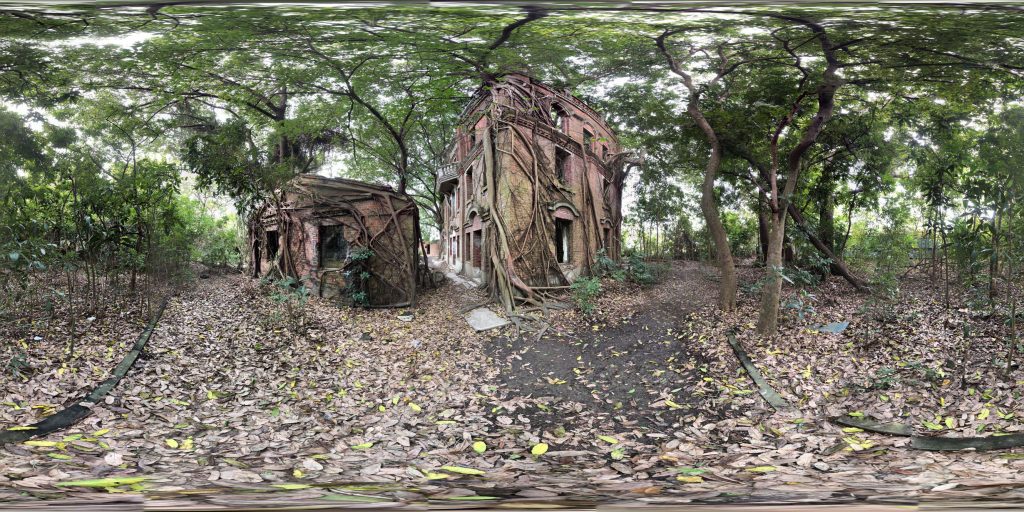
A 360-degree panoramic image captured at the abandoned and haunted Liu Family Mansion in Taiwan. Photo by: 偶然的旅人
Welcome to a world of exploration and intrigue at Abandoned in 360, where adventure awaits with our exclusive membership options. Dive into the mysteries of forgotten places with our Gold Membership, offering access to GPS coordinates to thousands of abandoned locations worldwide. For those seeking a deeper immersion, our Platinum Membership goes beyond the map, providing members with exclusive photos and captivating 3D virtual walkthroughs of these remarkable sites. Discover hidden histories and untold stories as we continually expand our map with new locations each month. Embark on your journey today and uncover the secrets of the past like never before. Join us and start exploring with Abandoned in 360.
Do you have 360-degree panoramic images captured in an abandoned location? Send your images to Abandonedin360@gmail.com. If you choose to go out and do some urban exploring in your town, here are some safety tips before you head out on your Urbex adventure. If you want to start shooting 360-degree panoramic images, you might want to look onto one-click 360-degree action cameras.
Click on a state below and explore the top abandoned places for urban exploring in that state.
You might also like