Abandoned Powell Building: Exploring Milledgeville’s Historic Asylum
Step inside the abandoned Powell Building at Central State Hospital in Milledgeville, Georgia, and explore a space where time and neglect have reshaped every corridor. From peeling paint and weathered walls to the quiet stillness that hangs in the air, this historic structure offers a raw look at decay, architecture, and the stories that linger long after a facility goes dark.
Below, you can experience the Powell Building at Central State Hospital through an immersive 360-degree virtual tour featuring 14 panoramic images. Scroll, click, and look around at your own pace to examine details you might miss on a fast walkthrough—perfect for urban explorers who appreciate atmosphere, history, and the beauty found in forgotten places.
Click here to view it in fullscreen.
If you’re fascinated by abandoned places in Georgia, the Powell Building in Milledgeville is a must-know destination. This imposing four-story structure, now a husk of peeling paint and echoing halls, was once the heart of Georgia’s largest insane asylum. Today it stands mostly empty, offering urban explorers (URBEX enthusiasts) an adventurous journey back through time. The building’s dark corridors and grand dome whisper stories of nearly 170 years of history, from compassionate care to harrowing scandals. In this post, we’ll uncover the Powell Building’s origins, its rise and fall, the reasons for its abandonment, and the lore that makes it a legendary site for urban exploring in Georgia.
Origins of the Georgia Lunatic Asylum (1842)
The story begins in 1837, when Georgia authorized a “State Lunatic, Idiot, and Epileptic Asylum” in Milledgeville. Construction soon followed, and by November 1, 1842, the first building opened its doors to patients. That initial structure – a four-story brick dormitory – together with later additions became known as the Center Building. This is the very building we now call the Powell Building, which served as the original hub of the asylum when it received its first patient in December 1842. The unfortunate inaugural patient, a man named Tillman Barnett of Bibb County, arrived chained to a wagon and died just months later of “maniacal exhaustion,” foreshadowing the asylum’s long and troubled history.
By 1855, the asylum embarked on expanding this main building. A grand central structure was constructed to connect the initial wings, forming a U-shaped complex. Completed in 1858, this expanded Center Building featured an impressive dome and neoclassical portico – intentionally designed to resemble the U.S. Capitol Building in Washington, D.C.. It housed administrative offices in the center and cavernous ward wings on each side, including a chapel added around 1855. The entire asylum complex sat on a 40-acre tract just outside Milledgeville (then Georgia’s capital), complete with its own farm, dairy, and even a cemetery, making it a self-sufficient little city for the mentally ill.
During the Civil War, the Center Building gained an eerie footnote in history. In 1864, Union General William T. Sherman’s army marched through Milledgeville on the infamous March to the Sea. Legend holds that Sherman spared the asylum’s buildings – including the still-young Center Building – recognizing it as a humanitarian institution without military significance. Patients and staff reportedly hid in the building’s basement and a network of tunnels during those turbulent times. To this day, tales of these underground passages add to the site’s mystique for urban explorers.
The Powell Building Emerges (Renaming and Expansion)
As the 19th century progressed, the asylum expanded dramatically. Under superintendent Dr. Thomas F. Green (1845–1879), patient care improved somewhat – physical restraints like chains were abolished and the asylum was run with an “institution as family” philosophy. Still, patient numbers kept climbing and the facilities struggled to keep up. By 1872, the asylum held 500+ patients with just a handful of physicians, a ratio of 112 patients per doctor. The wards overflowed as families across Georgia sent relatives deemed “unfit” or difficult to care for; after the Civil War this included formerly enslaved people and others with nowhere else to go.
In 1879, Dr. Theophilus Orgain Powell took over as superintendent, ushering in an era of both growth and notoriety. Dr. Powell, a former Confederate Army major, ran the institution with military efficiency. During his long tenure (1879–1907), the hospital’s population exploded from 700 to nearly 3,000. He oversaw construction of dozens of new buildings (including specialized African American patient wards, tuberculosis cottages, and “Colony Farm” acreage for food production). He also added humane touches like landscaped gardens, fountains, libraries, musical entertainment and dances for patients – improvements that earned international recognition for the asylum in its day.
However, Dr. Powell’s administration was not without controversy. He enforced strict racial segregation; Black patients were confined to a separate building, and when that building burned down in 1897, Powell infamously housed Black patients in the asylum’s tunnels until it could be rebuilt. Such episodes illustrate the darker side of the hospital’s operations even during supposedly progressive times. In 1898, near the end of Powell’s tenure, Georgia lawmakers officially renamed the facility from the Georgia Lunatic Asylum to Georgia State Sanitarium, hoping to modernize its image. By the time Dr. Powell died in 1907, the asylum had grown into a massive institution of 2,900 patients. To honor his impact (for better or worse), the venerable Center Building was renamed the Powell Building in 1907. From that point on, the asylum’s iconic heart bore the name it’s known by today.
Life Inside the Asylum’s Walls
At its peak, Central State Hospital (as the facility would later be called) was practically a city unto itself. By the mid-20th century it encompassed over 200 buildings on 1,700–2,000 acres, including dormitory-style wards, workshops, a fire station, a farm, a power plant, and even a railroad spur. It was reportedly the largest mental hospital in the world, housing nearly 12,000 to 13,000 patients at its peak in the 1960s. (For context, it rivaled New York’s Pilgrim State Hospital for that grim honor.) Throughout Georgia, people simply referred to the hospital by the name of its town – “Milledgeville” – and the very word became synonymous with mental illness. Parents would threaten misbehaving children with “I’ll send you to Milledgeville!” – such was the fearful aura the place held in the public imagination.
Inside the Powell Building and its adjuncts, daily life ranged from mundane routines to nightmarish scenes. In the 1800s, patients worked on the campus farm, in the laundry, and even helped construct buildings – a form of “therapy” that doubled as cheap labor. Religious services were held in the Powell Building’s chapel on Sundays, and recreational activities like billiards, theatricals, and dances were introduced in later years to brighten patients’ lives. The Powell Building’s central section housed administrative offices (and the superintendent’s quarters in early years), while its massive wings were lined with patient wards. Notably, each patient room door had a unique “bubble window” – a convex glass porthole that allowed staff to observe patients without opening the door. Many of these curious bubble windows have survived to this day (only two remain intact now), intriguing urbex explorers who peek into the rusted doors.
Despite attempts at humane care, the asylum also witnessed “the depths of man’s degradation,” as one 1950s hospital psychologist aptly put it. Treatment reflected the era’s limited understanding of mental illness. In the late 19th and early 20th centuries, that meant restraining violent patients in straitjackets or confining them to padded cells. By the 1930s and 1940s, more drastic measures arrived: insulin coma therapy, electroshock treatments, and even lobotomies were performed on patients in these very wards. Children with developmental disabilities were kept in metal crib-cages; adult patients might be doused in cold water or subjected to nauseating drugs in misguided efforts to “shock” them into sanity. The hospital also participated in medical experimentation – for example, in the 1910s patients were unwitting subjects in pellagra research (testing dietary changes for this vitamin deficiency disease), and in the 1920s doctors infected patients with malaria in an attempt to cure syphilis. In an era of widespread eugenics, involuntary sterilizations were also carried out on some asylum inmates considered “unfit”. These harsh practices, common at the time, leave a haunting legacy that clings to the Powell Building’s walls.
Overcrowding made everything worse. By the 1950s, the patient-to-doctor ratio at Milledgeville had become an appalling 100 to 1. In fact, an investigative reporter discovered that of the 48 “doctors” on staff, several had no medical training – they were actually former patients pressed into service. This shocking revelation came out in 1959, when journalist Jack Nelson published an exposé in the Atlanta Constitution calling the institution a “snake pit.” The expose revealed horrifying neglect and abuse: thousands of patients languishing with minimal care, and the asylum effectively being run by under-qualified staff. The scandal rocked Georgia. Hospital officials were fired, and the state finally boosted funding to hire qualified staff. Nelson’s reporting won a Pulitzer Prize and marked the beginning of meaningful reforms. It was a rare victory for the voiceless patients and a pivotal moment in the hospital’s history – but for countless individuals, it came far too late.
Notable Incidents and Scandals
The Powell Building and Central State Hospital have seen more than their share of tragedy and scandal. Here are some of the most infamous events associated with the hospital’s long history:
-
“City of the Feeble-Minded” Stigma: By the late 19th century, Milledgeville’s asylum had a daunting reputation. Families sent relatives for reasons ranging from actual psychosis to mere senility, alcoholism, or “imbecility.” The name Milledgeville itself became a chilling shorthand for a place to dump society’s unwanted. This stigma reinforced the isolation and shame surrounding mental illness for generations.
-
Fire and Tunnels (1897): In 1897, the asylum’s only ward for Black patients burned down. Superintendent Powell, rather than integrate patients into other buildings, confined Black patients in basement tunnels of the Powell Building until a new segregated ward was built. This disturbing decision highlights the Jim Crow era prejudice that even afflicted hospital care. One can only imagine the suffering of those kept in the bowels of the building.
-
Burial of 25,000 Patients: Death was a frequent visitor at Central State. From the 1840s through 20th century, an estimated 25,000 patients died and were buried on the hospital grounds in unmarked graves. For decades, simple iron stakes or numbered markers were the only record of the dead, many of which have been lost or overgrown. The result is a patchwork of forgotten cemeteries around the campus, a heartbreaking testament to lives effectively erased. (In the 1990s, volunteers finally erected a bronze angel monument and recorded the names they could, as a gesture of remembrance.)
-
1950s “Snake Pit” Exposé: As described above, journalist Jack Nelson’s 1959 investigative series was a watershed scandal. The revelation that Central State had only 48 doctors for 12,000 patients – and that even some of those doctors were actually asylum inmates – was a national embarrassment. The Pulitzer Prize-winning exposé forced Georgia’s government to acknowledge conditions that had festered for decades. This led to increased funding and eventually to de-institutionalization efforts under governors Carl Sanders and Jimmy Carter in the 1960s.
-
Modern Deaths and DOJ Investigation: Astoundingly, scandals continued into the 21st century. In 2007, an investigation found 42 suspicious patient deaths over a short period at Central State (by then much downsized). This prompted the U.S. Department of Justice to step in and demand changes to ensure patient safety. The fallout hastened the final closure of most of the hospital. By 2010, Georgia’s officials announced that the aging facility would shut its doors for good. After nearly 168 years, Milledgeville’s era as “state asylum” had come to an end.
These episodes, among others, cement Central State Hospital’s notoriety in the annals of psychiatric history. For all the good intentions and genuine care that undoubtedly existed here, the institution also embodied the failures of an overburdened system. Abuse, neglect, overcrowding, and archaic treatments left deep scars – and some say restless spirits – within the Powell Building’s now-abandoned halls.
From Milledgeville State Hospital to Abandonment
The latter half of the 20th century saw Central State Hospital gradually empty out. Multiple factors drove this decline: the advent of psychiatric medications, the rise of community mental health centers, and changing laws that favored smaller regional hospitals or outpatient care over massive institutions. In 1967, the facility was renamed Central State Hospital (having been called Milledgeville State Hospital since 1929). By this time, the patient census was already dropping from its peak. In the 1970s and 1980s, waves of patients were discharged or transferred out as part of de-institutionalization. Buildings that once bustled with activity fell quiet. Some old wards were repurposed as minimum-security prisons in the 90s to make use of the space, but even those have since closed, leaving boarded-up shells.
The Powell Building, being the symbolic heart of the campus, remained in use longer than many structures. Its ornate dome and columned entrance continued to house administrative offices up until the final years of the hospital. In fact, as recently as 2015 a small portion of the Powell Building was still occupied by state health department staff and the local redevelopment authority. For the most part, though, this gigantic 181,000-square-foot building was empty and deteriorating – “mostly empty and falling into decay,” as one account noted in 2015. Paint peeled from the walls, wallpaper hung in tatters, and the echo of your footsteps down its 300-foot hallways could send a shiver up your spine. Nature began reclaiming parts of the structure; ivy crept in windows and moisture ate away at plaster ornamentation.
Finally, in 2010, Central State Hospital closed its doors to psychiatric patients (aside from a few specialized units in newer buildings elsewhere on campus). The Powell Building – along with dozens of surrounding historic buildings like the Jones Building (a 1929 general hospital) and the Walker Building (1884 convalescent ward) – was left vacant. This once-grand edifice had effectively become an abandoned building. Its fate, however, remains a subject of intense debate and hope.
Preservation Efforts and Renaissance Park
For more than a decade after closure, local officials and preservationists have wrestled with what to do with the sprawling asylum campus. In 2012, the state created a redevelopment agency and branded the site “Renaissance Park.” The idea was to attract new investment and breathe new life into these historic buildings. A few small enterprises and state offices moved into peripheral buildings, but the biggest structures largely sat unused. By 2023, the State of Georgia decided that maintaining many of the crumbling wards was not feasible. Governor Brian Kemp signed an order to demolish three of the largest abandoned hospital buildings – the Jones, Walker, and Green buildings – citing safety hazards and costs. This sparked public outcry from historians and preservation groups who cherish the hospital’s legacy.
Crucially, the order spared the Powell Building. Officials announced that the iconic Powell Building would remain standing as the “centerpiece” of any future redevelopment on the campusg. As the oldest and most significant structure (listed on the National Register of Historic Places in 2005), the Powell Building has a protected status and symbolic value that even the state could not ignore. Plans have been floated to stabilize and renovate it, potentially turning it into a museum, educational center, or offices as part of the Renaissance Park project. Preservationists are adamant that this landmark – which witnessed so much of Georgia’s mental health history – should be preserved for posterity. While many neighboring shells may soon be lost to the wrecking ball, the Powell Building endures, awaiting its next chapter.
For now, though, it sits in limbo: sealed up, with asbestos abatement and minimal maintenance being done to keep it from deteriorating further. Its windows are mostly shuttered or broken, and a silence hangs over the once-bustling foyer where thousands of anxious souls passed through. This very juxtaposition – an important historic monument that is also profoundly neglected – makes the Powell Building an irresistible magnet for urban explorers.
Urban Exploring the Powell Building
For anyone into urban exploration in Georgia (URBEX), the Powell Building is like a holy grail. It combines elements that urban explorers seek out: grand architecture, advanced decay, and a heavy dose of eerie history. The building’s exterior alone is captivating – a long white facade topped by a weathered dome, with tall pillars guarding the entrance. Weeds sprout from the cracked steps where patients once lined up to enter. The atmosphere is quiet and forlorn; on a breezy day, you might hear shutters banging softly or birds nesting in the eaves.
Those who have ventured inside (legally or otherwise) report a spine-tingling experience. The interior is a labyrinth of hallways and ward rooms, some containing old metal bed frames or peeling murals from the 1970s. In certain spots, you might find padded isolation cells or remnants of medical equipment – stark reminders of the building’s prior use. One particularly haunting space is a small room painted entirely in soothing blue. In the asylum’s later years, this room was used to calm agitated patients; if color therapy failed, they might even be chained to a chair in the corner of the room. Standing in that space today, with paint peeling in strips, you can almost feel the anguish that once permeated it.
Exploring the Powell Building is an exercise in stepping back in time. Imagine walking down the “long hallway” that stretches through the center of the building – it’s the same corridor seen in a famous 1930s photograph, lined with arched transom windows and columns. In its heyday, this hall would have bustled with nurses, orderlies, and patients moving between wards. Now, your footsteps echo against the plaster walls, and each door you pass leads to a story. Some doors still have those convex glass observation windows; peering through them can send a jolt of adrenaline through even a seasoned explorer. What lurked behind those doors in 1900? Or in 1950? The mind runs wild.
Caution: It must be said that the Powell Building is officially off-limits to the public. The campus is patrolled by security, and the structures are hazardous (containing asbestos, lead paint, and unstable floors). Urban explorers often operate under the mantra “take nothing but pictures, leave nothing but footprints,” but one should add: enter at your own risk. The safest way to explore is from the outside or through sanctioned tours if they are ever offered. In recent years, the local historical society has opened a small museum exhibit about Central State Hospital at an adjacent building, and occasionally guided tours of the grounds are arranged. These offer a legal way to learn about the site. Trespassing inside the Powell Building, besides being dangerous, could jeopardize preservation efforts.
That said, even walking the grounds of Central State Hospital is a powerful experience. The pecan grove in front of the Powell Building is dotted with iron markers indicating those unmarked graves of patients. The air feels heavy with memory. Urban explorers who visit often describe an eerie stillness – as if the campus is paused, with the spirits of 25,000 former residents lingering quietly. Photographers in particular love the Powell Building for its haunting aesthetic. Sunlight streaming through broken windows casts dramatic shadows across the decay, making for stunning photographs. It’s no wonder this location has been featured in TV shows and even a CW network vampire series (the nearby Jones Building appeared in The Originals, doubling as a spooky set). The Powell Building itself, with its iconic silhouette, frequently graces abandoned Georgia photography collections
Other Names and Legacy
To truly appreciate the Powell Building’s significance, one should know the various names the institution carried over time:
-
Georgia Lunatic Asylum (opened 1842) – original name when Powell Building first opened
-
Georgia State Sanitarium (1898) – name change as mental health care evolved
-
Milledgeville State Hospital (1929) – another rename reflecting a modern hospital approach
-
Central State Hospital (1967 to present) – the final official name, still used today for the grounds and any remaining facilities
Throughout all these eras, the Powell Building (formerly called the Center Building or “Central Building”) remained the literal and symbolic center of the hospital’s campus. It has witnessed the full arc of mental health treatment – from 19th-century moral treatment to 20th-century horrors to 21st-century abandonment. Few places in the U.S. encapsulate the history of psychiatric care as completely as this structure. Little wonder the Powell Building is sometimes nicknamed “Georgia’s Gate to Hell” by local youths and ghost hunters, and conversely, a “Sanctuary of Healing” in older records. Its dual nature in nickname mirrors its dual legacy.
Conclusion
The Powell Building in Milledgeville, GA stands as a monumental reminder of our ever-evolving approach to mental health – the compassion, the mistakes, and the reforms. For urban explorers, it offers an adventurous trek into a past world: long empty wards, hidden tunnels, and artifacts of a bygone era of asylums. For historians and the curious, it’s a place that demands we remember the thousands of lives that passed through its doors – some healed, many hurt, all human.
As you explore (physically or virtually) this abandoned landmark in Georgia, do so with respect. Every cracked brick and rusted bed frame has a story to tell. The Powell Building may be crumbling, but its stories are very much alive. Whether it eventually becomes a museum or continues to sit in quiet decay, it remains an unforgettable site for anyone interested in URBEX, history, or the thin line between sanctuary and prison that it represented. In the silent, dusty sunlight of its halls, the Powell Building invites us to reflect on how far mental health care has come – and how the echoes of the past still inform the present. For those who seek adventure with meaning, this abandoned Georgia asylum promises both in abundance.
If you liked this blog post, you might be interested in learning about a few more buildings on the old Central State Hospital site such as the Howell Building, the Alan Kemper Building or the Ingram Building.
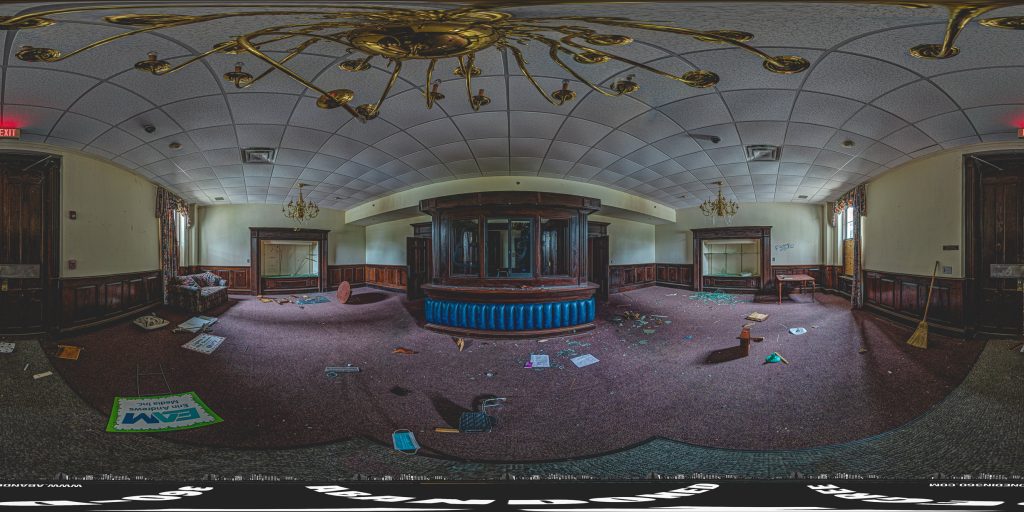
A 360-degree panoramic image inside the abandoned Powell Building at the old Central State Hospital in Milledgeville, Georgia. Photo by the Abandoned in 360 URBEX Team.
Welcome to a world of exploration and intrigue at Abandoned in 360, where adventure awaits with our exclusive membership options. Dive into the mysteries of forgotten places with our Gold Membership, offering access to GPS coordinates to thousands of abandoned locations worldwide. For those seeking a deeper immersion, our Platinum Membership goes beyond the map, providing members with exclusive photos and captivating 3D virtual walkthroughs of these remarkable sites. Discover hidden histories and untold stories as we continually expand our map with new locations each month. Embark on your journey today and uncover the secrets of the past like never before. Join us and start exploring with Abandoned in 360.
Equipment used to capture the 360-degree panoramic images:
- Canon DSLR camera
- Canon 8-15mm fisheye
- Manfrotto tripod
- Custom rotating tripod head
Do you have 360-degree panoramic images captured in an abandoned location? Send your images to Abandonedin360@gmail.com. If you choose to go out and do some urban exploring in your town, here are some safety tips before you head out on your Urbex adventure. If you want to start shooting 360-degree panoramic images, you might want to look onto one-click 360-degree action cameras.
Click on a state below and explore the top abandoned places for urban exploring in that state.
You might also like