Abandoned Remington Arms Munitions Factory in Bridgeport, Connecticut – History and URBEX Adventure
Embark on a comprehensive journey around the desolate and forgotten Remington Arms Munitions Factory, situated in the heart of Bridgeport, Connecticut. This virtual tour offers a unique 360-degree panoramic view, allowing you to immerse yourself in the eerie, abandoned spaces of the factory. As you navigate through the tour, you’ll experience the haunting silence and the remnants of a once-thriving production hub. The all-encompassing perspective provides a detailed look into every nook and cranny, revealing the history and stories hidden within the dilapidated walls. This digital exploration not only captures the essence of the factory’s past glory but also highlights the passage of time and the impact of industrial decline.
Click here to view it in fullscreen.
Image by: Ethan
In the heart of Bridgeport, Connecticut, an imposing relic of the Industrial Revolution stands silent yet awe-inspiring. The Remington Arms Munitions Factory – a sprawling ammunition plant that once hummed with machinery and thousands of workers – now lies abandoned, drawing urban explorers with its haunting beauty and storied past. It’s one of the most infamous abandoned places in Connecticut, a site where rusting structures and broken windows whisper tales of wartime heroics, industrial might, and eventual decline. For those into urban exploring in Connecticut, the allure of this decaying complex is irresistible: a chance to step back in time and experience a piece of living history, adrenaline and flashlight in hand.
Approaching the Remington Arms site, you’re greeted by the iconic shot tower rising above the East Side skyline. Its bottle-like silhouette, towering 10 stories high, was completed in 1909 and served a crucial function: molten lead was poured from the top, dropping 133 feet to form perfectly round gunshot in water basins below. Today, the shot tower’s brick facade is weathered and its windows eerily empty, yet it remains sturdy – a lone sentinel watching over what’s left of a once-mighty industrial complex. This is the gateway to a journey through time: from the factory’s construction in 1867, through its heyday supplying two world wars, to its ultimate abandonment and decay.
In this blog post, we’ll delve into the rich history of the Remington Arms Munitions Factory, uncovering when it was built and opened, how it operated for well over a century, and why it was left to ruin. We’ll explore the factory’s role in arming the nation, the dramatic events (including massive explosions and scandals) that shaped its story, and the legends of ghosts that now cloak its dark halls. With an adventurous tone and a respect for the past, let’s step inside this URBEX adventure and discover the secrets of Remington Arms in Bridgeport.
Origins of an Industrial Giant (1867–1912)
The story of the Remington Arms factory in Bridgeport begins in the late 19th century, at a time when Connecticut’s industrial engine was roaring to life. In 1867, a company called the Union Metallic Cartridge Company (UMC) opened a cartridge manufacturing plant on the city’s East End. This was the birth of the complex that would later become the Remington Arms factory. UMC was founded by businessman Marcellus Hartley, who foresaw the future of ammunition in metallic cartridges (a cutting-edge innovation after the Civil War). By bringing together financial backing and technological know-how, Hartley’s UMC quickly thrived, producing ammunition on a massive scale. In fact, by 1870 the factory’s production line (designed by engineer Alfred Hobbs) could churn out 120,000 cartridges a day – a remarkable feat for its time.
Throughout the late 1800s, UMC expanded its operations in Bridgeport, establishing itself as a powerhouse of munitions production. The company’s early success set the stage for a pivotal merger that would forever link Bridgeport to one of America’s most famous gunmakers. In 1888, Hartley acquired E. Remington & Sons (a New York-based firearms manufacturer founded in 1816), and soon the ammunition and firearms businesses were merged under the Remington-UMC banner. Although the firearms were still largely produced in Ilion, NY, the Bridgeport facility became an essential arm of Remington’s ammunition production and later, arms assembly. By the turn of the 20th century, Bridgeport’s East Side was transforming into a vast industrial campus dedicated to feeding America’s growing appetite for arms and ammunition.
A defining feature of the factory emerged in the early 1900s: the Remington shot tower. With the need to produce tons of lead shot (small spherical pellets for shotgun shells) in-house, construction of the shot tower began in 1908 and finished by February 1909. Standing about 190 feet tall, this brick tower was not only the tallest building in Connecticut for many years but also a blend of form and function. Each day, workers hoisted molten lead to the top of the tower and poured it through sieves. As the droplets fell 133 feet, they cooled into perfect spheres before landing in water pools at the bottom – an ingenious process to mass-produce ammunition shot. The shot tower was even designed to be ornamental; its architect wanted it to be an “ornament to the city,” and indeed, for decades it dominated Bridgeport’s skyline as a proud symbol of progress.
By the early 1900s, the Union Metallic Cartridge Company’s success also brought some peril. Industrial accidents were an ever-present risk in munitions manufacturing. On May 14, 1906, a catastrophe struck: 16 tons of gunpowder ignited in an on-site magazine, triggering a massive explosion. The blast was so powerful it shattered windows all over Bridgeport and was even felt across Long Island Sound. Towns as far as Old Saybrook thought an earthquake had hit. Incredibly – almost miraculously – no one was killed in the 1906 explosion. This close call spurred the company to take safety more seriously. They established a remote 422-acre testing and storage site called Remington Woods (several miles away) to handle live munitions, thus reducing the risk of such a disaster happening again in the heart of the city. To this day, that area remains undeveloped woodland, a lingering side-effect of the 1906 incident.
Shortly after, the corporate landscape shifted. In 1912, the Union Metallic Cartridge Company formally merged with Remington Arms. This merger turned the Bridgeport plant into Remington’s primary ammunition factory and even its corporate headquarters for a time. The timing couldn’t have been more critical, because the world was on the brink of immense conflict.
Wartime Boom and Expansion (1914–1945)
When World War I erupted in 1914, the demand for arms and ammunition skyrocketed – and Bridgeport was poised to deliver. Under the leadership of Remington-UMC (specifically Marcellus Hartley Dodge, Hartley’s grandson), the company undertook a staggering expansion to fulfill Allied wartime contracts. In 1915, Remington built an entirely new “Russian rifle plant” across the street from the original factory, after securing a contract from the Russian Empire for a million rifles and 100 million rounds of ammo. This expansion was epic in scale. In a matter of months, 13 massive factory buildings (each five stories tall) were erected along Boston Avenue, all connected by a half-mile long central corridor. The complex spanned 1.5 million square feet – by some measures, it was the largest manufacturing facility under one roof in the world at that time. So vast was the operation that workers reportedly rode bicycles inside to get from one end to the other!
Bridgeport’s population swelled with the influx of labor. Over 20,000 workers were employed by Remington in 1916, including thousands of newly hired immigrants and locals drawn by wartime jobs. Entire neighborhoods sprang up around the factory to house the workers – an area nicknamed “Remington City,” with 600 company-built houses for employees and their families. The factory campus by 1916 encompassed 73 acres and over 300 buildings, making it a self-contained industrial city within the city. The roar of machinery was constant, and the output was astonishing. By company records, over 17,000 workers at the Bridgeport plants were producing “literally tons of ammunition and weapons each year” during the first half of the 20th century. Remington’s Bridgeport complex became one of the largest munitions factories in the world, a powerhouse that armed not only U.S. forces but also allies abroad.
The factory’s contributions to World War I were significant – it supplied rifles and ammo to Britain, France, and Russia (until the Russian revolution abruptly canceled the Czar’s contracts). In fact, a noteworthy historical footnote: Remington-manufactured ammunition was aboard the Lusitania when it was sunk by a German U-boat in 1915, and some say the secondary explosions of that hidden munitions cargo hastened the ship’s demise. The war ended in 1918, and with it, the feverish production boom subsided. This sudden drop in demand left Remington with more factory space than it could use. The gigantic Boston Avenue rifle plant, built for the war effort, now stood partly idle. By 1920, Remington decided to sell that newer portion of the complex to General Electric (GE) for $7 million. GE repurposed those buildings for its own manufacturing (producing electrical appliances and even using one as its corporate headquarters for a time). Meanwhile, Remington continued making ammunition and other products in the remaining Barnum Avenue side of the campus, which still included the original shot tower and associated factories.
During the interwar years, Remington Arms – now partly owned by the DuPont Company (which bought a controlling share in 1933 amid the Great Depression) – kept the Bridgeport facility busy. The product lines diversified beyond just bullets and guns: Remington manufactured everything from typewriters and cash registers to household utensils at various plants. Still, ammunition and small arms were the bread and butter, especially as the world braced for another conflict.
World War II saw the Bridgeport factory roar back to life at full capacity. Old photographs from the 1940s show the sprawling complex at its peak, with smokestacks billowing and freight trains rolling in loaded with raw materials. Remington’s workforce swelled again (many women joined the factory lines while men went off to war) and the plant churned out countless rifles, cartridges, and other ordnance for the U.S. military and its allies. It’s said that every Allied soldier in WWII likely fired bullets that came out of Bridgeport. By this time, the facility was so extensive that it straddled both sides of Barnum Avenue, linked by tunnels under the street.
Yet, with such intensive production came great risks. The factory experienced tragic accidents even in these productive years. In 1942, at the height of wartime output, disaster struck again: a huge explosion on the production floor shook the plant. This time it was deadly. Seven workers were killed and some 80 others injured in the blast. Rumors circulated that it might have been an act of sabotage by enemy agents – after all, the plant was a critical military supplier – though nothing was proven. The 1942 explosion left a dark mark on the factory’s history. Along with other grisly workplace accidents (including tales of two unfortunate workers who fell into vats of molten metal), it fed into local legends that the complex might be cursed or haunted. Indeed, these incidents would birth ghost stories that linger to this day (more on that in the Urban Legends section below).
By war’s end in 1945, the Remington Arms plant in Bridgeport had established itself as a patriotic juggernaut – a place that had literally fueled America’s victories with munitions. It was a shining example of the Industrial Era, as one writer described, “a huge bustling facility in the heart of a burgeoning city” that was both an economic engine and a cornerstone of the American military complex. But the shine would not last forever. The mid-20th century brought new challenges that the old factory could not so easily overcome.
Decline and Final Years (1950s–1988)
After World War II, the demand for arms tapered off and many American factories faced the need to modernize. The Remington complex in Bridgeport, with its maze of old brick buildings, began to feel the strain of age and competition. The advent of the Cold War kept weapons manufacturing alive to an extent, but economic factors were stacking up against older industrial cities in the Northeast. By the 1960s, Bridgeport in general was experiencing an economic downturn – and Remington Arms was no exception. The cost of labor was rising, the facilities were becoming outdated, and southern and midwestern states beckoned with cheaper real estate and labor for new factories.
As the “Arsenal of America” during two world wars, Remington’s Bridgeport plant was legendary – but business logic dictated change. In 1970, Remington decided to move the majority of its ammunition production to a brand-new plant in Lonoke, Arkansas. This modern facility was more efficient and closer to the company’s customer base in the growing Sun Belt. The shift was emblematic of a broader trend of industrial migration; as one observer put it, “like many factories in the Northeast, it was only a matter of time before someone somewhere else could do it better and cheaper”. With the opening of the Arkansas plant, the Bridgeport operations began winding down. The sprawling Connecticut complex – which had once run at full tilt – now saw sections go quiet.
Remington didn’t shutter Bridgeport immediately in 1970, but over the next decade and a half it steadily downsized local production. In 1980, parts of the property (north of the site near an old cemetery) were sold off to other companies, and a few historic buildings were demolished to make way for new enterprises. The remaining active areas focused on specialty products and residual ammo work. By the early 1980s, however, it was clear that the end was near. In 1984, Remington moved its headquarters out of Bridgeport to Wilmington, Delaware, severing the corporate ties that had existed since 1912. A few years later, in 1988, Remington Arms ceased all production in Bridgeport. This marked the end of an era – 121 years of continuous industrial operation at the site had come to a close.
The factory complex, once the pride of Bridgeport, was left eerily silent. Remington sold off the last of the property (circa 1986, to a local developer group), and the gates were locked. What remained was a vast, empty shell: rows of brick workshops with broken panes, towering chimneys cold and crumbling, and of course the rusting shot tower, standing watch over an “empty sprawling complex… slowly eaten away by urban decay”. The departure of Remington was a heavy blow to the community – it not only symbolized the city’s economic decline but also left behind a contaminated brownfield that would prove challenging to repurpose. Tons of lead dust, chemicals, and even unexploded ordnance lurked in the soil and buildings, making redevelopment an expensive and daunting prospect.
For Bridgeport, the late 1980s and 1990s became a period of grappling with this blighted site. General Electric, which still owned the adjacent former rifle plant (across Boston Ave), also wound down operations – GE closed its last activities there by 2007, demolishing those newer structures by 2012. That left the Remington “Southern” plant on Barnum Avenue (around the shot tower) as a prominent ruin on the East Side. Various plans were floated for reusing the old Remington property: perhaps a new industrial park, or a mixed-use development. But the contamination and sheer scale of the derelict complex made investors skittish. For years, the site languished, passing through different owners. A company called RemGrit (an abrasives manufacturer) bought part of it in the late ’80s but only held it briefly. Storage warehouses and small businesses used bits of it here and there – even into the 2000s, GE was reportedly still using about a tenth of the property for storage of equipment. However, by and large, the majority of the factory became an abandoned wasteland. The phrase “ghost town” is often a cliché, but here it felt apt: the empty halls and courtyards that had once bustled with life were now occupied only by rust, pigeons, and stray cats.
Decay, Vandalism, and Urban Legends (1988–2010s)
Left to the elements and the occasional intruder, the Remington Arms factory’s condition deteriorated rapidly. Broken windows exposed the interiors to decades of rain and snow. Roofs leaked and collapsed in places, wooden floors buckled under moisture, and moss and vines crept over machinery that hadn’t budged since the Reagan era. Local youth and daring explorers found their way in, leaving graffiti tags on walls and sometimes absconding with artifacts. Scrap metal thieves scavenged whatever they could: copper wiring, steel beams, and pipes were torn out of the walls, leaving gaping wounds in the structure. The complex gained a reputation as a dangerous playground – not just because of its structural hazards, but due to its seedy surroundings. The neighborhood around 812 Barnum Avenue struggled with poverty and crime, and the abandoned factory unfortunately became a magnet for illicit activity at night. Police would occasionally sweep the site for trespassers, finding evidence of drug use or gang hideouts amid the ruins.
With no maintenance, small incidents often turned into major damage. One recurring threat was fire. Over the years, a number of suspicious fires broke out in the old Remington buildings, likely sparked by vandals or squatters. For example, in August 2010 a large blaze tore through one of the vacant structures, sending flames and black smoke into the sky and prompting firefighters to battle the inferno high atop the crumbling roof. Again in 2014, another fire gutted a section of the factory – a three-alarm inferno that authorities suspected was arson. And in 2017, yet another fire consumed part of a long-empty warehouse building on the site. Each fire left more of the place charred and unstable. By the late 2010s, entire building wings had collapsed into piles of brick and twisted metal. What little “character” the interiors once had (old equipment, signage, etc.) was largely destroyed, either by flame or the subsequent water damage and rot.
Yet, even as the physical condition of Remington Arms worsened, its legend grew among urban explorers and paranormal enthusiasts. Locals swapped ghost stories about the site’s tragic past. They spoke of seeing shadowy figures darting in the windows, hearing unexplained whispers and screams echoing in the empty halls, and feeling sudden cold spots that gave them goosebumps on hot summer days. The 1942 explosion that killed workers fueled tales that some of those who perished might still roam the factory as restless spirits. Reports of these hauntings became so prevalent that in 2009 the Travel Channel’s “Ghost Adventures” show filmed an episode at Remington Arms, eager to investigate the claims. The TV crew’s presence only cemented the factory’s status as one of Connecticut’s most haunted locales in the popular imagination.
Indeed, more than one person has flat-out labeled the property “cursed”. Considering the string of misfortunes – massive explosions, deadly accidents, financial scandals, arson, and decay – it’s easy to understand why such a dark aura surrounds the place. But for many urban explorers (or URBEX aficionados), these very elements made the Remington factory an ultimate destination. It was the perfect blend of history and mystery, danger and discovery.
Explorers who ventured past the barbed wire and “No Trespassing” signs describe an environment that is both eerie and awe-inspiring. Upon stepping inside, one might find long corridors littered with debris, shafts of light piercing through holes in the roof onto rusted conveyors and toppled file cabinets. In some rooms, mossy green growth carpeted the floors, reclaiming the man-made structure for nature. Pigeons fluttered out of dark corners, startled by intruders. Here and there, a lone piece of furniture – an office chair or a metal desk – would sit covered in dust, as if awaiting workers who would never return. In one building, urban explorers found old machinery lying on its side, such as a giant hydraulic press, amazingly “unmolested by scrappers” and still weighing several tons. Graffiti artists had left their marks on concrete pillars and brick walls, some works more elaborate than others, turning the site into an impromptu street art gallery.
The crown jewel for explorers was always the shot tower. Climbing the narrow metal stairs of this tower (not for the faint of heart, given many steps were corroded) rewarded the bold with a panoramic view of Bridgeport. One explorer recounted how reaching the top of the shot tower at sunrise was breathtaking – you could see the city skyline, the glint of the Long Island Sound, and the entirety of the abandoned complex below, looking like a post-apocalyptic scene. Standing up there, you might imagine the tower in its prime: vibrating from the hum of machinery, with workers hauling buckets of molten lead up and down. Today, of course, silence reigns, broken only by the wind or perhaps a distant police siren.
However exhilarating, exploring Remington Arms was (and still is) extremely dangerous and illegal. Police have detained trespassers, and there are real physical hazards – rotten floors, open elevator shafts, asbestos and lead dust, not to mention the unsavory individuals who might be using the site for activities far removed from history or photography. As the local website Damned Connecticut wryly noted, “You probably shouldn’t [go] – not because of things otherworldly, but because of people this worldly”, referencing the drug dealers and gang members known to frequent the blighted area. In its abandoned state, Remington Arms was a liability and a tragedy waiting to happen.
The Final Chapter: Preservation and Redevelopment (2020–Present)
By the 2010s, city officials and residents alike had grown tired of the Remington eyesore and its dangers. Numerous proposals to demolish or rehabilitate the site had come and gone, often stalled by lack of funds or disputes over who was responsible for cleanup. A breakthrough came when the City of Bridgeport gained legal ownership of major portions of the property around 2010–2011, after a protracted process with the former owners (Remington’s real-estate successors). In 2018, the city received some state and federal assistance to address this long-standing brownfield. Finally, in 2020, Bridgeport’s city government allocated $5 million to begin demolition of the remaining factory structures. Decades of decay had left most buildings past saving, so the plan was to clear everything except the historic shot tower.
Demolition crews arrived in force by April 2023, and the landscape began to change dramatically. One by one, the crumbling brick buildings that lined Barnum Avenue were knocked down. Longtime residents watched with bittersweet feelings as the “canyon of brick” that once defined the street was reduced to piles of rubble. By the end of 2023, the bulk of the Remington plant’s crumbling buildings were gone. Only a few small structures and outbuildings (including a garage that had been used by RemGrit Corp) and, of course, the shot tower were left standing amidst a cleared, fenced-off lot.
Saving the shot tower became a priority and a point of pride. The city spent an additional $3 million to stabilize and preserve the tower – boarding up its windows with painted panels and reinforcing the base – to ensure this landmark survives as a monument to Bridgeport’s industrial heritage. Though now lonely in an open field, the shot tower’s presence is meant to anchor future redevelopment with a touchstone of the past. In fact, local officials see it as a potential tourist attraction or centerpiece of whatever gets built next, given its distinctive appearance and historical significance.
As of early 2026, the Remington Arms site has been subdivided and is actively being marketed for redevelopment. The city controls 11 acres of the property, mostly on the south side where the factory buildings stood (these acres have been fully remediated and cleared). Another 5 acres remain in private hands (Remgrit Realty), largely vacant land on the periphery. In late 2025, Bridgeport put out a request for proposals (RFP) to attract developers, with a preference for projects that bring jobs – such as light manufacturing, tech, or even healthcare-related industry – rather than just housing. The RFP notes the site’s incredible history: “First constructed in 1867, the Remington Arms complex was an iconic landmark of industrial Bridgeport… its factories armed the U.S. military and forces abroad for more than a century until they were sold in 1986”. It also mentions that now, with the land cleared and the “restored Shot Tower” in place, the area is ready for a new chapter.
There is hope that new development on this site will revitalize the East Side neighborhood that Remington once sustained. Ideas floated have included advanced manufacturing facilities, a possible rail station (Barnum Station) to better connect Bridgeport’s East Side by train, or even educational and community spaces. Whatever comes, the emphasis is on balancing progress with heritage. The preservation of the shot tower ensures that any new complex will forever be reminded of what stood there before. As one local official put it, this is “both the end of an era and the beginning of a new chapter” for Bridgeport. The industrial legacy remains intact in the form of that towering brick obelisk, which will likely get plaques or even a small museum detailing the history of Remington Arms on the site.
Conclusion
The Remington Arms Munitions Factory in Bridgeport is a place where history and legend intertwine. From its opening in 1867 through a century of operation, it played a pivotal role in arming America, especially during two world wars. Its rise mirrored the growth of Bridgeport as an industrial powerhouse, and its fall symbolized the economic challenges that many Northeastern cities faced in the late 20th century. The factory’s ruins have inspired fear, awe, and curiosity – birthing ghost stories of molten-metal mishaps and wartime sabotage, as well as drawing intrepid urban explorers fascinated by what remains of a bygone era.
Today, as one walks by 812 Barnum Avenue, the scene is dramatically different than a decade ago. The sprawling complex is mostly gone, yet the shot tower still pierces the sky, defiantly proclaiming that something important once stood here. For urban explorers and history buffs alike, the Remington Arms factory remains an emblem of Connecticut’s rich industrial past – a past filled with innovation, toil, triumph, and tragedy. While we may soon see new buildings rise on the cleared land, the lessons and stories of Remington Arms won’t be buried. They live on in the photographs taken by explorers, the tales told by locals, and the very bricks of the preserved tower.
In the end, the saga of the Remington factory offers a cautionary tale about progress and change, but also a hopeful note about remembrance and renewal. The site’s future is still being written, even as its historic structures fade into memory. Will the new developments honor the spirit of the old factory? Will the shot tower become a proud monument amid modern facilities? For the city of Bridgeport and fans of URBEX adventures, seeing this abandoned giant find new purpose is a dream long in the making. The Remington Arms Munitions Factory may have been left to the ghosts for years, but its story isn’t over – it’s simply turning the page. And as for whether exploring such places is worth it, given all the risks and hardships… for those of us with an adventurous spirit and respect for history, the answer is yes.
If you liked this blog post, you might be interested in the Buckner Building in Alaska, the Presidio Modelo in Cuba or Six Flags New Orleans in Louisiana.
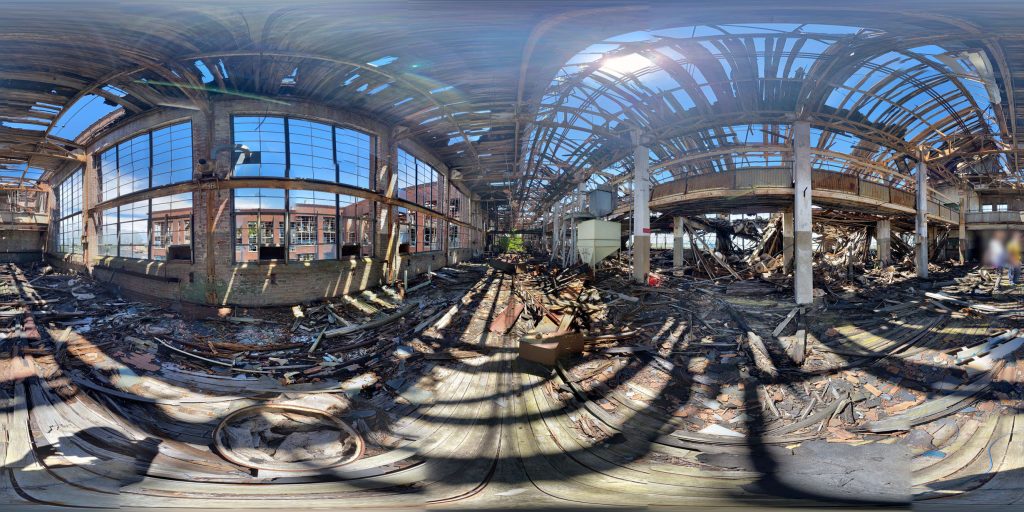
A 360-degree panoramic image at the abandoned Remington Arms Munitions Factory in the heart of Bridgeport, Connecticut. Image by: Ethan
Do you have 360-degree panoramic images captured in an abandoned location? Send your images to Abandonedin360@gmail.com. If you choose to go out and do some urban exploring in your town, here are some safety tips before you head out on your Urbex adventure.
Unlock the secrets of exploration by diving into precise GPS data available exclusively for an array of hidden gems and hundreds of other captivating sites, all within our members’ section. By investing in a Gold Membership, you’re not just gaining access; you’re securing a key to a vast, global archive of abandoned, untouched, and mysterious locations waiting to be discovered. Embark on your adventure with confidence, knowing every corner of the world can be within your reach. Don’t just observe—explore, discover, and claim the extraordinary journey that lies ahead with our treasure trove of world secrets. Subscribe now and transform the way you see the world!
If you want to start shooting 360-degree panoramic images, you might want to look onto one-click 360-degree action cameras.
Click on a state below and explore the top abandoned places for urban exploring in that state.
You might also like