Abandoned Asheville Waste Paper Plant: Urban Exploring North Carolina’s River Arts District
Asheville Waste Paper offers urban explorers a compelling look at an abandoned industrial site shaped by time, exposure, and decline. The remaining structure stands as a reminder of Asheville’s working past, where production once defined the space and daily activity filled its walls.
The panoramic images below give you a closer view of Asheville Waste Paper, revealing the weathered details, empty interiors, and fading character that make forgotten places like this so intriguing. For those drawn to decay, history, and the atmosphere of abandoned spaces, this location captures the quiet appeal that continues to make URBEX so fascinating.
Click here to view it in fullscreen.
In the heart of Asheville’s River Arts District stands a relic of industrial history, the Asheville Waste Paper Company, now a tantalizing destination for urban explorers. This sprawling abandoned site in North Carolina has become an URBEX gem – a place where rusty machinery, waterlogged warehouses, and colorful graffiti murals intertwine to tell a story of enterprise, art, and decay. For those passionate about urban exploring in North Carolina, Asheville Waste Paper offers a unique adventure: stepping into an abandoned in North Carolina landmark that once thrived as a bustling recycling plant. Visitors today find themselves navigating soggy concrete floors and mud-stained walls, with the French Broad River just yards away reminding them of the flood that sealed the site’s fate. An iconic Homer Simpson mural grins down from the old factory facade, a beacon to explorers and a symbol of the site’s quirky blend of pop culture and industrial grit. Friendly yet mysterious, inviting yet foreboding – this long-defunct plant beckons the curious to uncover its secrets. In this post, we’ll delve into the history of Asheville Waste Paper – from its construction and opening in 1941 to its operating heyday – and explore how it came to be abandoned. We’ll walk through its decades of activity, the reasons behind its closure (including a devastating hurricane), and the cultural imprint it left, from local recycling legacy to street art canvas. Strap on your boots and get ready for an adventurous tour of one of Asheville’s most intriguing abandoned sites, where every peeling paint and faded sign whispers stories of a bygone era.
Founding and Early History (1941)
The Asheville Waste Paper Company’s story begins in the early 1940s, amid wartime resourcefulness and a budding awareness of recycling. The company was founded in 1941 by Carl McMahan, a city garbage truck driver with a keen eye for opportunity. As he made his rounds, McMahan noticed huge volumes of paper and metal being sent to the dump – materials he realized could be reclaimed and reused. Determined to make a difference (and a living), he started salvaging scrap paper and aluminum on his own. What began with Carl collecting cans and stacks of old paper at his home soon evolved into a formal business: he eventually opened a small recycling facility in Asheville in 1941. This modest start – essentially a hand-operated baler in a tiny storefront – laid the groundwork for a venture that would span the next eight decades.
From the outset, Asheville Waste Paper was a family affair grounded in hard work. Carl McMahan’s timing was auspicious; World War II was on, and scrap drives were encouraged nationwide. His fledgling recycling outlet likely capitalized on the wartime push to conserve resources like paper. By collecting, sorting, and baling waste paper, Carl provided a much-needed service to the community and local industries. Asheville Waste Paper Co. Inc. quickly became known as a reliable place to drop off unwanted paper, cardboard, and cans. According to company lore, Carl’s dedication was unmatched – he would personally hand-sort paper from trash and operate the baler by sheer muscle. The business was literally built on sweat and determination, with a mission to reduce waste long before “going green” was trendy.
Within two decades, Carl McMahan’s hard work bore fruit. By 1962, after roughly 20 years at the helm, he was ready to retire. But the company remained in the family’s hands: Carl passed the reins to his son, Paul McMahan, ensuring that the founder’s vision and values carried on. Under Paul’s leadership, Asheville Waste Paper grew steadily through the 1960s and 70s. The U.S. was changing – the post-war boom meant more consumption and more trash, but also a growing recycling movement by the late 70s. The McMahan family’s little recycling company adapted and survived through it all. Paul expanded services and nurtured relationships with local businesses for their scrap paper needs. In time, he too prepared the next generation. Paul eventually handed the business to his daughter, Annette McMahan, and her husband, Cam Pace. This husband-and-wife team modernized operations and carried Asheville Waste Paper into the late 20th century.
By the turn of the millennium, Asheville Waste Paper Company was not just a mom-and-pop shop; it had become a community institution. Annette and Cam Pace managed the company for decades, weathering the ups and downs of the recycling industry. In the early 2000s, global changes in recycling (like shifts in paper prices and overseas demand) challenged small operators, but the Asheville Waste Paper plant kept on baling mountains of cardboard and office paper from western North Carolina. Their commitment to service and quality sorting earned them loyal customers – from local art studios and shops in Asheville’s downtown, to offices, schools, and neighboring counties that sent truckloads of recyclables. Long-time Asheville residents remember the steady procession of big trucks rumbling toward the plant, laden with old corrugated boxes and newspaper destined to be compacted into huge bales.
Through it all, the McMahan/Pace family ethos of hard work and community focus remained intact. In fact, family ownership continued into a fourth generation: in 2020, Annette and Cam’s son Trey Pace, along with his wife Gabe, took over management of the company. It’s rare for a small business to survive so long, but Asheville Waste Paper did so by evolving while staying true to its roots. “Customer service and strong family values set us apart,” said Gabe Pace in a 2022 interview, emphasizing that many people chose Asheville Waste Paper because they trusted the people behind it. By the early 2020s, the company proudly advertised itself as “Family Owned & Operated since 1941” – a remarkable 83-year run as a continuous family business.
A Family-Run Recycling Staple (1940s–2000s)
Over the decades, Asheville Waste Paper Company grew from Carl McMahan’s tiny storefront into a regional recycling powerhouse. What started with a lone hand-press baler and a few piles of paper became a full-fledged recycling plant on a multi-acre site. The facility ultimately occupied 304 Lyman Street, a sizable tract of land (about 2 acres of it actively used for operations) in Asheville’s low-lying River Arts District. On this property stood large metal warehouse buildings where the sorting and baling took place, as well as outdoor yard space for storing baled materials. The company invested in heavy equipment to keep up with demand. By the 2010s, Asheville Waste Paper ran two industrial-sized balers, an industrial shredder, forklifts, and a truck scale on-site, employing a team of about 13 workers to keep the operation humming. Truckloads of recyclables would arrive, get weighed on the scale at the gate, and be offloaded for processing. Inside the main warehouse, conveyor belts and chutes fed mountains of cardboard into the powerful balers, which compressed and tied the material into dense bales weighing up to 500–1000 pounds each. Meanwhile, in another area, workers hand-sorted paper and ran sensitive documents through the shredder as part of the company’s shredding service. The atmosphere was a mix of mechanized clamor and human effort: the thump of balers, the whir of forklifts, and the sight of employees in gloves and safety vests pulling out contaminants by hand.
Despite growth and mechanization, Asheville Waste Paper always retained a hands-on, meticulous approach to recycling. In fact, it prided itself on being one of the only “double-sorted” recycling facilities in the region. This meant materials were sorted at least twice – first by customers (or source separation) and then refined by staff – to ensure the cleanest possible recyclable output. The company did not embrace single-stream recycling (where all materials are mixed together) when that trend became popular; instead, it stuck to its old-school method of keeping paper grades separate and high-quality. “We are one of the only non-single-stream recyclers in western North Carolina,” Gabe Pace noted, describing how everything that comes in is sorted by hand to remove plastics or contaminants. This careful process paid off. By avoiding dirty or mixed loads, Asheville Waste Paper was able to produce premium recyclable bales that mills would pay top dollar for.
At its peak, the plant processed an impressive volume of material. In 2021 alone, over 15.3 million pounds of old corrugated cardboard and other paper grades passed through Asheville Waste Paper’s facility. To put that in perspective, that’s more than 7,650 tons of paper – the equivalent of saving tens of thousands of trees in a year. Month after month, the company bundled up everything from office paper and newspaper to cereal boxes and old shipping cartons, shipping these bales out to paper mills for recycling. The operation was steady and vital: local governments, businesses, and residents relied on Asheville Waste Paper to handle recyclables that might otherwise end up in landfills. The plant also offered public drop-off and document shredding services, making it a one-stop shop for the community’s recycling needs. Many Asheville families remember driving down to 304 Lyman Street with a trunk full of cardboard or old files, greeted by friendly employees who would help unload and ensure the materials were properly handled.
Over time, Asheville Waste Paper gained a reputation as a “staple for recycling” in the Asheville area. It was more than just a business; it was part of the environmental and social fabric of the community. School groups toured the facility to learn about recycling, local artists picked up discarded cardboard for projects, and the company’s owners were often seen at city meetings discussing waste reduction initiatives. Being family-run gave it a personal touch. Employees were treated like extended family – many of the sorters and drivers stayed with the company for years, even decades. Gabe Pace once noted that several staff members had been with Asheville Waste Paper for over 20 years, a testament to the close-knit work culture where “we maintain a family feeling every day”.
With such deep roots, it’s no surprise that Asheville Waste Paper Company also became one of the oldest continuously operating recycling facilities in the entire United States. The McMahan/Pace property on Lyman Street had been in use since the 1940s, making it a true historical oddity in the recycling industry. By the 2020s, very few recycling plants in America could claim 80+ years of operation under the same family ownership. An announcement in late 2025 described the site as a “historic property – held by the McMahan/Pace family since the 1940s and formerly one of the oldest recycling facilities in the United States”. This longevity speaks to the tenacity and adaptability of the family and their employees. Through war, economic booms and busts, changes in waste management policy, and generational shifts, Asheville Waste Paper kept its doors open and its balers running.
Trials, Challenges, and Triumphs
No 80-year history is without its bumps in the road. Asheville Waste Paper Company had its share of challenges and scandals scattered among the triumphs. One early challenge came in the form of legal trouble. In 1951, during the company’s first decade, founder Carl McMahan faced a federal lawsuit alleging violations of the Fair Labor Standards Act (FLSA). Records indicate that the U.S. Secretary of Labor filed a case against “Carl McMahan, et al, doing business as Asheville Waste Paper Company” for not complying with wage and hour laws. The exact details are lost to history, but it likely involved issues like overtime pay or minimum wage for employees. This brush with the law was a wake-up call for the young company to modernize its labor practices. Carl resolved the issue (the outcome isn’t widely documented), and Asheville Waste Paper moved forward, learning to navigate regulations as it grew. This early “scandal” highlights the growing pains many small businesses faced in the mid-20th century, adjusting to new federal labor standards. It’s a testament to the company’s resilience that it overcame the setback and continued to thrive.
Another dramatic trial by fire – literally – struck in the mid-1990s. On April 2, 1995, a massive blaze engulfed a section of Asheville’s River Arts District, starting in the historic Cotton Mill nearby. The inferno was so large that it “devoured two historic buildings” and spewed embers across the district. Those wind-blown sparks ignited secondary fires at several neighboring sites, including an ice warehouse, an auto shop, and Asheville Waste Paper Inc. on Riverside Drive. In the chaos, part of the Waste Paper Company’s property caught fire. Firefighters from some 20 departments converged to battle the blazes. Fortunately, they managed to contain the fire at Asheville Waste Paper before it consumed the entire plant. The incident, which occurred exactly 18 years to the day after a previous Cotton Mill fire, caused at least $1 million in damages across the area. At the Waste Paper site, some storage areas or piles of recyclables likely burned. Long-time employees would later recall the charred smell of paper bales that had smoldered, and how the entire team pitched in to clean up and rebuild. Amazingly, no one was injured in the 1995 fire, and Asheville Waste Paper emerged relatively unscathed, resuming operations after repairs. Surviving that scare further cemented the company’s reputation for grit and perseverance.
Economic challenges also tested the company. The recycling industry can be notoriously volatile – prices for paper can swing dramatically with global market demand. Asheville Waste Paper navigated booms when cardboard was “brown gold” and busts when prices tanked. During slow periods, the Paces would hold onto bales in the warehouse rather than sell at a loss, effectively using their facility as storage until markets improved. As Gabe Pace explained, “In months where prices drop, we hold material… in good times and bad times, we’re still shipping”. This savvy strategy kept revenue flowing and the business afloat even when other small recyclers had to shut down. The company also saw competition increase – big national waste companies moved into the area over the years. Yet Asheville Waste Paper’s personalized service and niche (high-quality sorted paper) allowed it to carve out a loyal customer base.
One notable expansion attempt was beyond Asheville: the company at one point branched into neighboring states. In the 2010s, Asheville Waste Paper acquired or partnered with Tri City Waste Paper Co. Inc. in Kingsport, Tennessee, to extend its recycling network. However, that venture met challenges as well. By early 2019, Tri City Waste Paper announced it would close operations, forcing some municipal clients to find new recyclers. Reports indicated that Asheville Waste Paper (as the parent company) declined to comment on the closure, suggesting it was a difficult decision likely due to market pressures. While not a scandal per se, the shuttering of the Tennessee branch showed how tough the recycling business could be – even for a veteran company. Still, the Asheville flagship continued on, focusing on its core operations at home.
Through each challenge – legal issues, fires, economic swings, and competitive pressures – Asheville Waste Paper demonstrated a remarkable ability to bounce back. The company’s triumphs were often quiet but impactful: every year in business was itself a victory, proving that a small family enterprise could endure. By the time the 2020s arrived, the Paces and their team had amassed a wealth of experience in “troubleshooting” crises. If an equipment breakdown occurred, they’d fix it and invest in better machinery (such as upgrading a baler in 2019 to improve efficiency). If labor was tight, they’d retain workers by treating them like family, complete with safety bonuses and even new steel-toed boots every Christmas for the crew. If floods threatened (and indeed, being by the river, minor floods were a periodic nuisance), they fortified the facility with barriers and pumps. Little did they know, however, that the ultimate trial was looming on the horizon – one that would test the company in ways beyond any past hardship.
Murals and Urban Art at Asheville Waste Paper
One of the most fascinating and unexpected aspects of the Asheville Waste Paper site is its transformation into a street art gallery over the years. As the surrounding neighborhood evolved into the River Arts District – a hub for artists and creatives – the old recycling plant’s exterior walls became a canvas for Asheville’s muralists. You can’t talk about this site without mentioning the vibrant murals that adorn its buildings, turning an industrial backdrop into an outdoor art exhibit. In fact, “one spot in the River Arts District where you’ll find a TON of murals is the Asheville Waste Paper Mill,” noted one travelogue of offbeat attractions. The drab metal siding and concrete of the plant gradually blossomed with color and character, thanks to both local and visiting artists who left their mark (with permission from the owners or sometimes clandestinely).
Chief among these artworks – and now practically a landmark in its own right – is the Homer Simpson mural on one of the main warehouse buildings. This giant mural depicts Homer Simpson (from The Simpsons) merged with Bender (from Futurama) in a humorous mashup, complete with Homer’s iconic pink doughnut. Painted by renowned NYC street artist Jerkface around 2016, the cartoonish mural looms large over the district, visible from far down Lyman Street. It quickly became beloved by locals and tourists alike – a sort of quirky mascot for the area. The big Homer Simpson painting gave the Asheville Waste Paper building the nickname “the Homer Simpson donut building,” and it’s often the first thing people recall about the site. Urban explorers approaching the abandoned plant today will likely be greeted by Homer’s googly eyes and outstretched arms, still bright against the faded gray wall, signaling that this isn’t just another old factory – it’s a piece of Asheville’s colorful arts scene.
The Homer Simpson mural is just the beginning. Walking the perimeter of the Asheville Waste Paper complex is like strolling through an open-air art museum. One wall boasts a haunting zombie figure mural by Asheville artist Dustin Spagnola. The undead character’s decaying face eerily complements the real-life decay of the building, and when the site was active, you could even see stacks of compressed waste paper bales nearby – “Spagnola’s zombie mural looks even more haunting against the backdrop of the waste paper bales and scattered debris on the ground,” one observer wrote in 2017. Nearby, another section of wall features a stunning portrait of Beyoncé (circa her Lemonade album), painted by local muralist Gus Cutty. With piercing eyes and a defiant pose, Beyoncé stares out from the crumbling structure, an image of strength amid ruin. Elsewhere, you’ll find an edgy mural of Beetlejuice popping out with his wild grin, a serene figure by artist Alli Good, and a collage of graffiti characters and designs from various creators who participated in events like the Burners and BBQ graffiti jam in 2016. In fact, a whole graffiti wall at the back of the property was the product of that 2016 event, showcasing contributions from multiple artists in a riot of color and styles.
These murals did more than just decorate the facility – they symbolized the bridging of Asheville’s industrial past with its artistic present. Here was a working recycling plant, not a typical art gallery by any means, yet it became an unofficial part of the River Arts District arts tour. Tourists and locals doing mural hunts would venture to Asheville Waste Paper’s grounds (staying on the outside, as the plant was operational) to snap photos of the Homer Simpson piece or the other artworks. The owners appeared to tolerate and even encourage the murals, appreciating that it brought positive attention. Over time, as operations wound down at the site, the art multiplied – blank walls invited new tags and paintings. Urban explorers in the last couple of years might find layers of graffiti, from elaborate commissioned murals to spontaneous spray-painted messages left by passersby. It’s an ever-evolving tapestry.
The presence of such notable street art has made the Asheville Waste Paper location a must-see for urban art enthusiasts. It is a place where you can admire the juxtaposition of bright, contemporary murals against the fading infrastructure of a mid-century factory. As one blogger put it, Asheville Waste Paper is a spot where “the city is alive with color” and the drab walls come to life with creativity. For the urban explorer, this means that a visit to the abandoned plant isn’t only about the thrill of trespassing into an industrial ruin; it’s also about appreciating an out-of-gallery art experience. Photographers, in particular, love this site because they can capture images of graffiti and murals framed by broken windows, rusted metal beams, and creeping vines – the contrast tells a compelling story of how culture repurposes space.
Even in abandonment, the murals remain (albeit weather-worn and mud-splattered after the flood – more on that soon). They lend a strangely upbeat vibe to what would otherwise be a somber, derelict place. As you round a corner of the deserted warehouse, you might lock eyes with a painted character – be it Homer Simpson or a giant zombie – and be reminded that this place was part of a living community, not isolated from it. The art humanizes the space and provides an emotional connection for explorers. It’s one reason why Asheville Waste Paper stands out among abandoned places in North Carolina: few other ruins offer such a rich combination of history and art in one location.
Hurricane Helene: Flood and Abandonment (2024)
The Asheville Waste Paper Company weathered many storms in a figurative sense, but in late 2024 it faced a very literal storm that proved catastrophic. Hurricane Helene, a powerful tropical system, struck Western North Carolina in September 2024 and brought torrential rains that caused historic flooding across the region. Asheville, nestled in the mountains but bisected by rivers, was hit especially hard. The French Broad River, which flows right alongside the River Arts District and past the Waste Paper plant, rose to record levels – cresting at about 24 feet on September 28, 2024, several feet higher than ever recorded. The River Arts District (RAD), home to dozens of studios, businesses, and indeed the Asheville Waste Paper facility, was inundated with floodwaters. In what residents described as an “apocalyptic” scene, water, mud, and debris swept through the area. Low-lying buildings were submerged up to their roofs in some cases, and others had water gushing through windows and loading docks.
The Asheville Waste Paper plant, at 304 Lyman Street, was directly in the flood’s path. Being just a stone’s throw from the river’s edge, the recycling yard and warehouses were rapidly swamped. Heavy bales of paper and cardboard, which normally sat stacked and secured, were lifted and tossed about by the rushing water. In the immediate aftermath, witnesses noted that “debris from the Asheville Waste Paper Company has drifted upground in the R.A.D.” – essentially, the flood ripped apart the plant’s stock of materials and scattered it across the arts district. Soggy clumps of shredded paper, chunks of baled cardboard, and even pieces of equipment were found strewn blocks away once the water receded. The beloved murals did not escape unscathed; the lower portions were caked in a thick layer of brown mud, and one wall partially collapsed under the force of floating wreckage. It was clear that the site had taken a devastating hit.
The human impact was equally severe. Thankfully, because the storm had been forecast, the Paces and their employees had evacuated and no one was at the facility when the flood struck – a crucial move that ensured no injuries or loss of life on site. However, the damage to the business was monumental. The floodwaters submerged machinery, ruined vehicles, and destroyed records. Imagine the scene: a recycling plant turned inside out, with piles of once neatly-sorted paper now turned to pulp, the yard’s asphalt ripped up, and the buildings’ interiors filled with foul river mud and debris. One of the plant’s large balers – a piece of equipment weighing many tons – was knocked offline and left in a state of disrepair. In the flood’s wake, when owners Trey and Gabe Pace returned to assess the situation, they were heartbroken. “Our family was devastated seeing the aftermath of Hurricane Helene. Everything our family had worked for over 83 years was swept away overnight,” said Trey and Whitney Pace, reflecting on the destruction. Indeed, it was the end of an era.
In October 2024, shortly after the hurricane, the Asheville Waste Paper Company announced that it would close the Lyman Street facility until further notice to deal with the disaster’s aftermath. Initially, there might have been a glimmer of hope that they could recover – the phrasing was “closing our facility until further notice as we repair and work through the aftermath of this tragedy”. Loyal customers and locals offered support, recalling how the company had been there for the community’s recycling needs for so long. However, as weeks turned into months, it became apparent that the damage was too extensive for a quick fix. The cost to clean, repair, and restart the aging plant (especially under challenging market conditions for recyclers) was prohibitive. Expensive machinery had been destroyed, and the site’s buildings were structurally compromised by water. Moreover, the flood had traumatized the entire River Arts District; infrastructure improvements and new flood mitigation requirements were likely to follow, making any rebuild even more daunting.
By early 2025, the facility remained closed and inactive – effectively abandoned. For the first time in living memory, no trucks came and went at Asheville Waste Paper, and the gates stayed locked. The once-busy recycling yard fell silent except for the occasional sound of wind rattling twisted sheet metal. Inside the dim warehouses, lines of dried mud on the walls marked the high-water line, reaching several feet above the floor. In offices that had bustled with phones and paperwork, file cabinets were toppled and coated in sludge. It was a haunting tableau, especially for those who remembered the place alive with workers. The scene was echoed all around the neighborhood: the River Arts District’s studios, cafes, and galleries were similarly devastated, described poignantly by one report as “mud-caked or crumbling” after Helene’s wrath.
Asheville Waste Paper’s closure was not just a business decision; it was a cultural loss for Asheville. The company had been a quiet pillar of the community, and now its physical presence turned into a husk. Many locals felt a mix of sorrow and nostalgia seeing the once-familiar site in such a state. Urban explorers, for their part, were drawn to it – within months, the location transformed from an operational facility to one of the most compelling abandoned places in town. The reason for its abandonment was crystal clear: the catastrophic flood damage from Hurricane Helene. Unlike some abandoned sites that close due to economic decline or relocation, this one was felled by a natural disaster.
The story doesn’t end there, though. Even as the site sat idle, plans were brewing for a new chapter. The waste paper company remained under the ownership of the Pace family, and they began seeking ways to repurpose or transfer the property in a beneficial way. In an inspiring twist, an opportunity emerged to turn this tragedy into a phoenix-like rebirth for the community. Enter Salvage Station – a popular Asheville music venue that, coincidentally, had also been destroyed by Helene’s flood. Salvage Station’s original riverside location, about a mile upstream, was wiped out in the same event. By 2025, the Salvage Station owners were looking for a new home, and the Paces were looking for a new purpose for their land. A partnership was born.
In November 2025, it was announced that Salvage Station would rebuild its venue at the former Asheville Waste Paper site as part of a collaborative agreement. The 13.5-acre property, once filled with recycling equipment, would be cleaned up and transformed into a year-round indoor music venue – a development the Paces welcomed wholeheartedly. The iconic Homer Simpson mural building is slated to become the centerpiece of this new venue, preserved and upcycled into a concert hall of sorts. Trey Pace expressed relief and happiness in knowing the land would continue to serve the community, saying that seeing Salvage Station’s vision “has brought so much happiness to our family in knowing our property will continue to serve the community, as it always has”. Essentially, the site will shed its identity as a recycling plant and gain a new life as an arts and entertainment hub – truly full circle for the River Arts District.
However, as of the time of writing, those plans are still in development, and the site remains abandoned and largely unchanged since the flood. This makes it a snapshot in time – the calm (or rather, the ruin) before the renaissance. For urban explorers, the window to experience Asheville Waste Paper in its raw post-flood state is limited, as construction and rehabilitation will eventually commence. But for now, it stands as it was left in 2024: a mud-stained memorial to its own history.
Urban Exploration at the Abandoned Asheville Waste Paper Plant
For urban explorers (URBEX enthusiasts), the abandoned Asheville Waste Paper plant is a playground of the past – albeit one that must be approached with caution and respect. The site’s current state is a mix of ruin and resilience. As you approach 304 Lyman Street, you’ll likely first notice the silence: no rumble of trucks, no voices, just the wind and the distant rush of the French Broad River. The front gate may be secured (and trespassing is technically not permitted), but determined explorers have been known to find a way in or gain permission for photography. Once inside, you are greeted by scenes both eerie and captivating.
The main warehouse building, where workers once sorted and baled paper, now stands hollowed out. Sunlight streams through broken skylights, illuminating the vast interior space littered with remnants of the plant’s operations. Conveyor belts hang askew, partly submerged in dried mud. There’s a damp, earthy smell – a combination of river silt, mold, and old paper. You might see toppled stacks of sodden cardboard bales, now hardened into misshapen lumps after drying out. Rust creeps over metal surfaces of machinery that was submerged. Offices along one side are ransacked by the flood: desk drawers flung open by water force, paperwork plastered against walls, computers overturned and caked in muck. Every step you take squishes on a layer of dirt that was once riverbed. Urban explorers should wear sturdy waterproof boots here; sections of the floor are still slick or soft from residual moisture, and hazards like jagged metal or broken glass abound.
One of the most striking sights is the juxtaposition of art and ruin. The bright murals on exterior walls peak into view from the inside through gaping doorways. For instance, as you stand in a doorway on the north side, you can see the lower half of Homer Simpson’s mural outside, his painted belly now streaked with mud up to about 3 feet – showing just how high the floodwaters rose against that wall. Step outside into the yard area, and you’ll find graffiti pieces that survived, albeit muddied and chipped. The Lemonade-era Beyoncé mural still gazes fiercely, though her lower legs are obscured by a brown stain of dried sludge. On another wall, Spagnola’s greenish zombie peeks out, oddly fitting amid the post-apocalyptic vibe of the site. These artworks give the space a surreal feeling: it’s not often you find fine urban art in a disaster zone. It’s both beautiful and melancholic – a reminder of the lively culture that thrived here pre-flood.
For those interested in photography and documentation, the Asheville Waste Paper site offers endless inspiration. Nature is slowly reclaiming parts of the property: vines curl around the bent chain-link fence, weeds poke through cracks in the loading dock concrete, and a thin layer of moss has started to grow on waterlogged wooden pallets strewn about. In the quieter corners, you might hear the drip-drip of lingering water seeping from walls or the sudden flutter of a disturbed bird that has made a nest in the rafters. Each room and area tells a story. In one corner of the warehouse, the old American Baler Corp machine (installed not long before the flood) sits silent, its control panel dead and a line of mud marking its midriff. Nearby, a calendar from September 2024 still hangs on the wall, untouched since employees hurriedly left before the storm – a literal time capsule of the last day this place was normal.
Exploring here also means confronting the aftermath of tragedy. It’s hard not to feel a sense of poignancy as you wade through what was once a thriving business. Old photographs tacked on a bulletin board show smiling workers at a company picnic, now smeared and water-damaged. A sign by the entrance gate reads “Thank you for letting us support your recycling needs” – the company’s final public message when it announced the closure after the flood – still faintly visible through the dirt. Such details lend gravity to the exploration; this is not just a random derelict building, but a place that meant something to people and a city.
Given the hazards (unstable structures, contamination from floodwaters, etc.), urban explorers should be extremely careful at this site. Protective gear like masks (for mold) and gloves is advisable. Always go in pairs or groups for safety, and heed any “No Trespassing” signs – if the owners or authorities have the area fenced off, one should respect that or seek official permission. The River Arts District community is vigilant since the flood, and there may be security patrols or at least watchful neighbors around. That said, many explorers have managed to document the site, sharing photos online of the eerie beauty inside. Just remember that this location is in a transitioning state; what you find one week might change the next as cleanup efforts or Salvage Station’s preparations begin.
Exploring Asheville Waste Paper now is, in a way, witnessing history frozen at a turning point. The site is an emblem of both destruction and hope. You can almost imagine the furious floodwaters when you see a dirty watermark on a mural, and simultaneously envision the future concerts and crowds that might fill this space down the line. For fans of urban exploring in North Carolina, this place combines multiple elements that define a great URBEX adventure: an authentic industrial ruin, layers of history, unique visuals (thanks to the murals and flood damage), and an emotional narrative. It’s not often you find an abandoned site in North Carolina that has both the machinery of a factory and the artistry of a gallery under one (half-collapsed) roof.
One pro tip for explorers and photographers: visit during daylight, and preferably on a clear day when sunlight can stream in and illuminate the interiors – the interplay of light and shadow through broken windows makes for dramatic shots, and you’ll want good light to capture the colorful murals amidst the drab surroundings. Sunset can be particularly magical, as the golden light often bathes the Homer Simpson mural, making it glow against the darkening silhouette of the warehouse. But do wrap up and leave before dark for safety and to avoid unwanted encounters.
The Future of Asheville Waste Paper Site
As fascinating as the Asheville Waste Paper site’s abandoned chapter is, it’s important to recognize that this chapter is likely drawing to a close. The story of this place is still being written, with an uplifting next phase on the horizon. The future of the Asheville Waste Paper site is tied to the resurgence of Asheville’s arts and music scene. With the Salvage Station project in motion, the very structures that urban explorers tread carefully today are slated for renovation and revival. Plans include an extensive cleanup of the 13.5-acre property to remediate the flood damage and remove debris, followed by construction efforts to adapt the industrial buildings into a concert venue and community space. The same walls that once echoed with the crunching of paper and the hum of balers may soon reverberate with live music and laughter. It’s a transformation that fits Asheville’s ethos: celebrating heritage while evolving creatively.
For the Pace family, this future is a silver lining to the dark storm cloud Helene brought. Rather than see the land languish or be sold off to a generic development, they are directly involved in upcycling the site for community benefit. “We’re not just rebuilding a venue—we’re rebuilding momentum, rebuilding livelihoods, and helping keep the lights shining bright in the River Arts District,” the Salvage Station ownership team said, emphasizing a mission to honor the legacy of the land. And what a legacy it is – from 1941 until 2024, that land was dedicated to service (first recycling, now entertainment).
The Homer Simpson mural and other surviving artworks will likely be preserved as part of the new venue’s quirky character, giving them a more permanent audience. In fact, one can easily imagine future concert-goers marveling at the giant Homer on the wall as they enjoy a show, perhaps unaware that it was once the emblem of an abandoned URBEX hotspot. The melding of past and future will add depth to the new Salvage Station: attendees will be partying in a space that has 80+ years of history embedded in its bones.
Of course, for urban explorers, the advent of redevelopment is bittersweet. The very factors that make Asheville Waste Paper a great exploration site – its neglect and dilapidation – will be erased by renovation. Clean crews will scrub away the mud, engineers will reinforce or rebuild walls, and any hazardous remnants will be cleared out. The thrill of poking around a forbidden, crumbling site will be replaced by the welcome, orderly environment of a public venue. But that is the natural lifecycle of many abandoned places: eventually, they are either lost completely or reborn into something new. In this case, seeing the space reborn in a way that still serves the public (rather than, say, being turned into luxury condos) is a relief to many locals. It means the Asheville Waste Paper story will continue, albeit in a different form.
For now, if you stand at the threshold of the property on a quiet day, you can almost feel time suspended. To one side is the wreckage of the flood, telling a tale of destruction. To the other side, you might notice stakes in the ground or survey markings – subtle signs of the upcoming construction, whispering of renewal. It’s as if the site is holding its breath between what was and what will be. In these final months (or year) of its abandoned state, Asheville Waste Paper serves as a poignant reminder of nature’s power and the impermanence of even the sturdiest institutions. But it also showcases the spirit of Asheville: creative, resilient, and community-oriented. The floods may have knocked this place down, but the people of Asheville found a way to build something positive from the wreckage.
Conclusion
Exploring the abandoned Asheville Waste Paper plant is both an adventure and a lesson in history. With its inception in 1941, the facility witnessed generations of hard work, innovation, and community service, operating for over 80 years before meeting an abrupt fate at the hands of Hurricane Helene. From its humble beginnings by Carl McMahan to its stature as one of the nation’s oldest recycling companies, it accumulated stories in every corner – some triumphant, some turbulent. The reasons for its abandonment are etched visibly in mud and damage: a natural disaster that left it waterlogged and economically unviable to restart. Yet, walking through it today, you also see the layers of historical significance – the labor of love that went into recycling millions of pounds of material, the adaptations through time, and even the way art and industry collided on its walls. There’s a certain awe in stepping into the silent warehouse and knowing that decades of daily toil happened right where you stand, and that an entire community’s recycling habits revolved around this spot.
For urban explorers and history buffs alike, Asheville Waste Paper is a case study in how places evolve and how they die – and perhaps how they live again. Its scandals and struggles (like the 1951 labor case or the 1995 fire) give context to its resilience, while its embrace of street art and eventual repurposing show how no space is ever static. It’s also a stark example of climate impacts; seeing an inland city site devastated by a hurricane’s floods drives home the reality of extreme weather events (and indeed, spurred conversations about better flood management in Asheville).
If you’re planning to explore, do so responsibly. As enticing as it is, remember that this site has owners with plans, and safety is a concern. Always prioritize respect for the property and local regulations. If you get the chance to visit (legally) or view it from the perimeter, take a moment to appreciate not just the decay but the dedication and life that once filled those buildings.
In the not-too-distant future, when the Asheville Waste Paper site is cleaned up and reborn as a music venue, the URBEX chapter of its existence will pass into legend. Urban explorers will swap stories of “remember when we snuck into the old waste paper plant?” and cherish the photos of Homer Simpson presiding over wreckage. Yet, the essence of the place – its adventurous spirit – will live on. After all, a venue forged from the skeleton of a recycling plant has its own kind of magic and will undoubtedly attract those with a taste for the offbeat and authentic. The Asheville Waste Paper Company may have closed its doors, but its legacy will resonate for years to come, whether in the memories of those who explored its abandoned halls or the melodies that will echo in its refurbished walls. Asheville’s urban explorers, art lovers, and history keepers can all agree: this site is one for the ages, a testament to the city’s past and its constant reinvention.
If you liked this blog post, you might be interested in reading about the Dupree Gardens in Florida, the Charlton Memorial Hospital in Georgia or the Fleetwood Shipwrecks in the United Kingdom.
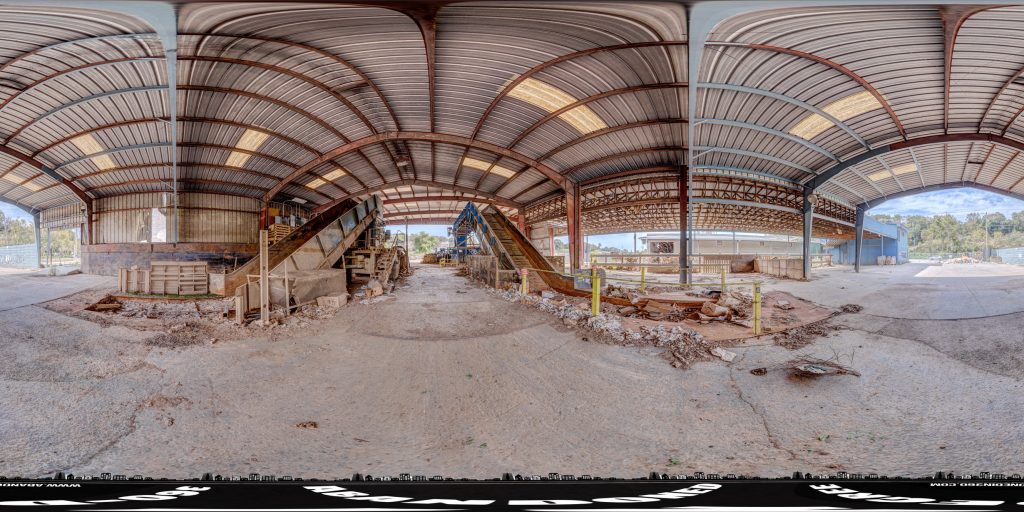
A 360-degree panoramic image captured at the abandoned Asheville Waste Paper property after Hurricane Helene caused damaging flooding to the area. Photo by the Abandoned in 360 URBEX team.
Welcome to a world of exploration and intrigue at Abandoned in 360, where adventure awaits with our exclusive membership options. Dive into the mysteries of forgotten places with our Gold Membership, offering access to GPS coordinates to thousands of abandoned locations worldwide. For those seeking a deeper immersion, our Platinum Membership goes beyond the map, providing members with exclusive photos and captivating 3D virtual walkthroughs of these remarkable sites. Discover hidden histories and untold stories as we continually expand our map with new locations each month. Embark on your journey today and uncover the secrets of the past like never before. Join us and start exploring with Abandoned in 360.
Equipment used to capture the 360-degree panoramic images:
- Canon DSLR camera
- Canon 8-15mm fisheye
- Manfrotto tripod
- Custom rotating tripod head
Do you have 360-degree panoramic images captured in an abandoned location? Send your images to Abandonedin360@gmail.com. If you choose to go out and do some urban exploring in your town, here are some safety tips before you head out on your Urbex adventure. If you want to start shooting 360-degree panoramic images, you might want to look onto one-click 360-degree action cameras.
Click on a state below and explore the top abandoned places for urban exploring in that state.
You might also like