Exploring the Abandoned Devinska Kobyla Missile Base: Slovakia’s Cold War URBEX Adventure
Take a look at the abandoned Devinska Kobyla Missile Base in Slovakia, a Cold War–era site that still feels hidden in plain sight for anyone drawn to military history and forgotten infrastructure. Tucked into the rugged landscape near Devínska Kobyla, this former base offers a stark glimpse into a period defined by secrecy, strategy, and constant readiness—where reinforced structures, corridors, and hardened spaces were built for a world that expected the worst.
Using the panoramic images on Google Maps Street View below, you can explore the Devinska Kobyla Missile Base from multiple angles and get a feel for its layout, atmosphere, and lingering details without stepping off the trail. It is the kind of place that rewards careful observation: weathered concrete, industrial remnants, and the quiet contrast between nature and abandoned defenses that makes urban exploration so compelling.
Photo by:Petr Koždoň
Photo by: Matúš Michálek
Photo by: Cirrus Sanofi
Photo by:Petr Koždoň
Photo by:Petr Koždoň
High above the city of Bratislava, hidden among the woods of Devinska Kobyla hill, lies a forgotten Cold War relic. The Devinska Kobyla Missile Base is one of the most intriguing abandoned sites in Slovakia, offering a unique blend of history and adventure for urban explorers. This once-secret anti-aircraft missile base, built to guard the Iron Curtain border, now stands in ruins – its concrete bunkers and barracks slowly succumbing to nature. In this blog post, we’ll journey through the missile base’s past and present: from its construction in the late 1970s, through its years of operation defending Czechoslovakia’s skies, to its abandonment and current status as a playground for URBEX enthusiasts. With an adventurous yet informative approach, let’s uncover the stories etched into the rusting metal and crumbling concrete of Devinska Kobyla Missile Base.
Built to Guard the Iron Curtain: History and Construction
The Devinska Kobyla Missile Base was born out of Cold War tensions. Construction of this military installation took place between 1979 and 1983, during a period when Czechoslovakia, as part of the Soviet-led Warsaw Pact, was fortifying its defenses against the West. The base was established as part of a network of anti-aircraft missile sites designed to protect Bratislava and its surroundings from potential NATO air attacks. Being located on Devinska Kobyla – the highest hill in Bratislava – gave the base a strategic vantage point. In fact, Bratislava’s position right on the edge of the Iron Curtain made it one of the Eastern Bloc’s most exposed cities to Western strikes. Placing a missile base here was a direct response to that vulnerability.
What made the Devinska Kobyla site particularly interesting was its role as a peacetime “firing position” (palpost). The base was armed with Soviet-made S-125 Neva surface-to-air missile systems (known to NATO as the SA-3 Goa). Uniquely, the base was intentionally conspicuous – a show of force that could be observed by prying eyes across the border. The idea was that the base “was to be visible to the enemy in peacetime”, serving as a deterrent symbol on the hill. In the event of an actual conflict, however, this visibility would turn into a clever ploy: the missile launchers and their crew could be swiftly moved from Devinska Kobyla to alternative hidden sites, leaving behind a decoy target. (During exercises, the unit actually stationed its equipment at a backup location near Most pri Bratislave while construction on Devinska Kobyla was underway.) In this way, the base was both a genuine defense installation and a strategic bluff – a product of Cold War gamesmanship.
Timeline – Key Dates for Devinska Kobyla Missile Base: – Late 1970s: Construction begins on the missile base (as tensions heighten in the Cold War).
– 1983: Construction completed; base becomes operational with an anti-aircraft missile unit on site.
– 1983–1997: Active service period of the base, hosting a Czechoslovak (later Slovak) air defense unit.
– 1989: End of Communist rule in Czechoslovakia; base remains in military use through the transition.
– 1997: The missile unit is disbanded/relocated and the base is officially closed down.
– Late 1990s–present: Base stands abandoned, gradually stripped and reclaimed by nature.
During its operational years, Devinska Kobyla Missile Base was home to the 6th Anti-Aircraft Missile Battalion of the Czechoslovak People’s Army (later the Slovak Army). This unit was part of the 186th Anti-Aircraft Missile Brigade and maintained a full missile battery on site. At the height of its readiness, the base housed 16 anti-aircraft missiles in its bunkers, ready to launch if enemy aircraft breached the border. The missiles were kept in underground silos and hangars, with supporting radar and guidance systems positioned on the hill. In theory, these weapons formed a shield over Bratislava. Had the Cold War turned hot, any unwelcome aircraft approaching from Austria’s direction could have been met with a volley of Soviet SAMs streaking upward from Devinska Kobyla.
Cold War Activities and Secrecy
Life at the missile base was shrouded in secrecy. Ordinary citizens knew little about what went on behind the barbed wire fences atop Devinska Kobyla – the area was strictly off-limits to the public. The base’s presence was a hush-hush affair, though locals in nearby villages surely noticed military convoys rumbling up the hill and the occasional radar rotating above the treetops. Armed guards controlled access to the site, and the surrounding woods were patrolled. In fact, the entire Devinska Kobyla hill lay within the border zone adjacent to Austria, which meant extra-tight security.
To understand the base’s environment, it’s important to realize that Devinska Kobyla literally straddled the Iron Curtain – the fortified boundary separating the Communist East from the capitalist West. Just down the slope from the base, the Morava River marked the frontier between Czechoslovakia and Austria. This border was among the deadliest in the world at the time. To prevent citizens from fleeing to the West, the authorities created a heavily policed frontier zone. Border guards with dogs patrolled behind barbed-wire fences and monitored the area day and night. They had orders to stop anyone attempting to cross illegally – with lethal force if necessary. Human life was often deemed secondary to border security; if a guard wounded a fleeing “escapee,” standard procedure was to let the person bleed while waiting for backup, rather than administer first aid. It was a grim regime: between 1970 and 1989 alone, over 9,500 people tried to escape across Czechoslovakia’s western border. Many were caught, and some paid with their lives. In one notorious incident in 1986, a teenage student from East Germany was mauled by guard dogs and left to die as he attempted to cross into Austria not far from Bratislava. These are the kinds of dark historical undertones that surround the missile base – while no such violence occurred at the base itself, it stood watch over a border where the Cold War turned deadly real.
Inside Devinska Kobyla Base, the daily activities of the soldiers and officers were likely routine but intense. We can imagine them drilling in tracking imaginary targets on radar screens, maintaining the missile hardware, and standing on alert during international flare-ups. The personnel stationed here lived on-site in barracks, always at the ready. The base had concrete bunkers for the missiles, a central command post (with radar equipment to detect incoming aircraft), support buildings like garages and fuel depots, and living quarters for the crew. During peacetime, training launches or exercises might have been conducted (likely at a different site, since firing a missile from this position would have been both provocative and dangerous under normal circumstances). Meanwhile, NATO intelligence surely took note of Devinska Kobyla – reconnaissance photos would have shown the telltale shapes of missile pads and radar domes on the hill, confirming that Bratislava was ringed with air defenses.
Secrecy also meant that any mishaps or incidents at the base were kept quiet. There are no public records of accidents or scandals specific to Devinska Kobyla’s operation – a testament to how effectively the regime controlled information. For local residents, the base was a place of mystery. Some might recall hearing muffled explosions or seeing strange lights in the sky during night exercises. Others knew someone who was stationed there, but those in uniform were typically tight-lipped due to military oaths. In essence, Devinska Kobyla Missile Base served its purpose in silent vigilance. It deterred potential threats by its mere existence and maintained the Cold War balance of power from behind closed gates.
The Fall of the Iron Curtain and Abandonment
The late 1980s brought seismic changes. In 1989, the Iron Curtain fell and Czechoslovakia’s Communist government collapsed during the Velvet Revolution. Suddenly, the East-West standoff that had justified bases like Devinska Kobyla was coming to an end. Over the next few years, Czechoslovakia split into two nations (Slovakia and the Czech Republic in 1993) and began integrating with Western Europe. Such changes left a Warsaw Pact missile site on the Austrian border somewhat redundant.
Yet the Devinska Kobyla base didn’t shut down immediately. For several years into the 1990s, it remained under military control and was reportedly still guarded even as its importance dwindled. The Slovak Army inherited the site after 1993 and continued to operate the aging S-125 Neva missiles for a time. However, geopolitical reality had flipped – NATO was no longer an enemy, and in fact Slovakia would eventually seek to join NATO (which it did in 2004). Maintaining a secret Soviet missile base on the edge of Bratislava made little sense (and the equipment was becoming outdated). Around 1996, the decision was made to decommission Devinska Kobyla. The unit stationed there was disbanded and its missile launchers and radar systems were removed. By 1997, the gates of the base were closed for good as the site’s remaining functions were abolished and the equipment moved out to a different location. The proud air-defense facility on the hill had fulfilled its duty and was no longer needed.
There were multiple reasons for the abandonment. The immediate cause was the dissolution of the Warsaw Pact and the end of the Cold War threat – Slovakia no longer faced a dire risk of air attack from the West. Budgetary constraints in the young Slovak Republic likely played a role too; keeping an old missile base operational costs money that could be spent elsewhere. Additionally, the military technology was obsolete. The S-125 “Neva” missile system, first developed in the 1960s, was being phased out. (In fact, Slovakia retired the last of its S-125 missiles by 2003.) Rather than upgrading this particular base, the Slovak military concentrated its resources on more modern defenses and cooperative security under NATO.
When the military left, Devinska Kobyla Missile Base entered a new chapter as an accidental time capsule. The soldiers departed swiftly, and what remained was a ghost base frozen in time. Initially, some basic security may have lingered – perhaps a guard at the gate for a year or two – but eventually even that faded away. There was no formal plan for the site’s reuse. So, like many abandoned military facilities, it was largely left to the elements. And once word got out that the base was no longer guarded, other forces descended upon it: looters and scrappers. Locals from nearby areas (or perhaps organized scrap-metal thieves) began stripping anything valuable from the base’s buildings. Over the late 1990s and early 2000s, the site was picked clean. Everything that could be pried loose and sold was taken – heavy machinery, electrical wiring, copper pipes, metal railings, generators, even the fixtures like toilets and sinks were hauled off. By the time they were done, only the hulks of structures remained. An official report noted that the interiors were left with cut cables dangling and empty switch boxes, with just a few pieces of the ventilation system still in place amidst otherwise barren rooms.
With human activity gone, nature began creeping back into Devinska Kobyla Base. Trees and bushes gradually overtook the perimeter and open areas. Grasses cracked through the pavement of the old military road. Each passing year of rain and frost chipped away at concrete and paint. Moss and ivy climbed the walls. The once neatly maintained base quickly transformed into a scene of overgrowth and decay, almost camouflaging itself in the forest.
More than two decades of abandonment have left the base in a state of advanced ruin. The mostly concrete structures are being reclaimed by nature, with vegetation obscuring bunkers and vines crawling over collapsed fences. Roughly 15 buildings and bunkers still stand in one form or another on the site, but many are mere shells of what they once were. Roofs have caved in or been stripped off, exposing interiors to rain and snow. Freeze-thaw cycles have opened gaping cracks in the tarmac and blast pads. Graffiti has blossomed everywhere on the base’s remains – garish murals and spray-painted tags cover the gray walls in a riot of color. In the absence of soldiers, local street artists and vandals have made the place their canvas, leaving behind layer upon layer of graffiti that gets updated regularly.
Walking through today, one can identify the skeletal layout of the base. There’s the crumbling barracks and administrative building, the long missile hangars dug into the hillside, and various support buildings like garages, storage depots, and concrete pillboxes. But without context, a casual observer might not even realize what these ruins once were. Imagination is required to picture Devinska Kobyla in its heyday, bristling with rockets and radar. Look closely at the ground and you may notice circular concrete pads and foundation outlines – these were likely the launch positions where missile launchers would be emplaced when the base went on high alert. Now those pads are just strange, empty rings on the forest floor, often puddled with rainwater and strewn with fallen leaves.
Urban Exploration at Devinska Kobyla Missile Base
These days, the missile base has found a new purpose that its builders never intended: it’s become a hotspot for urban exploration in Slovakia. For fans of URBEX – the exploration of abandoned man-made structures – Devinska Kobyla Missile Base is a dream location. The combination of Cold War history, decaying architecture, and an overgrown wilderness setting makes it a thrilling place to explore with a sense of adventure.
What’s remarkable is that access to the base is now essentially open. The once-forbidden military zone is no longer fenced off or guarded. In fact, all the old gates and warning signs have been removed, meaning anyone can simply wander in. Decades ago, a curious civilian would risk arrest or worse trying to get near these bunkers; today, hikers and local families stroll through the area freely, sometimes even picnicking amid the ruins. Officially, the property might still belong to the state or army, and it’s technically not sanctioned for public entry, but this rule is not enforced at all. Authorities have largely turned a blind eye to visitors, and there is growing sentiment to embrace the site’s tourism potential rather than keep it off-limits.
Upon arriving at the base, the first structure you’re likely to encounter is this abandoned barracks/administrative building near the former entrance. It’s a three-story concrete block that has been gutted over the years. The stairwells remain intact but without railings, and every floor is littered with debris. Sunlight streams in through glassless window frames, illuminating rooms painted with colorful graffiti murals. The ground floor, which may have once housed a kitchen and cafeteria, now features a fallen wall spray-painted in neon and piles of rubble (along with some inexplicable old tires left lying around). Walking inside, you must tread carefully: broken glass crunches underfoot and large holes gape in the floor where cellar access doors have been left open, dropping about six feet down with no stairs or covers. In some sections the ceiling has rotted through – chunks of wood and plaster hang down, threatening to collapse. It’s silent except for the drip of water and the scurrying of unseen critters that have taken up residence. Despite the hazards, this building is a popular photo spot for explorers, thanks to the eerie beauty of its decaying interior and vibrant graffiti.
Deeper into the base, paths and old roadways lead uphill toward the heart of the installation. The main military road that once carried trucks and launch vehicles is now an overgrown trail. As you follow it, you begin to spot odd mounds and entrances in the woods: these are the bunkers and missile hangars. Devinska Kobyla base has several large bunkers built into the slope, camouflaged by earth and trees. Their blast doors have been removed, leaving cavernous openings in the hillsides. You might pass a collapsed guard post or an empty sentry hut, now overtaken by moss. Farther up, three massive hangar-like structures appear, partially buried in the terrain and flanked by thick concrete walls. Back in the day, these hangars likely sheltered the mobile missile launchers and trucks, hiding them from spy planes and satellites overheadn. They’re well concealed – even today you have to look closely through the brush to find all of them, as nature’s camouflage is doing its work. Each hangar is paired with an underground bunker corridor. Typically, a heavy blast door would have sealed these entrances, but now they yawn open, dark and beckoning.
Stepping into one of these former missile garages is an awe-inspiring experience for an urban explorer. The dimensions are enormous – big enough to house and service trucks carrying 8-meter-long missiles. With the steel doors gone, daylight pours partway in, revealing graffiti-covered concrete walls and the rusted remains of hinges and bolts. Further inside, however, total darkness reigns. Narrow corridors branch off from the main bay, connecting to adjoining bunkers and munition storage rooms in a maze-like layout. These passages were built for efficiency and protection, not comfort; you often need to crouch or stoop because some connecting doors are barely a meter (about 3 feet) high. Water drips from the ceiling in places, and the ground is slick with mud. The air is cool, heavy with the smell of damp concrete and earth. If you switch off your flashlight, you’re engulfed in absolute blackness – an experience both eerie and exhilarating. It’s easy to get spooked imagining that somewhere in the tunnel a figure might lurk (though in reality the biggest things to fear are low pipes and maybe a bat or two). Flashlights are essential in these bunkers, not only to see the intriguing details – like stenciled numbers on the walls or remnants of an air ventilation shaft – but also to avoid hazards in the dark. In some sections, ceiling panels have fallen and sharp metal rods protrude. One tunnel might suddenly dead-end in a collapsed chamber, while another opens into a second hangar with a gaping hole in the roof letting in a beam of light. The effect is cinematic: nature and decay have transformed these military facilities into a post-apocalyptic scene straight out of a movie.
Throughout the base, the atmosphere is one of profound stillness. Eerie is the word many use to describe it. With the Cold War long over, the site feels frozen in a bygone era, yet it’s also been reinterpreted by later generations (through graffiti and use as a hangout). The juxtaposition of high-security past and free-for-all present is fascinating. One moment you’re imagining soldiers hustling to their battle stations; the next, you’re snapping a photo of street art on a bunker wall. It’s this blend of history and urban culture that gives Devinska Kobyla its special allure for explorers.
As you climb nearer to the summit of Devinska Kobyla hill, you’ll come upon what remains of the base’s old watchtower and radar platform. One distinctive structure is a tall, rusted metal tube with a caged platform at the top – presumably an observation tower or radio relay mast from the base’s operational days. Amazingly, the internal ladder is still there, and the bold (or reckless) can climb up inside this tower. From the top, you get a stunning panorama: the entire city of Bratislava unfolds to the east in the distance, and looking west you gaze deep into what was once enemy territory – the green plains of Austria just across the Morava River. It’s a poignant sight. In the 1980s, a Slovak soldier might have stood watch here scanning for any sign of a NATO incursion. Now, you can stand in the same spot freely enjoying the view that was forbidden to most people back then.
In fact, a modern observation tower has recently been built on Devinska Kobyla, not far from the missile base’s ruins. Opened in 2020, this sleek wooden lookout tower was erected as a tourist attraction and offers even higher vantage points. On clear days visitors can see multiple countries from the top – Bratislava and its surroundings, the hills of eastern Austria, and even as far as Hungary and the Czech Republic at the horizon. The new tower signifies how the area is transforming from a secret military zone into a public recreational space. Many hikers now combine a visit to the abandoned base with a climb up the lookout tower, merging a taste of history with scenic views.
Before you rush off to explore Devinska Kobyla Missile Base, however, a few safety notes for urban explorers. As emphasized, bring a flashlight (or headlamp) for the bunkers – it’s pitch dark inside and there are holes, low ceilings, and sharp objects you need to see. Wear sturdy footwear with good grip; the ground is uneven with rocks, broken glass, and rusty metal scattered about. It’s wise to go with a buddy or group if possible. There is almost no cell phone reception on the hill except in a few spots, so don’t count on calling for help easily if you twist an ankle deep in the woods. Watch out for uncovered manholes or pits – over the years some deep utility shafts have been left open, hidden by leaves until you’re almost upon them. Similarly, in the multi-story buildings, be extremely cautious near stairwells and on upper floors, as there might be sections of flooring that have rotten through (a fall could be serious). Essentially, the rule is the same as for exploring any abandoned in Slovakia or elsewhere: enter at your own risk and stay aware of your surroundings. The site has endured 23+ years of neglect, so treat it with respect and caution. If you do that, you’re in for an unforgettable exploration.
Legacy and Future Prospects
For now, Devinska Kobyla Missile Base remains an unofficial outdoor museum of the Cold War – a place where history is literally written on the walls (in peeling paint and spray can ink). Its legacy is multilayered. On one hand, it stands as a monument to a tense period in Slovak history, reminding those who visit of how real the East-West divide once was. On the other hand, it has been embraced by the public in a way that would have seemed unthinkable decades ago: as a hiking destination, an “urban art gallery,” and a teaching ground where younger generations can tangibly connect with the past. Few places offer such a visceral sense of the Cold War’s imprint on local geography.
Recognizing this unique value, local authorities and enthusiasts have started discussing ways to preserve and repurpose the site. The missile base sits within the Devinská Kobyla National Nature Reserve (a protected landscape area), which means any development must be sensitive to the environment. In 2021, an architectural competition was organized by a Bratislava architectural studio seeking ideas to revitalize the missile base complex. This student competition invited creative proposals on how to transform the dilapidated area into something that serves the community while honoring its history. The vision expressed by the organizers was inspiring: they see potential for the base to be cleaned up and integrated into a public space that could include historical exhibits, lookout points, and leisure facilities – perhaps a park or open-air museum that keeps the dramatic concrete structures but gives them new purpose. The idea is that preserving its “rich historical heritage” would not only pay tribute to the Cold War period, but also “support tourism and create another relaxing place for the people of Bratislava”. There are successful examples abroad of old military bunkers being turned into remarkable architectural attractions, and Bratislava could do the same here. Such plans are still in the concept stage as of today, but they signal a positive future for Devinska Kobyla Missile Base.
In conclusion, the Devinska Kobyla Missile Base is far more than just an abandoned ruin. It’s a concrete chronicle of Slovakia’s 20th-century history – from the height of the Cold War to the peaceful present day. For urban explorers, it offers a rare blend of adventure and education: you can physically walk through Cold War infrastructure and feel the echoes of the past, all while enjoying the challenge of exploration and the beauty of an overgrown, forgotten place. This abandoned military base in Slovakia has transformed from a top-secret fortress into an open playground of discovery. Whether you’re interested in military history, love photographing decay and graffiti, or simply crave an off-the-beaten-path adventure, Devinska Kobyla will not disappoint. Just a short distance from Bratislava’s urban bustle, you can step into the wilderness and back in time. In doing so, you’ll gain a new appreciation for the resilience of both nature and history – as even concrete and steel, meant for war, eventually yield to green forests and curious hikers. The Devinska Kobyla Missile Base truly stands as Slovakia’s Cold War URBEX treasure, waiting to be experienced by those daring enough to explore its depths.
If you liked this blog post, you might be interested in the Sant Salvador de la Vedella in Spain, the Lil 500 Go Karts in Florida, or the Holly Building at Scott State Prison in Milledgeville, Georgia.
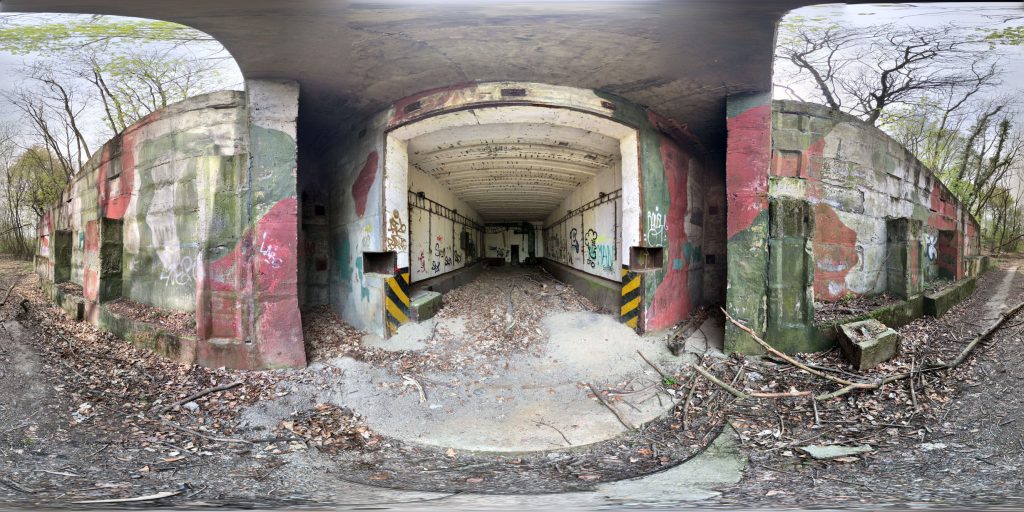
A 360-degree panoramic image at the abandoned Devinska Kobyla Missile Base in Slovakia. Photo by: Cirrus Sanofi
Welcome to a world of exploration and intrigue at Abandoned in 360, where adventure awaits with our exclusive membership options. Dive into the mysteries of forgotten places with our Gold Membership, offering access to GPS coordinates to thousands of abandoned locations worldwide. For those seeking a deeper immersion, our Platinum Membership goes beyond the map, providing members with exclusive photos and captivating 3D virtual walkthroughs of these remarkable sites. Discover hidden histories and untold stories as we continually expand our map with new locations each month. Embark on your journey today and uncover the secrets of the past like never before. Join us and start exploring with Abandoned in 360.
Do you have 360-degree panoramic images captured in an abandoned location? Send your images to Abandonedin360@gmail.com. If you choose to go out and do some urban exploring in your town, here are some safety tips before you head out on your Urbex adventure. If you want to start shooting 360-degree panoramic images, you might want to look onto one-click 360-degree action cameras.
Click on a state below and explore the top abandoned places for urban exploring in that state.
You might also like